Water Scavenger Beetle
Water scavenger beetles exhibit several unique behaviors and adaptations for life in freshwater environments:
Are there any unique behaviors or adaptations that water scavenger beetles have developed?
Water scavenger beetles exhibit several unique behaviors and adaptations for life in freshwater environments:
- Respiration Technique: Unlike many other aquatic insects that surface abdomen-first, these beetles hang suspended from the water surface by their heads. To replenish their air supply, they extend their short, clubbed antennae through the surface film. When diving, they fold their antennae back to capture a bubble of air, which is then stored as a silvery covering over their body.1
- Reproductive Strategy: Females produce a silklike, waterproof egg case to protect their offspring. Depending on the species, this case may be attached to underwater vegetation, left to float on the surface, or even carried by the female herself.1
- Locomotion: These beetles swim by moving the middle and hind legs on each side of their body in unison.1
While some species are predatory, most adults primarily feed on algae or decaying organic matter.1
What are some common species of water scavenger beetles?
The superfamily Hydrophiloidea, which includes the family Hydrophilidae, comprises approximately 3,200 species of water scavenger beetles. While many species are identified by their scientific family name, two commonly cited genera within this group include:
- Hydrophilus: This is the type genus for the family and represents a well-known group of these aquatic insects.15
- Tropisternus: Another common genus often referenced when discussing the habits and characteristics of these beetles.1
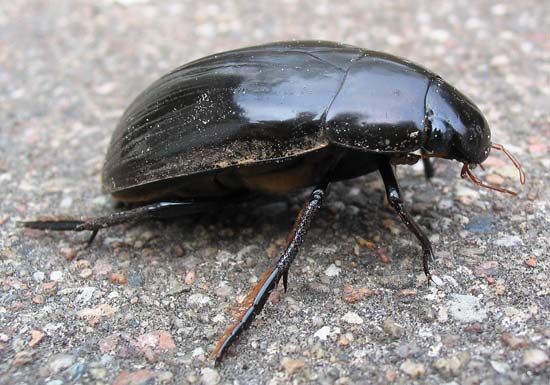
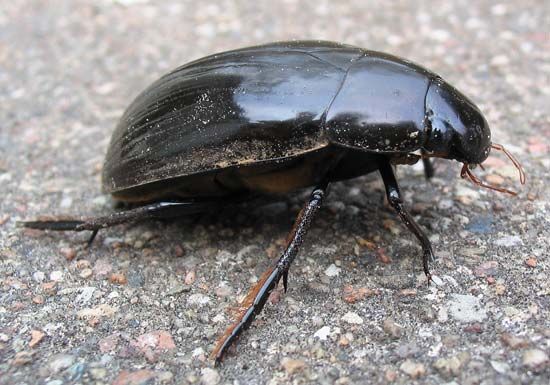
These beetles are typically found in marshy freshwater ponds worldwide, particularly in warmer regions, and are characterized by their smooth, dark, oval-shaped bodies. While the majority of adults in these genera feed on algae or decaying organic matter, it is important to note that a small number of species within the broader group have evolved to be predators.1
How do water scavenger beetles protect themselves from predators?
While the provided search results detail the physical characteristics, respiration, and reproductive habits of water scavenger beetles, they do not explicitly describe specific defensive behaviors or adaptations these beetles use to protect themselves from predators.
General entomological research notes that many beetles produce defensive chemical compounds to repel attackers, and some species utilize strong odors as a deterrent. However, the specific mechanisms employed by the family Hydrophilidae are not detailed in the available documentation.1
What is the life cycle of a water scavenger beetle?
The life cycle of a water scavenger beetle follows the process of complete metamorphosis, which consists of four distinct developmental stages: egg, larva, pupa, and adult.1
- Egg: The female deposits approximately 100 eggs into a silklike, waterproof egg case. Depending on the species, this case may be attached to underwater vegetation, left to float on the water’s surface, or carried by the female herself.6
- Larva: Upon hatching, the larvae begin a period of growth characterized by molting. As the larva feeds and grows, its skin (cuticle) becomes too small and splits, allowing the insect to crawl out and form a new, larger skin. This process typically repeats three to five times until the larva reaches maturity. While many larvae must surface for air, some species breathe through the body wall and abdominal filaments.16
- Pupa: After a nonfeeding prepupal stage, the insect enters the pupal stage, often forming a pupal cell for protection. The pupa resembles the adult but is soft, pale, and possesses wing pads.91
- Adult: The adult emerges from the pupal skin, and its outer skeleton eventually hardens and darkens. Adults are primarily aquatic, feeding on algae or decaying matter, though some species are predators.16
Sources
- water scavenger beetle — Encyclopædia Britannica
- predaceous diving beetle — Encyclopædia Britannica
- malacostracan - Reproduction and life cycles — Encyclopædia Britannica
- Reproductive behaviour - Coelenterates — Encyclopædia Britannica
- heteropteran - Annotated classification — Encyclopædia Britannica
- water beetle — Encyclopædia Britannica
- Hydrophilidae — Merriam-Webster
- Chemoreception - Defensive odors — Encyclopædia Britannica
- Coleoptera - Pupae — Encyclopædia Britannica
- annelid - Development — Encyclopædia Britannica
- Animal development - The larval stage — Encyclopædia Britannica
- Coleoptera - General features — Encyclopædia Britannica
Published on · 3 min read