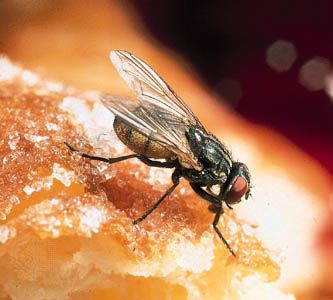
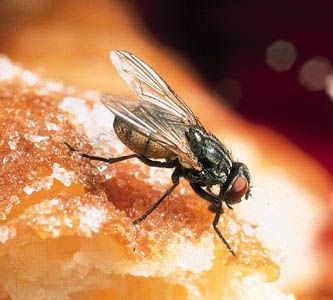
Picture-winged Fly
A picture-winged fly is any member of the insect family Otitidae, which belongs to the order Diptera (the fly order).
What is picture-winged fly?
A picture-winged fly is any member of the insect family Otitidae, which belongs to the order Diptera (the fly order).1
These insects are characterized by their small size and distinctive wings, which are typically spotted or banded with colors such as black, brown, or yellow. They are frequently observed in moist environments or resting on flowers.1
The diet of these flies varies by life stage:
- Adults: Primarily consume nectar or fluids derived from decaying plant matter.1
- Larvae: Generally feed on dung and decomposing underground plant parts, including bulbs, tubers, and roots, as well as within stems; they may occasionally feed on healthy plant tissue.1
What are the main characteristics of the order Diptera?
The order Diptera, commonly known as “true flies,” is one of the largest insect groups, comprising over 160,000 species. These insects are generally small and soft-bodied, typically possessing sucking mouthparts.23
Key Characteristics
- Wing Structure: The most defining feature of Diptera is the presence of a single pair of functional forewings. The hind wings are modified into small, knob-like balancing organs called halteres, which distinguish them from other insects that may appear similar.4
- Life Cycle: Dipterans undergo complete metamorphosis, consisting of four stages: egg, larva (often called a maggot), pupa, and adult. Larvae and adults often occupy different habitats, allowing the species to adapt to diverse environments.25
- Taxonomic Features: Classification is based on the structure of antennae, wing venation, and chaetotaxy—the specific arrangement of strong bristles on the body.4
Ecological and Economic Impact
Dipterans play complex roles in ecosystems. While many species are beneficial as pollinators, scavengers, or predators of other pests, others are significant vectors of disease or agricultural pests. Their larvae are found in diverse habitats, ranging from soil and decaying organic matter to aquatic environments.235
How do these flies help in the process of decomposition?
Flies, particularly in their larval stage (maggots), are essential to the process of decomposition and the cycling of nutrients in terrestrial ecosystems.66
Their role in decomposition includes:
- Rapid Colonization: Flies are often the first to arrive at decaying organic matter, such as carrion (rotting flesh). They rapidly colonize these materials, initiating the breakdown process.6
- Nutrient Redistribution: Maggots feed on decaying organic matter, breaking it down into simpler forms. Their waste products provide vital nutrients that support the growth of molds, fungi, and plants.7
- Sequential Decay: Different species of maggots often attack dead animals in a strict, predictable sequence as the body progresses through various stages of decay, from initial death and putrefaction to mummification.8
- Food Web Support: Beyond their role as decomposers, the larvae themselves serve as a critical food source for birds, small mammals, frogs, and toads, effectively integrating the nutrients from decaying matter back into the broader food chain.7
What other types of insects have patterned wings?
Many insects exhibit intricate wing patterns that serve various functions, such as camouflage, protection, or signaling. Here are several types of insects known for their patterned wings:
- Lepidoptera (Butterflies and Moths): Perhaps the most famous for their wing patterns, these insects have wings covered in fine, delicate scales that create a vast array of colors and designs. While butterflies are often noted for their dramatic, colorful patterns, many moths also display striking designs, such as the regal moth, tiger moth, and luna moth.10
- Odonata (Dragonflies and Damselflies): These insects possess two pairs of membranous wings characterized by a complex network of small crossveins. While often transparent, these wings frequently feature colored markings or a conspicuous stigma (a thickened, pigmented cell on the wing).1112
- Heteroptera (True Bugs): Some members of this order have specialized wing textures and patterns. For instance, lace bugs (Tingidae) are named for their lacelike pattern of fine, interconnecting wing veins that help them blend in with the leaves they feed on.13
- Coleoptera (Beetles): Certain beetles, such as the net-winged beetle, are characterized by elytra (wing covers) featuring a raised network of lines or veins.14
Sources
- picture-winged fly — Encyclopædia Britannica
- Diptera: Top Questions — Encyclopædia Britannica
- Diptera - Distinguishing taxonomic features — Encyclopædia Britannica
- Diptera — Encyclopædia Britannica
- Diptera - General features — Encyclopædia Britannica
- Diptera - Ecology — Encyclopædia Britannica
- Diptera - Larvae — Encyclopædia Britannica
- blow fly: Top Questions — Encyclopædia Britannica
- entomophagy — Encyclopædia Britannica
- heteropteran - Wings — Encyclopædia Britannica
- What’s the difference between moths and butterflies? — Encyclopædia Britannica
- insect - Annotated classification — Encyclopædia Britannica
- net-winged beetle — Encyclopædia Britannica
- dragonfly — Encyclopædia Britannica
Published on · 3 min read