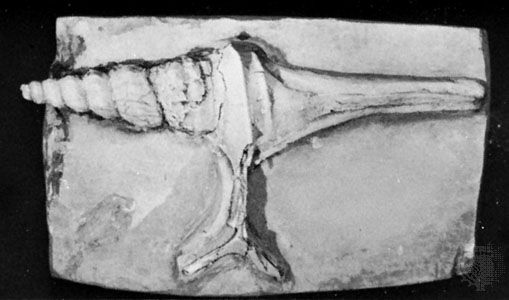
Bactrites
Bactrites is a genus of extinct cephalopods that lived from the Devonian to the Permian periods, approximately 408 to 245 million years ago. These marine…
What is Bactrites?
Bactrites is a genus of extinct cephalopods that lived from the Devonian to the Permian periods, approximately 408 to 245 million years ago. These marine animals possessed a straight, tapering shell composed of a linear series of chambers, which the animal occupied sequentially. They were predatory, using tentacles to capture prey.12
Paleontologists often consider Bactrites to be a significant evolutionary link, as they are believed to have given rise to more advanced cephalopod groups, including ammonoids and belemnoids. While some specimens have been tentatively identified in the Silurian Period, their classification during that era remains uncertain. The name is derived from the Greek word baktron, meaning “stick” or “staff,” reflecting the animal’s characteristic straight shell shape.132
How did cephalopod shells evolve from straight to coiled shapes?
The evolution of cephalopod shells from straight to coiled forms was primarily a response to the physical limitations of an elongated, straight shell. Early cephalopods, such as the nautiloid Orthoceras, possessed long, straight shells that became increasingly unmanageable as they grew. To improve mobility and balance, these organisms evolved to coil their shells, a structural adaptation similar to that seen in gastropods.2
In the case of Ammonoidea, the transition is well-documented. They evolved during the Devonian Period from straight-shelled ancestors like Bactrites. By the Late Devonian Epoch, these lineages had developed coiled shells, as seen in the genus Goniatites.2
Conversely, modern cephalopods followed a different evolutionary path. Their shells became internal and often degenerate due to the mantle overgrowing the shell, an adaptation that likely supported a more active, swimming lifestyle. While most modern forms have lost the external shell, some lineages like Spirula retain a coiled internal structure derived from belemnite-like ancestors.2
What are the main differences between nautiloids and ammonoids?
Nautiloids and ammonoids are both extinct groups of shelled cephalopods that relied on external shells for protection and buoyancy. While they share a common ancestry and a similar general appearance, they are distinguished by several key biological and evolutionary differences:45
- Suture Patterns: The most significant diagnostic difference lies in the sutures—the lines where the internal partitioning walls (septa) meet the outer shell wall. Ammonoids are characterized by highly complex, crenulated, and folded suture patterns, whereas nautiloids possess much simpler, relatively straight or gently curved sutures.4
- Evolutionary Lineage: Ammonoids are believed to have evolved during the Devonian Period from straight-shelled ancestors known as Bactrites. Nautiloids, which appeared much earlier in the Late Cambrian, represent a more primitive and less specialized lineage.25
- Survival and Extinction: Nautiloids are represented today by the modern pearly nautilus, which has survived to the present day. In contrast, all ammonoid groups went extinct by the end of the Cretaceous Period, a demise some scientists attribute to the collapse of plankton populations during the K–T extinction.4
What other types of marine life existed during the Devonian Period?
The Devonian Period, often called the “Age of Fishes,” hosted a vast array of marine life, ranging from diverse invertebrates to the emergence of complex vertebrate groups.
Invertebrates
The seas were dominated by established Paleozoic groups, including:
- Reef Builders: Corals (especially rugose and tabulate forms) and stromatoporoids were essential for building extensive reef systems.6
- Shelled Organisms: Brachiopods were highly diverse, while bivalves and gastropods flourished in nearshore environments. The Scaphopoda (tusk shells) made their first appearance during this time.6
- Arthropods: Trilobites remained significant, though many stocks declined toward the end of the period. Giant eurypterids (sea scorpions) acted as major predators.6
- Others: Crinoids were abundant, and bryozoans were common in shallow shelf seas.6
Vertebrates
The Devonian saw a revolutionary diversification of fish:
- Early Fishes: The period began with jawless agnathans (ostracoderms) and saw the rise of armored placoderms, such as the massive Dunkleosteus.7
- Modern Lineages: Sharklike chondrichthians and early bony fishes—including lungfishes, coelacanths, and rhipidistians—all appeared during this era.7
- Conodonts: These primitive, eel-like vertebrates were highly abundant and are now vital for dating rock layers.7
Sources
- Bactrites — Encyclopædia Britannica
- cephalopod - Evolution and paleontology — Encyclopædia Britannica
- Bactrites — Merriam-Webster
- ammonoid — Encyclopædia Britannica
- cephalopod - Form and function — Encyclopædia Britannica
- Devonian Period - Invertebrates — Encyclopædia Britannica
- Devonian Period - Vertebrates — Encyclopædia Britannica
Published on · 3 min read