Ribbon Worm
Ribbon worms, belonging to the phylum Nemertea, are notable for being the simplest animals to possess both a circulatory system and a complete gut with a…
Are there any notable species of ribbon worms, and what makes them significant?
Ribbon worms, belonging to the phylum Nemertea, are notable for being the simplest animals to possess both a circulatory system and a complete gut with a separate mouth and anus.1
A particularly significant species is Lineus longissimus, which is recognized for its extraordinary size; it can reach lengths of up to 30 meters (100 feet), making it one of the longest animals in the world.1
Beyond their size, ribbon worms are biologically significant for several reasons:
- Unique Anatomy: They are defined by a muscular, eversible proboscis used for trapping prey, burrowing, or movement.1
- Regenerative Abilities: All species possess the ability to regenerate lost or damaged body parts, and some can reproduce asexually by fragmenting into multiple complete individuals.1
- Evolutionary Position: They represent a distinct phylum at the peak of acoelomate development, with some researchers debating whether their rhynchocoel (proboscis cavity) might actually be a true coelom.1
How do ribbon worms fit into the larger classification of invertebrates?
Ribbon worms are classified within the kingdom Animalia as members of the phylum Nemertea (also known as Rhynchocoela). Within the subkingdom Eumetazoa, they are categorized as acoelomate animals—meaning they lack a true body cavity—though they are distinguished from other acoelomates by their more complex physiological systems.1234
Their position in the classification of invertebrates is defined by several key evolutionary advancements:
- Digestive and Circulatory Systems: Unlike flatworms (phylum Platyhelminthes), which typically have a single-opening gut, ribbon worms possess a complete digestive tract with a separate mouth and anus, as well as a closed circulatory system.14
- Body Plan: They are often regarded as a distinct phylum representing the highest point of acoelomate development. While they lack a true coelom, they possess a fluid-filled chamber called a rhynchocoel that houses their signature eversible proboscis.14
- Taxonomic Relationships: While historically compared to flatworms due to similarities in embryonic development and body plan, molecular evidence has helped clarify their distinct status within the Bilateria.14
What is the scientific name for ribbon worms and what does it mean?
The scientific name for ribbon worms is Nemertea (also known as the phylum Nemertea or Rhynchocoela).73
The name is derived from the New Latin Nemertea, which originates from the Greek Nēmertēs (Nemertes). In Greek mythology, Nemertes was one of the Nereids, the sea nymphs who were the daughters of Nereus and Doris. The suffix -ea was added to the name to denote a category or class.17
What are the distinctive physical characteristics of ribbon worms?
Ribbon worms (phylum Nemertea) possess several distinctive physical characteristics that set them apart from other invertebrates:
Primary Anatomical Features
- Proboscis: Their most defining feature is a muscular, eversible tube-shaped organ called a proboscis, which is housed in a fluid-filled chamber above the gut known as the rhynchocoel. In many aquatic species, this organ is equipped with a needlelike stylet used to capture prey or assist in movement.1
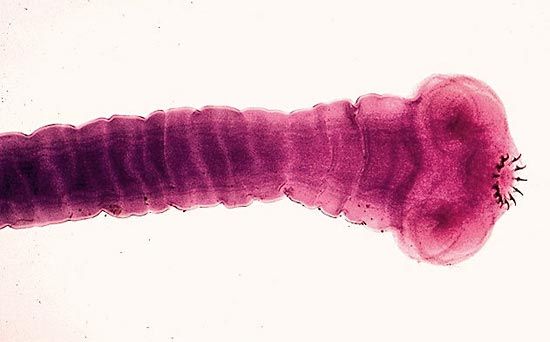
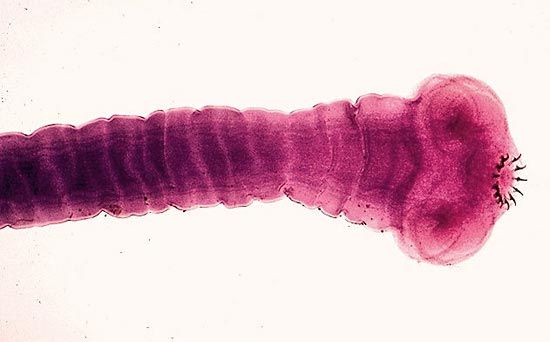
- Body Shape and Size: Most ribbon worms are long and slender, typically measuring less than 20 cm (8 inches). However, they exhibit significant variation; some deep-water species are flat and broad with finlike appendages, while the giant species Lineus longissimus can reach lengths of up to 30 meters (100 feet).1
- Internal Systems: They are the simplest animals to feature a complete digestive tract—including both a mouth and an anus—and a circulatory system.1
Appearance and Regeneration
- Coloration: While some are uniformly colored, many species are vividly patterned with stripes, bands, speckles, or geometric shapes.1
- Regeneration: All ribbon worms possess the ability to regenerate lost or damaged body parts, and some can reproduce asexually by breaking into fragments that grow into complete individuals.1
Sources
- ribbon worm — Encyclopædia Britannica
- taxonomy - A classification of living organisms — Encyclopædia Britannica
- Nemertea — Merriam-Webster
- Endocrine system - Phylum Nemertea — Encyclopædia Britannica
- Palaeonemertea — Merriam-Webster
- Animal - Acoelomates — Encyclopædia Britannica
- nemertean — Merriam-Webster
Published on · 3 min read