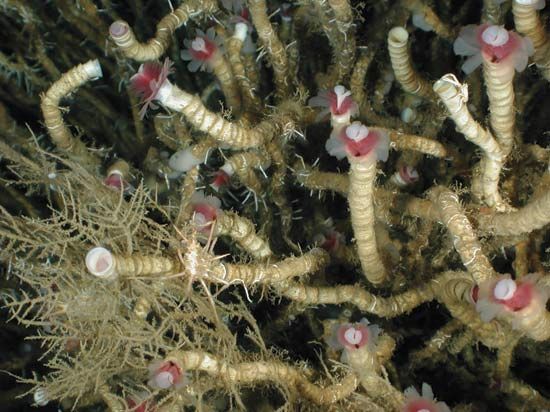
Tentacle Worm
A tentacle worm refers to any member of the genus Thelepus, which are tube-dwelling, segmented worms belonging to the class Polychaeta within the phylum…
What is tentacle worm?
A tentacle worm refers to any member of the genus Thelepus, which are tube-dwelling, segmented worms belonging to the class Polychaeta within the phylum Annelida. These are sedentary marine invertebrates that remain fixed to the sea bottom, typically residing within an underground tube for their entire length. A common species, T. cincinnatus, measures between 5 and 10 centimetres (about 2 to 4 inches) in length and is characterized by its pale red color, lacelike markings on the backside, and gills featuring numerous unbranched filaments arranged in two separate rows.1
It is important to distinguish these from other marine animals that possess tentacle-like structures, such as the horseshoe worm (phylum Phoronida) or lophophorates, which use a specialized organ called a lophophore for feeding. Similarly, beard worms (family Siboglinidae) are distinct polychaetes that bear a beardlike mass of tentacles but lack a mouth and anus in their adult stage.234
What is a lophophore and how does it help marine animals feed?
A lophophore is a specialized, circular or horseshoe-shaped organ found surrounding the mouth of certain aquatic invertebrate animals5. This structure consists of a fan of ciliated tentacles that play a critical role in feeding.52
The lophophore functions primarily as a filter-feeding mechanism. The movement of the cilia creates water currents that draw food particles toward the animal’s mouth. In addition to gathering or straining minute organisms for nutrition, the organ may also serve a respiratory function in some species.27
Animals that possess this organ are collectively known as lophophorates, which include three distinct phyla:
- Moss animals (phylum Bryozoa)
- Lamp shells (phylum Brachiopoda)
- Phoronid worms (phylum Phoronida)
While these groups were once thought to be closely related due to the presence of the lophophore, modern classification suggests they are not as closely linked as previously believed.2
How do polychaete worms differ from other types of worms?
Polychaete worms, which belong to the class Polychaeta within the phylum Annelida, are distinguished from other annelids—such as oligochaetes (e.g., earthworms) and leeches—by several key anatomical and developmental features.89
Key Differences
- Parapodia and Setae: Unique among annelids, most polychaete body segments feature a pair of parapodia—fleshy, lobelike outgrowths used for locomotion, feeding, or respiration. These parapodia bear bundles of setae (tiny, movable bristles), which are essential for species identification. In contrast, oligochaetes typically have setae embedded directly in the body wall and lack parapodia, while leeches generally lack setae entirely.8101112
- Reproduction: Most polychaetes have separate sexes and reproduce by discharging eggs and sperm directly into the water, where fertilization occurs. Many species also undergo a free-swimming larval stage known as a trochophore. Conversely, oligochaetes and leeches are hermaphroditic and typically reproduce using a clitellum—a glandular structure that secretes a cocoon to protect developing embryos—without a free-living larval stage.8913
- Body Structure: Polychaetes often possess complex head appendages, such as tentacles and palps, which are less common or absent in other annelid groups. While some polychaetes are free-moving, others are sedentary and construct tubes from materials like calcium carbonate or mucus.810
What are some other examples of tube-dwelling marine animals?
Beyond the various polychaete worms, several other marine animals have evolved to live in or construct tube-like structures for protection, feeding, or habitat:
- Crustaceans: Many amphipods are notable tube dwellers. They typically construct their homes using sand or mud particles held together by secretions and attached to bottom substrates. Some species even carry their tubes with them as portable houses.14
- Mollusks: The worm shell (family Vermetidae) is a marine snail that lives in an irregularly coiled, narrow tube resembling a worm. These snails cement themselves to rocks or coral and feed by secreting a mucous net to capture suspended particles.15
- Other Worm-like Phyla: In addition to polychaetes, the horseshoe worm (phylum Phoronida) and the beardworm (phylum Pogonophora) are well-known tube-dwelling organisms.12
While these animals utilize tubes for shelter, it is worth noting that other marine creatures, such as echinoderms, possess “tube feet.” These are hydraulic structures used for locomotion, feeding, and respiration rather than for constructing a permanent dwelling.16
Sources
- horseshoe worm — Encyclopædia Britannica
- lophophore — Merriam-Webster
- tentacle worm — Encyclopædia Britannica
- beard worm — Encyclopædia Britannica
- lophophorate — Encyclopædia Britannica
- moss animal — Encyclopædia Britannica
- lophophore hypothesis — Encyclopædia Britannica
- polychaete — Encyclopædia Britannica
- annelid - Development — Encyclopædia Britannica
- annelid - External features — Encyclopædia Britannica
- Reproductive behaviour - Segmented worms — Encyclopædia Britannica
- annelid - Polychaetes — Encyclopædia Britannica
- annelid - Distinguishing taxonomic features — Encyclopædia Britannica
- echinoderm - Water-vascular system — Encyclopædia Britannica
- tube worm — Encyclopædia Britannica
- annelid - Behaviour and associations. — Encyclopædia Britannica
- arthropod - Muscles , appendages , and locomotion — Encyclopædia Britannica
- worm shell — Encyclopædia Britannica
- worm tube — Merriam-Webster
- tubesnout — Encyclopædia Britannica
Published on · 3 min read