River Teviot
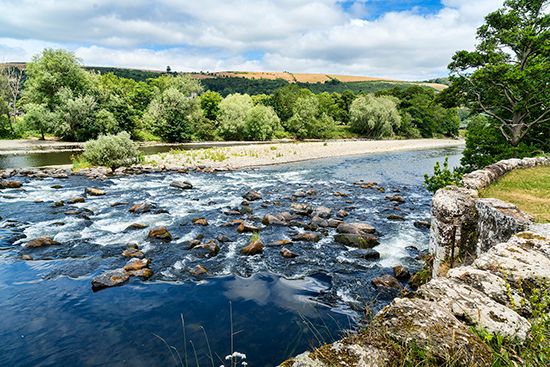
The River Teviot is a tributary of the River Tweed located in southern Scotland. Its valley, known as Teviotdale, makes up a significant portion of the…
What is River Teviot?
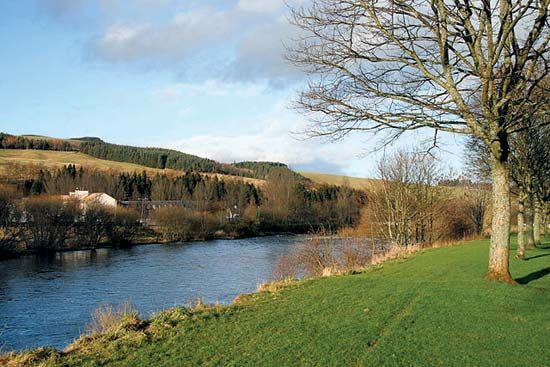
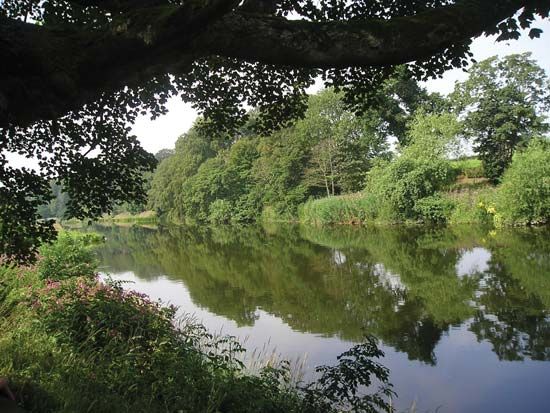
The River Teviot is a tributary of the River Tweed located in southern Scotland. Its valley, known as Teviotdale, makes up a significant portion of the historic county of Roxburghshire.1
The river flows in a northeasterly direction, passing the town of Hawick before reaching its confluence with the Tweed at Kelso. The surrounding landscape is characterized by a mix of improved farmland on the valley’s alluvial haughs and gravel terraces, while the majority of the basin is composed of steep, rounded hills primarily utilized for rough sheep grazing. Additionally, the river is well-known for being rich in trout.12
What is the significance of the River Tweed in Scottish history?
The River Tweed holds significant historical importance as a defining boundary between Scotland and England. Since the 12th century, the river has served as a political frontier, a role that frequently placed the border town of Berwick-upon-Tweed at the center of territorial disputes.21
Throughout this period, Berwick changed hands between the English and the Scots 13 times before finally being surrendered to England in 1482. Beyond its role as a border, the river valley has long been a hub for economic and cultural activity. The region is home to several famous abbeys and has historically supported a robust woolen-manufacturing industry, which gave rise to the region’s well-known textile production. Today, the river remains a vital feature of the Scottish Borders, supporting agriculture, tourism, and traditional fishing practices.123
How do rivers shape the landscape of the Scottish Borders?
Rivers have played a fundamental role in shaping the landscape of the Scottish Borders, primarily through the action of the River Tweed and its tributaries, such as the River Teviot.
The region’s topography is defined by the Southern Uplands, which have been carved by glacial activity into rolling mountains and narrow, flat-floored valleys. These rivers have dissected the landscape, creating a network of valleys that serve as the primary centers for population and economic activity.13
Key geomorphic features shaped by these river systems include:
- Alluvial Haughs and Terraces: The valley floors, particularly along the Teviot and the lower Tweed, feature fertile alluvial deposits and gravel terraces that provide productive agricultural land.21
- The Merse: As the Tweed flows eastward, its valley broadens significantly to form the Merse, a fertile agricultural plain.31
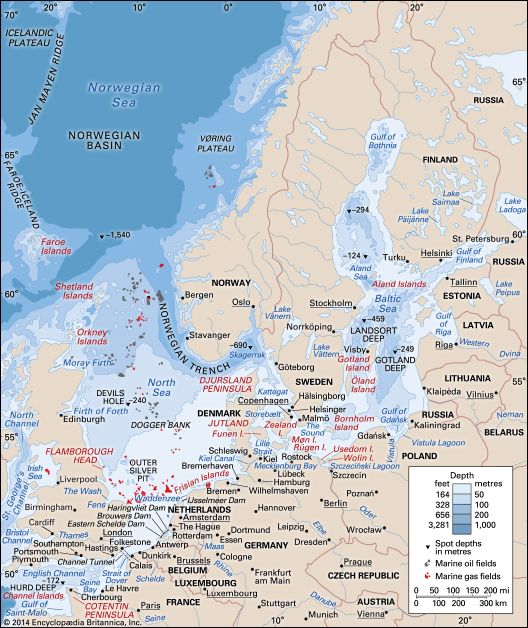
- Upland Drainage: The rivers drain the surrounding rounded hills and plateaus, with the Tweed flowing eastward to the North Sea, contrasting with other Scottish rivers that drain into the Atlantic.67
What are some famous historical sites found in the Tweed valley?
The Tweed valley is home to several significant historical sites that reflect the region’s rich cultural and political heritage:
- Abbotsford House: Located on the banks of the River Tweed, this Gothic-style baronial mansion was the home of the 19th-century novelist Sir Walter Scott. It houses his extensive library and a collection of historical relics, remaining largely unchanged since the early 19th century.10
- Melrose Abbey: Founded in 1136, this Cistercian abbey was a major religious center that suffered frequent attacks during border conflicts, eventually being reduced to ruins in 1545. The site is notable as the burial place of the heart of Robert the Bruce.112
- Trimontium: Situated near Newstead, this site marks the location of an ancient Roman fort, which is commemorated today by a heritage center.11
- Berwick-upon-Tweed: A historic border town that changed hands between England and Scotland 13 times. It features well-preserved ramparts originally built by Edward I and later rebuilt by Elizabeth I, as well as the striking 19th-century Royal Border Bridge.3
Sources
- River Teviot — Encyclopædia Britannica
- River Tweed — Encyclopædia Britannica
- Scottish Borders — Encyclopædia Britannica
- Tweed — Merriam-Webster
- Berwick-upon-Tweed — Encyclopædia Britannica
- Scotland - Drainage — Encyclopædia Britannica
- Scotland - Relief of Scotland — Encyclopædia Britannica
- river - Non-fluvial invasion and deposition — Encyclopædia Britannica
- river - Terraces and geomorphic history — Encyclopædia Britannica
- Abbotsford — Encyclopædia Britannica
- Melrose — Encyclopædia Britannica
- Selkirk — Encyclopædia Britannica
- Scotland - Medieval economy and society — Encyclopædia Britannica
Published on · 3 min read