River Tweed
The provided search results do not contain information regarding the etymological origin of the name "River Tweed." While the River Tweed is a significant…
What is the origin of the name ‘River Tweed’?
The provided search results do not contain information regarding the etymological origin of the name “River Tweed.” While the River Tweed is a significant waterway in Scotland and England, the available documentation clarifies only that the fabric known as “tweed” was not named after the river, but rather originated from a clerical error involving the Scottish word “tweel.”12
What recreational activities are popular along the River Tweed, and how do they contribute to the local economy?
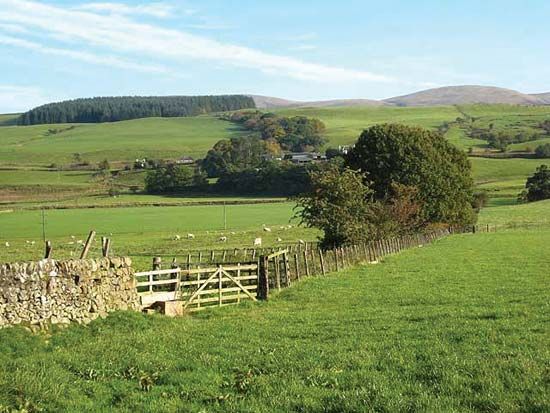
The River Tweed and its surrounding valley are central to the economy and tourism of the Scottish Borders. The region leverages its natural landscape and historical significance to support a robust local economy.
Popular Recreational Activities
Tourism in the Tweed valley is driven by several key outdoor pursuits:
- Fishing: The river is well-known for its trout and salmon fishing, which attracts enthusiasts to the area.24
- Hunting: Grouse hunting is a popular activity supported by the region’s moorland scenery.2
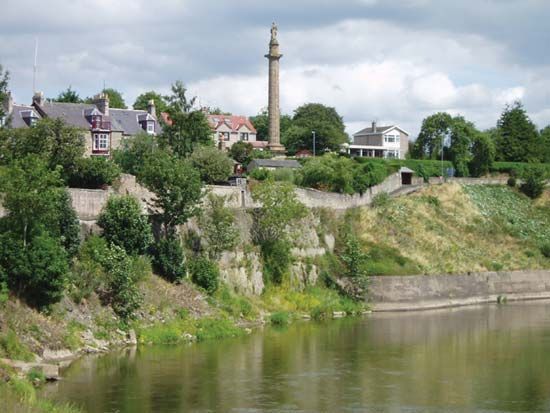
- Sightseeing: Visitors are drawn to the scenic valleys, the historic towns—many of which feature famous abbeys—and the cultural heritage of the area.52
- Heritage Exploration: The proximity to Hadrian’s Wall, a UNESCO World Heritage site, serves as a major draw for tourists interested in Roman history.2
Economic Contribution
These activities contribute to the local economy by sustaining the service sector, particularly in market and tourist towns like Kelso, Peebles, and Galashiels. Tourism helps diversify an economy that has traditionally relied on agriculture, fishing, and the manufacturing of woolen goods and knitwear.52
What are some of the major towns and cities along the River Tweed?
Several notable towns are situated along the River Tweed, serving as key centers for industry, agriculture, and tourism within the Scottish Borders:
- Peebles: Located at the junction of the Eddleston Water and the Tweed, this historic county town is known for its scenic setting and its transition from a textile-based economy to one focused on retail and tourism.2
- Galashiels: A significant town in the region, historically recognized for its woolen manufacturing and knitwear industries.5
- Melrose: Situated in a gorgelike valley, this town is famous for its historic abbey and its position along the river’s eastward course.7
- Kelso: An agricultural market center located where the River Teviot joins the Tweed. It is well-known for its large cobbled square and the ruins of its medieval abbey.78
- Berwick-upon-Tweed: Located in England, this border town sits at the mouth of the river where it enters the North Sea. It has a long history of being disputed between Scotland and England.76
Where is the River Tweed located, and what are its main geographical features?
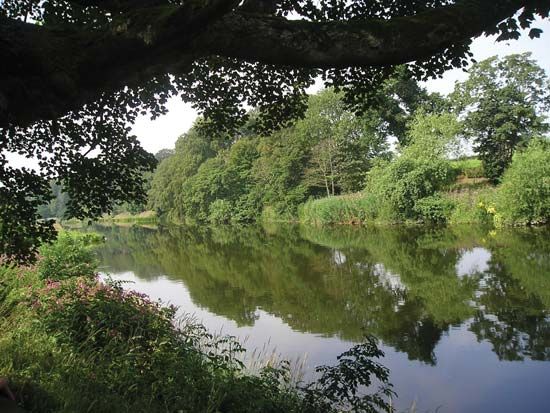
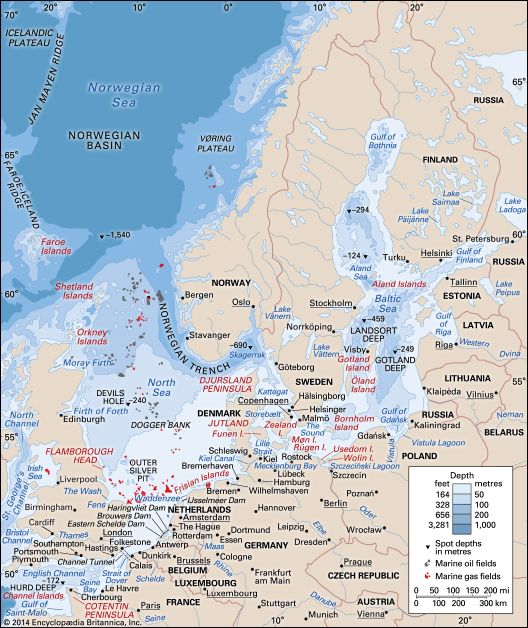
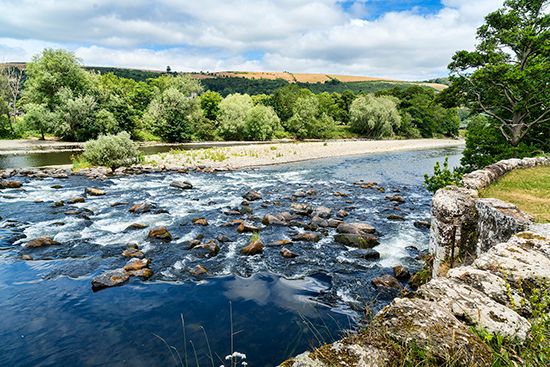
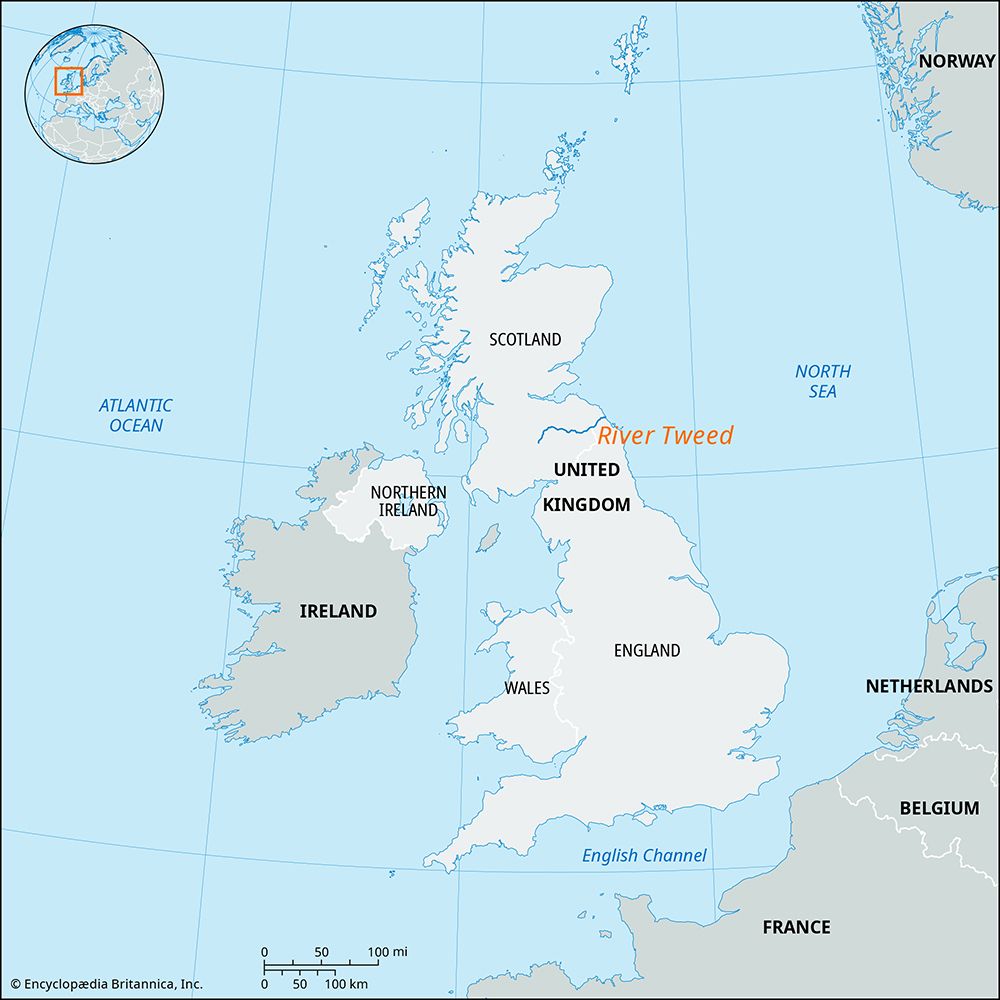
The River Tweed is located in the Scottish Borders council area of southeastern Scotland. It flows eastward for 97 miles (156 km), forming the border with England for 17 miles (27 km) before entering the North Sea at Berwick-upon-Tweed.2
Geographical Features
The river’s course is defined by diverse landscapes:
- Source and Upper Course: The river rises at Tweed’s Wells and flows northeast through a flat-floored valley. Its upper tributaries include the Talla Water and Lyne Water.2
- Southern Uplands: The Tweed flows eastward through the Southern Uplands in a gorgelike valley until it reaches Melrose. Along this stretch, it is joined by the Leithen, Gala, and the Ettrick-Yarrow system.2
- The Merse: East of Melrose, the river enters the Merse, a broad, fertile agricultural basin.25
- Confluence: At Kelso, the Tweed is joined by the River Teviot, which drains the surrounding hills of the region.26
Sources
- Tweed — Merriam-Webster
- River Tweed — Encyclopædia Britannica
- tweed — Encyclopædia Britannica
- Scotland - Services — Encyclopædia Britannica
- Scottish Borders — Encyclopædia Britannica
- River Teviot — Encyclopædia Britannica
- Peebles — Encyclopædia Britannica
- Kelso — Encyclopædia Britannica
- Berwick-upon-Tweed — Encyclopædia Britannica
Published on · 3 min read