Rubber Tree
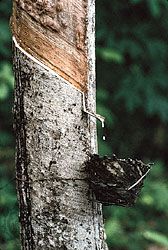
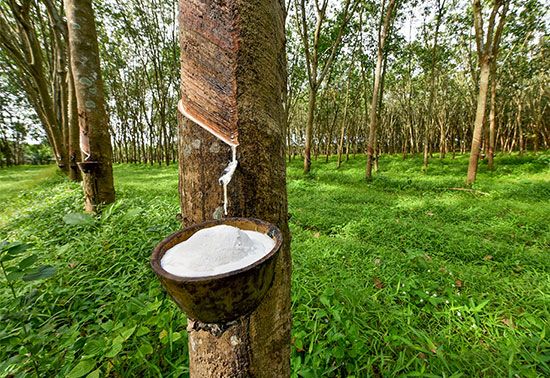
Natural rubber is produced by tapping the Hevea tree, which involves cutting the bark at a 30° angle to allow a milky latex to exude. This liquid, an aqueous…
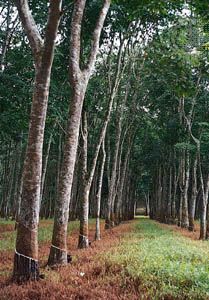
How is latex extracted from rubber trees and processed into rubber?
Natural rubber is produced by tapping the Hevea tree, which involves cutting the bark at a 30° angle to allow a milky latex to exude. This liquid, an aqueous suspension of polyisoprene, is collected and processed through coagulation.1
Coagulation and Preparation
- Crumb Rubber: Latex is coagulated using formic acid to form curds, which are washed, dried, and compacted into standard blocks for shipping.1
- Smoked Sheets: The coagulum is pressed into thin sheets and dried over a smoky wood fire, which provides natural protection against mold.1
- Concentrated Latex: About 10 percent of production is concentrated to 60 percent rubber content for use in dipped goods like gloves.1
Curing
Once shaped, rubber undergoes curing in pressurized, heated molds—typically at 160 °C—to facilitate the interlinking reaction that gives the material its final properties. Other methods include steam heating in autoclaves or microwave irradiation.2
How long does it take for a rubber tree to mature and produce latex?
A rubber tree (Hevea brasiliensis) typically begins production when it reaches 5 or 6 years of age. Once the tree reaches this maturity, it can be tapped for latex regularly, and with proper care, its productive lifespan may extend for more than 20 years.3
How do synthetic rubbers compare to natural rubber from the rubber tree?
Natural rubber and synthetic rubber are both elastomers—polymers capable of stretching and returning to their original shape—but they differ in their origins and specialized applications.5
Natural Rubber
Natural rubber is derived from latex, a milky fluid harvested primarily from the Hevea brasiliensis tree. Its primary chemical constituent is polyisoprene. Natural rubber is highly valued for its excellent flex resistance and low heat buildup, making it the preferred choice for demanding applications such as tires for racing cars, trucks, and airplanes.5
Synthetic Rubber
Synthetic rubbers are derived from petroleum and natural gas through chemical processes. While early attempts sought to replicate natural rubber, modern synthetic chemistry allows for the creation of materials with specific, enhanced properties:56
- Specialized Performance: Unlike natural rubber, which has poor oil and heat resistance, synthetic variants like nitrile rubber and fluoroelastomers offer superior resistance to oil, chemicals, and extreme temperatures.5
- Versatility: Synthetic rubbers can be modified for specific needs, such as butadiene rubber for high abrasion resistance in tire treads or silicones for use in surgical implants.57
- Production: Today, synthetic rubber accounts for more than half of global production, providing a reliable and often more cost-effective alternative to natural sources.56
What are the main uses of natural rubber in modern industries?
Natural rubber remains a vital industrial material due to its unique combination of elasticity, resilience, and toughness. Its primary applications in modern industry include:
- Automotive and Transportation: More than half of all rubber produced is utilized in the manufacturing of tires for automobiles, trucks, buses, and aircraft. Natural rubber is specifically favored for these high-performance applications because of its excellent flex resistance and low heat buildup during operation.5
- Mechanical Components: Beyond tires, natural rubber is essential for producing various mechanical parts, including springs, mountings, gaskets, belts, and hoses, which rely on its durability and elastic properties.5
- Consumer Goods: The material is widely used in the production of everyday items such as footwear, clothing, furniture, and toys.5
- Adhesives: Due to its chemical structure, natural rubber is also a key component in the formulation of various industrial adhesives.5
The industrial utility of natural rubber was fundamentally transformed by the invention of vulcanization, a process that stabilizes the material, making it resistant to temperature fluctuations and significantly more durable for heavy-duty use.58
Sources
- rubber - Tapping and coagulation — Encyclopædia Britannica
- rubber - Curing — Encyclopædia Britannica
- rubber tree — Encyclopædia Britannica
- rubber - The rubber tree — Encyclopædia Britannica
- rubber — Encyclopædia Britannica
- butadiene rubber — Encyclopædia Britannica
- rubber - The rise of synthetic rubber — Encyclopædia Britannica
- rubber - Development of the natural rubber industry — Encyclopædia Britannica
Published on · 3 min read