Rubidium-strontium Dating
Rubidium-strontium dating is a geochronological method used to estimate the age of rocks, minerals, and meteorites by measuring the accumulation of the…
What is rubidium-strontium dating?
Rubidium-strontium dating is a geochronological method used to estimate the age of rocks, minerals, and meteorites by measuring the accumulation of the stable isotope strontium-87, which is produced by the radioactive decay of the unstable isotope rubidium-87.1
Because the half-life of rubidium-87 is approximately 50 billion years, this method is particularly well-suited for dating very old geological materials. The process relies on the principle of radioactive decay, where parent atoms transform into daughter atoms at a constant, known rate.12
When using this method, researchers must account for the initial amount of strontium present at the time of a rock’s formation. This is often achieved through isochron methods, which analyze a suite of samples to test for internal consistency and correct for initial isotopic ratios. While rubidium-strontium dating is not as precise as uranium-lead dating, it was historically significant as the first isotopic dating method to be widely exploited, providing much of our foundational knowledge regarding Earth history.132
What is the difference between relative and absolute dating?
The primary difference between relative and absolute dating lies in how they measure the passage of time and the level of precision they provide.
Relative Dating
Relative dating determines the chronological order of past events without assigning a specific numerical age. It relies on logical deduction and visual observation of rock layers and fossils. Key concepts include:45
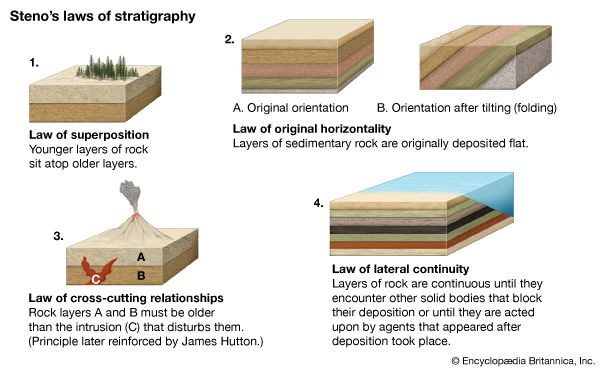
- Law of Superposition: In an undisturbed sequence of sedimentary rock, the oldest layers are at the bottom and the youngest are at the top.45
- Cross-cutting Relationships: Features like dikes or faults that cut across existing rock units are younger than the units they displace.5
- Application: This method is highly effective for establishing sequences in local or regional settings using simple visual criteria, such as fossil content or structural patterns.5
Absolute Dating
Absolute dating provides specific numerical ages for rocks and events, typically expressed as the time elapsed since a rock-forming event.46
- Mechanism: It utilizes the decay of radioactive isotopes within minerals. Because these isotopes decay at a constant, known rate, scientists can calculate the age by measuring the ratio of parent atoms to daughter atoms.436
- Precision: This method requires sophisticated equipment, such as a mass spectrometer, and careful isolation of high-quality minerals. It is essential for calibrating the fossil record and correlating geological events across vast distances.463
While relative dating provides the sequence of events, absolute dating provides the temporal framework necessary to understand the duration and timing of Earth’s history.65
How does the uranium-lead dating method compare to rubidium-strontium dating?
The uranium-lead and rubidium-strontium methods are both essential tools in geochronology, but they differ significantly in precision, methodology, and reliability.
Precision and Reliability
The uranium-lead method is generally considered superior for providing precise age information with fewer assumptions. A major advantage is the existence of two uranium-lead chronometers (based on the decay of uranium-235 and uranium-238). This allows researchers to plot results on a concordia diagram, providing a built-in mechanism to verify if a closed isotopic system has been maintained. Consequently, uranium-lead dating can achieve errors as low as ±2 million years. In contrast, the rubidium-strontium method typically yields higher uncertainties, often ranging from ±30 to 50 million years.5
Methodological Differences
- Uranium-Lead: This method focuses on specific minerals like zircon, baddeleyite, and titanite. Recent technological advances allow for the analysis of extremely small samples (a few millionths of a gram), enabling the selection of high-quality, crack-free grains to ensure data accuracy.58
- Rubidium-Strontium: This technique is frequently employed using the isochron method on whole-rock samples. While it was the first method to be widely exploited and is applicable to a broad range of rocks, it is more susceptible to complications. Rubidium is highly mobile in fluids during cooling or chemical weathering, which can disturb the isotopic system and invalidate the age.910
What are some other common isotopes used in radiometric dating?
Beyond the uranium-lead and rubidium-strontium systems, several other isotopes are vital for radiometric dating, categorized by their half-lives and specific applications.
Major Decay Schemes
These methods are used to date geological materials based on the decay of long-lived parent isotopes into stable daughter products:13
- Potassium-Argon (K-Ar): This method measures the decay of potassium-40 into argon-40. It is highly versatile and widely used for dating potassium-bearing minerals like mica and hornblende, as well as volcanic rocks.141513
- Samarium-Neodymium (Sm-Nd): Based on the decay of samarium-147 to neodymium-143, this method is particularly useful for mafic igneous rocks, meteorites, and metamorphic garnets.1613
- Rhenium-Osmium (Re-Os): This system involves the decay of rhenium-187 to osmium-187 and is primarily applied to trace minerals found in ore deposits, such as molybdenite.13
Cosmogenic and Short-Lived Isotopes
For more recent events, researchers utilize isotopes produced by cosmic-ray bombardment or those within the uranium-thorium decay series:13
- Carbon-14: The most widely used cosmogenic isotope, carbon-14 is essential for dating organic materials (biogenic carbon) from approximately 500 to 60,000 years old.1317
- Uranium-Thorium Series: Isotopes such as thorium-230 and protactinium-231 are used to date recent ocean sediments, coral, and carbonate deposits.13
- Beryllium-10 and Aluminum-26: These are frequently employed to date glacial ice, marine sediments, and quartz in rock exposures.13
Sources
- rubidium-strontium dating — Encyclopædia Britannica
- dating - Dating metamorphic rocks — Encyclopædia Britannica
- dating - Principles of isotopic dating — Encyclopædia Britannica
- dating: Top Questions — Encyclopædia Britannica
- dating - Double uranium-lead chronometers — Encyclopædia Britannica
- dating - Distinctions between relative-age and absolute-age measurements — Encyclopædia Britannica
- dating - Determination of sequence — Encyclopædia Britannica
- uranium-thorium-lead dating — Encyclopædia Britannica
- dating - Uranium–lead method — Encyclopædia Britannica
- dating - Dating simple igneous rocks — Encyclopædia Britannica
- dating - The isochron method — Encyclopædia Britannica
- radioactivity - Measurement of half-life — Encyclopædia Britannica
- dating - Potassium–argon methods — Encyclopædia Britannica
- potassium-argon dating — Encyclopædia Britannica
- dating - Samarium–neodymium method — Encyclopædia Britannica
- dating - Origin of radioactive elements used — Encyclopædia Britannica
- carbon-14 dating — Encyclopædia Britannica
Published on · 4 min read