Law of Superposition
The law of superposition is a fundamental principle of stratigraphy and geology which states that in an undisturbed sequence of sedimentary rock layers, the…
What is law of superposition?
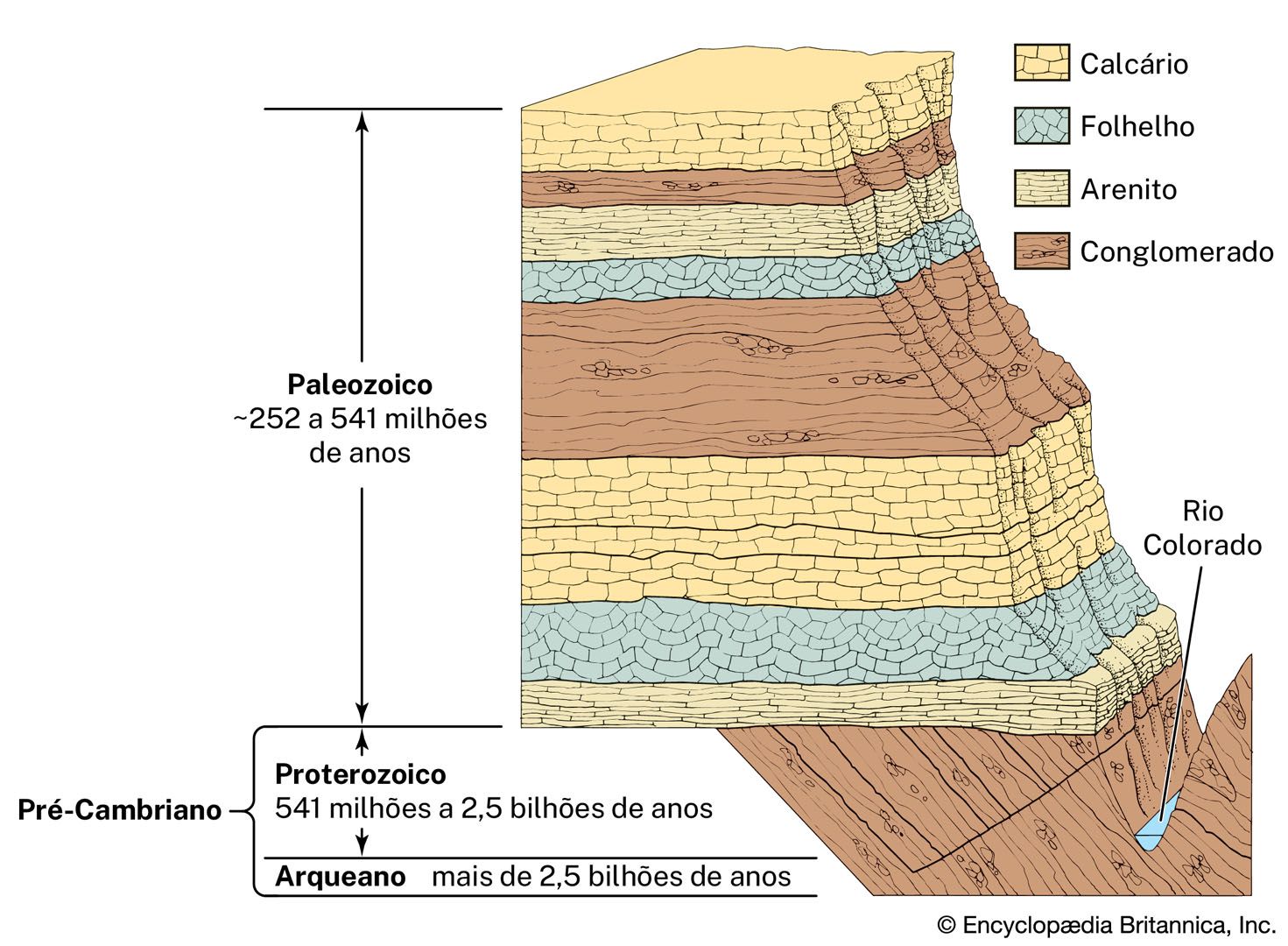
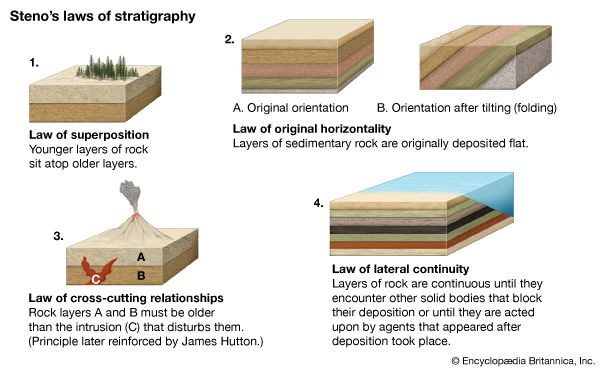
The law of superposition is a fundamental principle of stratigraphy and geology which states that in an undisturbed sequence of sedimentary rock layers, the oldest strata are located at the base, while the layers become progressively younger toward the top.12
Formulated by the Danish scientist Nicolaus Steno in 1669, this principle allows geologists to determine the relative ages of rock units through simple observation. However, the law assumes the sequence has not been significantly altered. In practice, geological processes such as tectonic deformation can tilt or overturn rock layers, and erosion may remove portions of the record, making it difficult to identify the original top and bottom of a sequence. Additionally, structural features like thrust faults can displace rock, potentially placing older units on top of younger ones.12
To confirm the orientation of these layers, geologists look for indicators of “top” such as cross-beds, ripple marks, or specific fossil patterns.2
Who was Nicolaus Steno and how did he develop this principle?
Nicolaus Steno (1638–1686) was a Danish anatomist and geologist whose pioneering observations laid the groundwork for modern geology and stratigraphy. Initially trained in anatomy—where he famously discovered the parotid salivary duct—Steno later moved to Florence, where his extensive travels and study of the Italian landscape led to his revolutionary geological insights.41
Steno developed the law of superposition while investigating how solid objects, such as shark teeth, became embedded within solid rock. In his 1669 treatise, The Prodromus of Nicolaus Steno’s Dissertation Concerning a Solid Body Enclosed by Process of Nature Within a Solid, he proposed that sediments settle from fluids in nearly horizontal, continuous layers. He concluded that because these strata are deposited sequentially, the layers at the bottom must be the oldest, while those resting above them are progressively younger. This realization allowed scientists to decipher the chronological history of the Earth’s crust through the study of rock layers and fossils.564
What are some ways geologists identify if rock layers have been overturned?
Geologists identify whether rock layers have been overturned by looking for “top and bottom” indicators—asymmetric physical features preserved within the rock that reveal its original orientation. Because sedimentary layers are deposited horizontally with the oldest at the bottom, any deviation from this sequence suggests geological deformation.7
Key methods for determining the original “up” direction include:
- Cross-bedding: In wind- or water-lain sandstone, the tops of sand mounds are often eroded during deposition, creating truncated layers that clearly point toward the original top.7
- Graded Bedding: This refers to a progressive upward decrease in grain size within a single bed. The finer material at the top indicates the direction of younger strata.37
- Ripple Marks: Asymmetric patterns formed by water movement can be preserved in rock, serving as a reliable indicator of the original top surface.7
- Mud Cracks and Rain Prints: The orientation of these features in mudstones can indicate the uppermost surface of the layer.7
- Pillow Basalts: In igneous rocks, these structures form under water; their convex-upward shapes provide a direct indication of the depositional top.7
- Fossil Orientation: Certain fossils accumulate in specific, predictable patterns that can define the top side of a rock unit.7
How do thrust faults complicate the study of rock sequences?
Thrust faults significantly complicate the study of rock sequences by disrupting the law of superposition, which states that in an undisturbed sequence, older layers are found at the bottom and younger layers at the top.9
In regions of intense crustal compression, such as mountain belts, thrust faults can cause older rock units to be pushed up and over younger ones. This displacement creates a deceptive stratigraphic record where the chronological order appears reversed or repeated, potentially leading to incorrect interpretations of the Earth’s history if the faulting is not recognized.39
These complications are further exacerbated by the following factors:
- Subtlety: In some instances, fault planes are only a few centimeters thick, making them extremely difficult to detect during field mapping.9
- Structural Complexity: Thrust faults often follow bedding planes before cutting across strata at steep angles, which can obscure the relationship between different rock units.9
- Deformation: The movement along these faults is frequently associated with folding and other forms of crustal deformation, which can further distort the original orientation of the rock layers.310
Sources
- law of superposition — Encyclopædia Britannica
- law of superposition — Merriam-Webster
- dating - Determination of sequence — Encyclopædia Britannica
- Nicolaus Steno — Encyclopædia Britannica
- geochronology - The principle of superposition of rock strata — Encyclopædia Britannica
- Earth sciences - Paleontology and stratigraphy — Encyclopædia Britannica
- sedimentary rock - Sedimentary structures — Encyclopædia Britannica
- dating - Principles and techniques — Encyclopædia Britannica
- fault — Encyclopædia Britannica
- stratigraphy — Encyclopædia Britannica
- fold — Encyclopædia Britannica
Published on · 3 min read