Sahara Desert Ant
Sahara desert ants, belonging to the genus Cataglyphis, play a vital role in their harsh environment primarily as scavengers. By foraging across the…
What role do Sahara desert ants play in their ecosystem?
Sahara desert ants, belonging to the genus Cataglyphis, play a vital role in their harsh environment primarily as scavengers. By foraging across the scorching sand and salt-pan terrain of the Sahara, these ants locate and collect dead insects, which serve as a primary food source for the colony.12
As eusocial insects, their foraging activities are essential for the survival of the entire colony, as worker ants are responsible for bringing food back to nourish the larvae, the queen, and other mature members of the nest. Their ability to thrive in extreme surface temperatures—often exceeding 60 °C (140 °F)—allows them to exploit food resources in conditions that are lethal to many other organisms, effectively acting as efficient cleaners of the desert floor.12
How do Sahara desert ants communicate with each other?
Unlike many other ant species that rely on pheromone trails to communicate and navigate, Sahara desert ants (Cataglyphis) cannot use this method effectively. The extreme heat of their environment causes volatile chemicals in pheromones to evaporate too quickly to serve as reliable markers for routes or communication.1
Instead of chemical trails, these ants rely on sophisticated navigational mechanisms to interact with their environment and return to their nests. They utilize polarized light as a compass and employ a process called proprioception to measure distance by counting their steps, effectively acting as a pedometer. As they approach the nest entrance, they augment these internal mechanisms by using visual and olfactory cues to pinpoint the exact location.1
While they are eusocial insects that function as a cohesive family unit, their communication methods are adapted to survive in conditions that preclude the standard chemical signaling found in many other ants.1
How do Sahara desert ants compare to other desert-dwelling ant species?
Sahara desert ants (Cataglyphis) are distinguished from many other ant species by their extreme physiological and behavioral adaptations to heat. While many ants rely on pheromone trails to navigate and communicate, the intense heat of the Sahara causes these chemicals to evaporate too quickly for reliable use. Consequently, Cataglyphis ants have evolved unique navigational strategies, including using polarized light as a compass and a “pedometer” mechanism that uses proprioception to count steps and measure distance.1
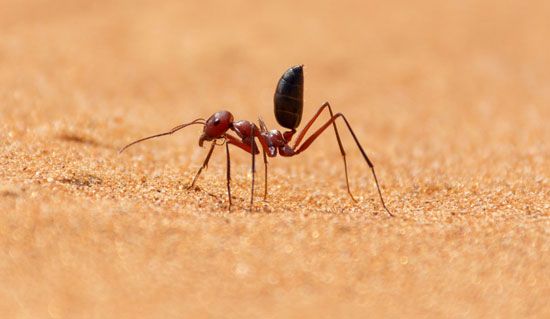
Physically, their long legs allow them to move rapidly and elevate their bodies above sand temperatures exceeding 60 °C (140 °F), making them among the most heat-tolerant insects known. In contrast, other desert-dwelling animals, such as the jerboa, avoid the heat by remaining in cool burrows during the day and foraging only at night.14
While many other ant species are opportunistic omnivores or specialized farmers like leafcutter ants, Sahara desert ants are specialized scavengers that exploit the carcasses of insects that have succumbed to the extreme environment.15
How do Sahara desert ants regulate their body temperature in extreme heat?
Sahara desert ants (Cataglyphis) regulate their body temperature primarily through physical adaptations rather than internal physiological cooling. Their most significant adaptation is their long legs, which allow them to move rapidly across the terrain and elevate their bodies above the scorched sand and salt-pan surfaces, where temperatures can reach 60 °C (140 °F) or higher. By keeping their bodies distanced from the extreme heat of the ground, they can forage for food in conditions that would be lethal to many other insects.1
These ants are among the most heat-tolerant arthropods known, capable of enduring these extreme temperatures for short periods while they search for the carcasses of other insects that have succumbed to the desert heat.1
Sources
- Sahara desert ant — Encyclopædia Britannica
- ant - Food — Encyclopædia Britannica
- Chemoreception - Primer pheromones — Encyclopædia Britannica
- What do ants eat? — Encyclopædia Britannica
- 8 Animals That Live in Extreme Environments — Encyclopædia Britannica
Published on · 3 min read