Saint John
Saint John is distinguished from the other U.S. Virgin Islands—St. Thomas and St. Croix—primarily by its emphasis on conservation and its relatively…
How does the culture of Saint John differ from the other U.S. Virgin Islands?
Saint John is distinguished from the other U.S. Virgin Islands—St. Thomas and St. Croix—primarily by its emphasis on conservation and its relatively undeveloped landscape.12
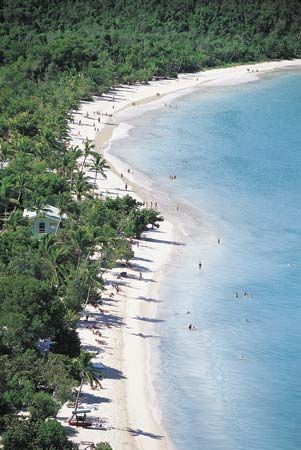
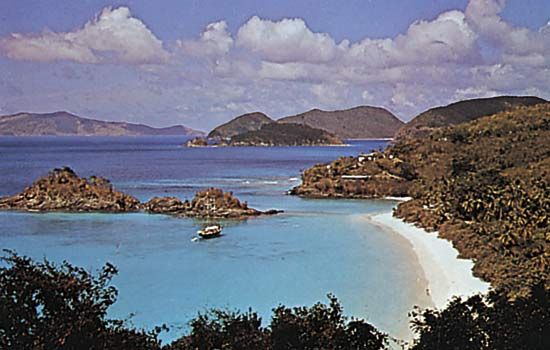
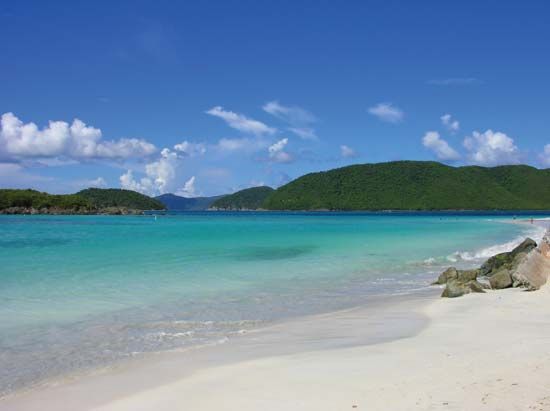
While the other islands feature larger urban centers and more extensive commercial infrastructure, more than three-quarters of Saint John is protected as the Virgin Islands National Park. This designation has preserved much of the island’s natural environment, including tropical forests, coral reefs, and historic sugar plantation ruins like the Annaberg Sugar Mill.231
Culturally and geographically, Saint John remains the smallest and least populated of the three main islands, with its residents concentrated in the small settlements of Cruz Bay and Coral Bay. Unlike the more commercialized hubs of Charlotte Amalie on St. Thomas or Christiansted on St. Croix, Saint John’s character is defined by its status as a well-watered, hilly, and largely preserved natural sanctuary.12
Where is Saint John located within the United States Virgin Islands?
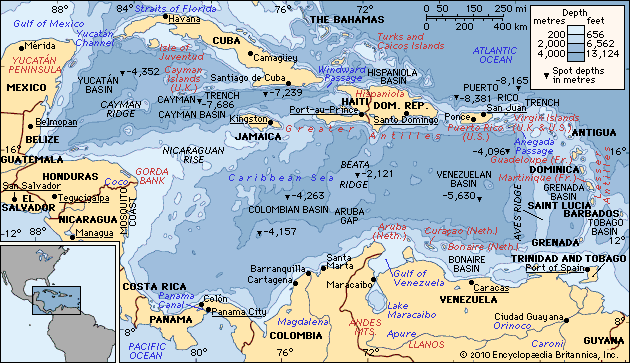
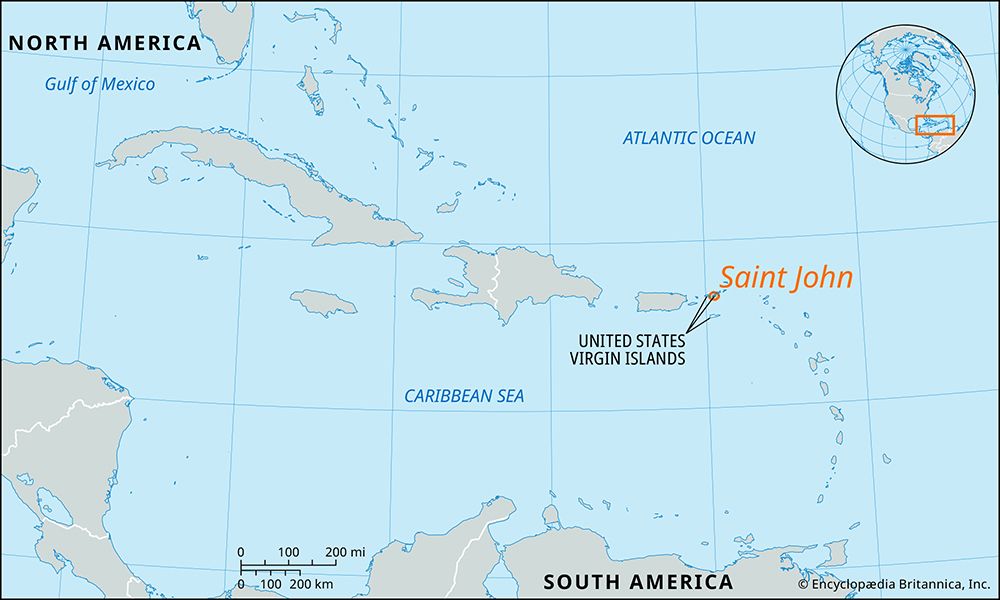
Saint John is the smallest of the three main U.S. Virgin Islands, located in the eastern Caribbean Sea. It is situated just three miles east of St. Thomas across Pillsbury Sound and lies approximately 80 miles east of San Juan, Puerto Rico.12
Among the U.S. group, Saint John is positioned closest to the British Virgin Islands, separated at its nearest point by only half a mile of water. The island is characterized by its steep, lofty hills and a coastline indented with numerous sheltered bays, including Coral Bay on its eastern end.21
What is the population of Saint John and how has it changed over time?
The population of Saint John, the smallest of the U.S. Virgin Islands, has remained relatively stable in recent decades. According to census data, the population was 4,197 in 2000 and 4,170 in 2010.1
Historically, the island’s demographics shifted significantly following its initial settlement by planters from St. Thomas in 1717. Within two decades of that settlement, the population consisted of 208 white inhabitants and 1,087 enslaved people, reflecting the island’s early development as a center for sugar and cotton plantations.1
What is the history of Saint John, including its colonization and acquisition by the United States?
Early History and Colonization
Saint John was visited by Christopher Columbus in 1493, though the island remained unsettled by Europeans for over two centuries, having been used primarily as a base by buccaneers. In 1684, Denmark claimed the island, and in 1717, it was formally colonized by planters arriving from St. Thomas.112
The island was rapidly developed into a plantation economy focused on sugar and cotton. This system relied heavily on enslaved labor, leading to a massive uprising in 1733, during which enslaved people held control of the island for six months before being defeated by French troops in 1734. Despite this and subsequent unrest, slavery persisted in the Danish West Indies until its abolition in 1848.11213
Acquisition by the United States
United States interest in the islands emerged during the American Civil War, though an initial attempt to purchase St. Thomas and St. John for $7.5 million was rejected by the U.S. Senate in 1870.12
The U.S. moved to acquire the territory during World War I, recognizing the islands’ strategic value in protecting the Panama Canal and maritime routes. Fearing that the islands might be seized by the Allies or conquered by Germany, Denmark agreed to the sale. In 1917, the United States purchased the islands for $25 million, and they became an unincorporated territory of the United States.12
Sources
- Saint John — Encyclopædia Britannica
- Virgin Islands - Relief — Encyclopædia Britannica
- Virgin Islands National Park — Encyclopædia Britannica
- United States Virgin Islands - People — Encyclopædia Britannica
- Saint Croix — Merriam-Webster
- Saint Thomas — Encyclopædia Britannica
- Saint Thomas — Merriam-Webster
- Saint John’s — Encyclopædia Britannica
- Saint Croix — Encyclopædia Britannica
- Saint John Island — Merriam-Webster
- Saint John — Encyclopædia Britannica
- Virgin Islands - Settlement and history of the U.S. Virgin Islands — Encyclopædia Britannica
- slave rebellions — Encyclopædia Britannica
Published on · 3 min read