Saint Johns River
The Saint Johns River is a vital component of Florida’s landscape, serving as the state's longest river. It drains a diverse region characterized by swamps…
What role does the Saint Johns River play in Florida’s ecosystem and biodiversity?
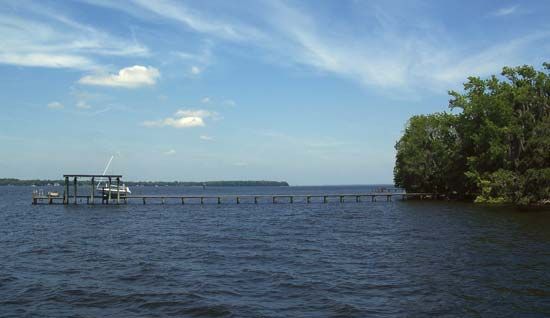
The Saint Johns River is a vital component of Florida’s landscape, serving as the state’s longest river. It drains a diverse region characterized by swamps, lakes, pine groves, and agricultural lands, providing essential habitat and recreational value, including significant fishing opportunities.1
The river’s ecosystem is defined by its low gradient and tidal influence, which extends far upstream, creating a broad estuary north of Palatka. These estuarine environments are critical for biodiversity, as they support productive fisheries and diverse aquatic life. The river also sustains various protected areas, such as the Lake Woodruff National Wildlife Refuge and Blue Spring State Park, which help preserve the region’s natural heritage.12
However, like many river systems, the Saint Johns is susceptible to water pollution from agricultural runoff and industrial waste. Such pollution can introduce excess nutrients, potentially leading to harmful algal blooms that threaten native species and ecosystem stability.2
How has the Saint Johns River been historically important for transportation and commerce in Florida?
The Saint Johns River has served as a critical artery for transportation and commerce in northeastern Florida throughout its history. Navigable for approximately 200 miles from Sanford to its mouth, the river provided a natural highway for early exploration and colonial development. In the 16th century, the river’s strategic location near the Atlantic coast influenced the establishment of early European settlements, such as the French colony of Fort Caroline near its mouth, which prompted Spanish efforts to secure the region.13
Beyond its role in early colonial history, the river became a vital channel for shipping and economic activity. Its deep channel—reaching up to 40 feet near Jacksonville—facilitated the movement of goods and supported the region’s agricultural and pastoral industries. While the 19th century saw a broader shift toward steamboat navigation across North American river systems to support rapid geographic expansion, the Saint Johns remained a persistent fixture for both commercial shipping and local transport. Today, the river continues to be an important corridor for maritime commerce and remains a significant resource for the state’s economy.14
What is the geographical location and length of the Saint Johns River in Florida?
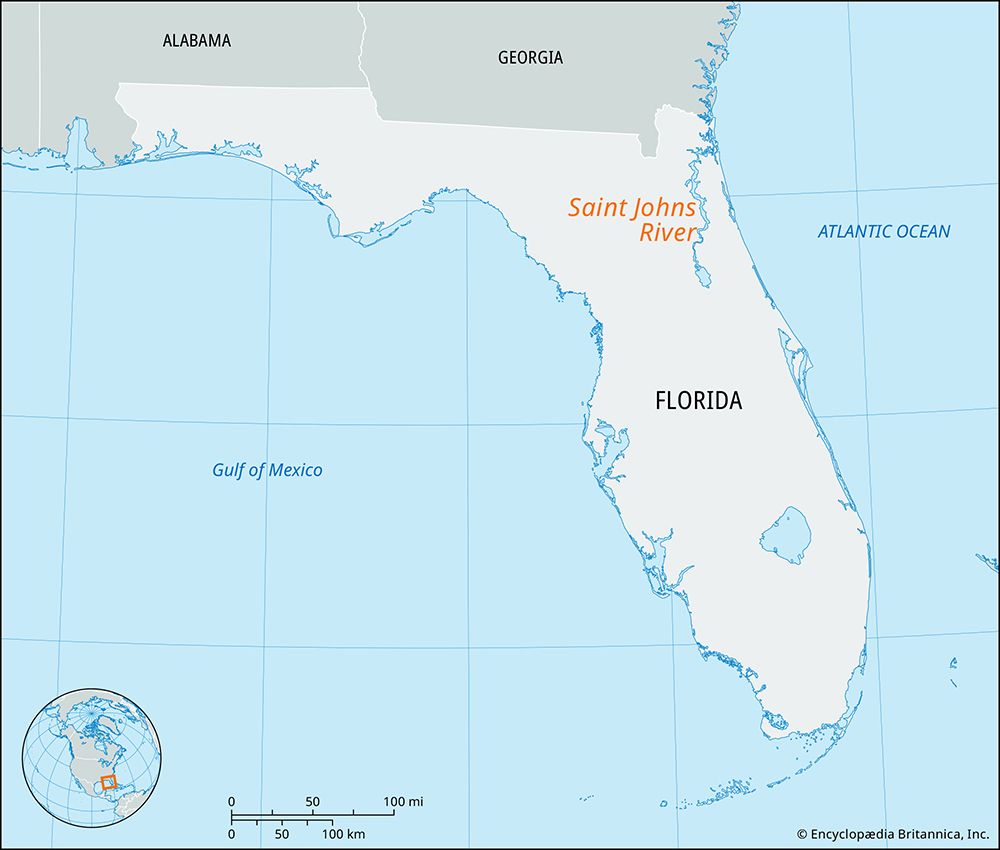
The Saint Johns River is the longest river in Florida, spanning a total course of 300 miles (485 km).1
It originates in the swamps of Brevard County, located southwest of Melbourne in the east-central part of the state. From there, the river flows northward, running parallel to the Atlantic coast. Upon reaching Jacksonville, the river turns eastward and empties into the Atlantic Ocean approximately 15 miles (25 km) away.1
It is important to distinguish this river from the Saint John River, which is a separate waterway located in Maine and Canada.5
What major cities and towns are located along the Saint Johns River?
Several cities and towns are situated along the course of the Saint Johns River, which serves as a significant waterway in northeastern Florida. Key locations include:
- Jacksonville: Located near the river’s mouth on the Atlantic Ocean, this major city serves as a primary transportation and commercial hub for the region.13
- Sanford: Situated along the river, this city marks the upstream limit of the river’s navigability.1
- Palatka: This town is located in the area where the river begins to widen into a broad estuary.1
- Melbourne: While the river originates in the swamps of Brevard County southwest of this city, it is a notable point of reference for the river’s headwaters.1
While St. Augustine is a prominent historical city in the region, it is situated on a peninsula between the San Sebastian and Matanzas rivers, rather than directly on the Saint Johns River.6
Sources
- Saint Johns River — Encyclopædia Britannica
- conservation - Pollution — Encyclopædia Britannica
- St. Augustine — Encyclopædia Britannica
- ship - Commercial steam navigation — Encyclopædia Britannica
- Saint John River — Encyclopædia Britannica
- Jacksonville — Encyclopædia Britannica
Published on · 3 min read