Saint Lucia
Saint Lucia is an island state situated in the Caribbean Sea. It is the second-largest island of the Windward Islands group within the Lesser Antilles.…
What is the geographical location and size of Saint Lucia?
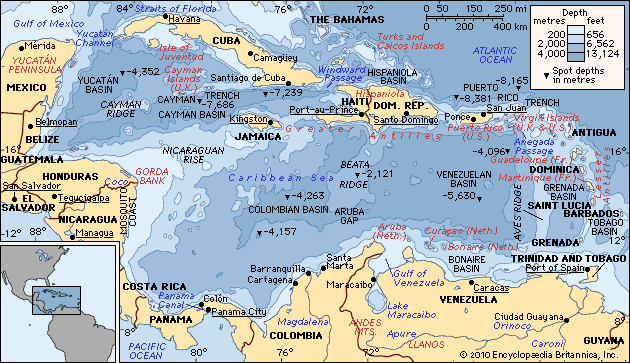
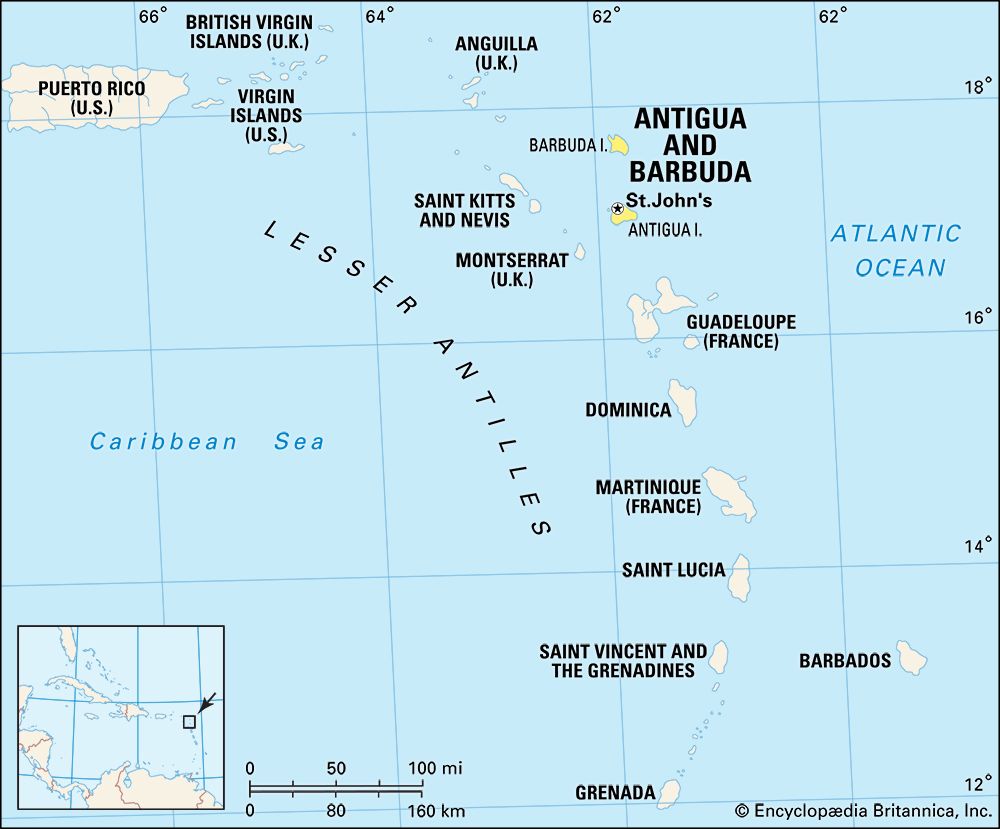
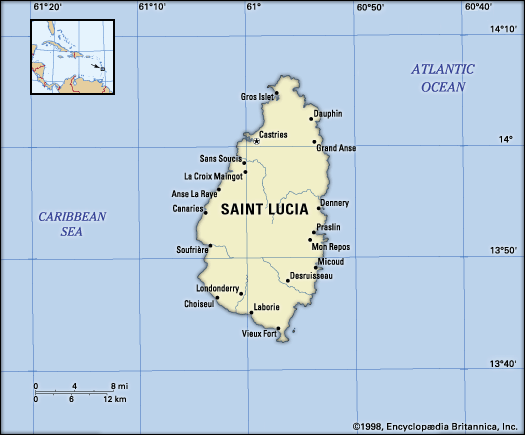
Saint Lucia is an island state situated in the Caribbean Sea. It is the second-largest island of the Windward Islands group within the Lesser Antilles. Geographically, it is located approximately 24 miles (39 km) south of Martinique and about 21 miles (34 km) northeast of Saint Vincent.1
Regarding its size, the island measures 27 miles (43 km) in length with a maximum width of 14 miles (23 km). Estimates for its total land area vary slightly between sources, with some citing 242 square miles and others noting 238 square miles (616 square kilometers). The nation’s capital and primary port is Castries.123
What are the main economic activities and industries in Saint Lucia?
The economy of Saint Lucia is driven by a combination of manufacturing, agriculture, and a rapidly expanding tourism sector.
Key Economic Sectors
- Manufacturing: Supported by the U.S. Caribbean Basin Initiative, the manufacturing sector includes an industrial free zone near Vieux Fort. Factories in this region produce electronic goods and toys for export. Other notable manufacturing activities include the production of cardboard cartons, clothing, rum, tobacco products, coconut products, concrete blocks, and beer.5
- Tourism: Since 1970, tourism has developed into a vital pillar of the economy. The industry was further bolstered in 1987 with the opening of a dedicated complex for cruise ships near Castries.5
- Agriculture: Historically significant, the agricultural sector has focused on the cultivation of bananas, cacao, and sugarcane.6
Trade
Saint Lucia’s primary exports include bananas, cardboard cartons, clothing, coconut products, and electronic goods. The nation maintains active trade relationships with the United States, Trinidad and Tobago, the United Kingdom, Barbados, and Dominica. Conversely, the country imports a variety of goods, including food, fuels, and manufactured products.1
How does Saint Lucia’s government structure work, and what type of political system does it have?
Saint Lucia operates as a constitutional monarchy and a parliamentary democracy within the Commonwealth.189
Government Structure
The British monarch serves as the head of state and is represented on the island by a governor-general. The government is headed by the prime minister, who is typically the leader of the majority party in the legislature.9
The legislative branch is a bicameral Parliament consisting of two chambers:109
- House of Assembly: Members are elected by universal adult suffrage.House of Assembly:** Members are elected by universal adult suffrage.10
- Senate: Members are appointed by the governor-general based on the advice of the prime minister, the leader of the opposition in the House, and the governor-general’s own discretion.9
Since achieving independence on February 22, 1979, the country has maintained this democratic framework, with political power alternating between major parties such as the Saint Lucia Labour Party (SLP) and the United Workers’ Party (UWP) through general elections.18
How did Saint Lucia gain its independence, and when?
Saint Lucia achieved its independence from the United Kingdom on February 22, 1979, transitioning into a parliamentary democracy within the Commonwealth.9
The path to sovereignty was a gradual process of constitutional evolution:
- Early Governance: Representative government began with the 1924 constitution, which introduced an elective element to the legislative council, followed by the 1936 constitution that provided for an unofficial majority.9
- Regional Integration: In 1958, the island joined the West Indies Federation. By 1960, the post of governor of the Windward Islands was abolished, granting Saint Lucia greater internal self-government.9
- Associated Statehood: Following the dissolution of the federation in 1962, the West Indies Act of 1967 established Saint Lucia as an associated state with the United Kingdom, a status it held until full independence was attained in 1979.9
Sources
- Saint Lucia: Country Facts — Encyclopædia Britannica
- Saint Lucia — Encyclopædia Britannica
- Saint Lucia — Merriam-Webster
- list of islands - Saint Lucia — Encyclopædia Britannica
- Saint Lucia - Manufacturing — Encyclopædia Britannica
- Saint Lucia - Trade — Encyclopædia Britannica
- Saint Vincent and the Grenadines - Manufacturing and trade — Encyclopædia Britannica
- history of Saint Lucia — Encyclopædia Britannica
- Saint Lucia - Independence of Saint Lucia — Encyclopædia Britannica
- Saint Lucia - Constitutional framework — Encyclopædia Britannica
Published on · 3 min read