Salp
A salp is a small, gelatinous, free-swimming marine invertebrate belonging to the subphylum Tunicata. These creatures are typically found in warm seas…
What is salp?
A salp is a small, gelatinous, free-swimming marine invertebrate belonging to the subphylum Tunicata. These creatures are typically found in warm seas, particularly throughout the Southern Hemisphere.12
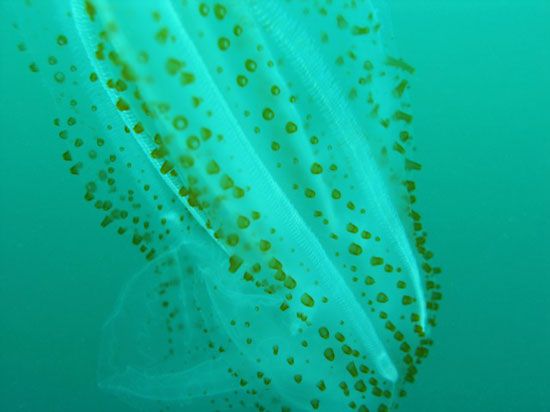
Salps are characterized by their transparent, barrel-shaped bodies, which feature openings at both ends and are encircled by muscle bands. They move through the water by contracting these muscles to expel jets of water, a form of propulsion that drives them forward. As filter feeders, they sustain themselves by consuming microscopic planktonic organisms.1
A notable aspect of the salp is its complex life cycle, which involves alternating between sexual and asexual reproductive phases. During the asexual phase, these animals often aggregate to form long, distinctive chains. Additionally, many species of salps are known to be luminescent.1
How do salps contribute to the ocean’s carbon cycle?
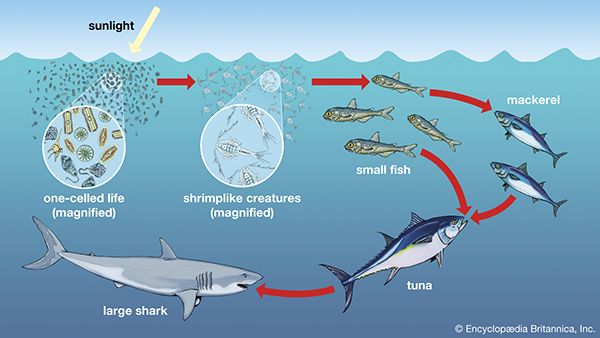
Salps play a significant role in the ocean’s carbon cycle through their efficient feeding habits and biological processes. As filter feeders, they consume vast quantities of microscopic planktonic organisms, effectively capturing carbon from the surface waters.
Because salps are highly mobile and possess a rapid growth rate, they can quickly process large amounts of organic matter. When they die or produce waste, their dense fecal pellets sink rapidly to the deep ocean floor. This process, often referred to as a biological pump, helps sequester carbon in the deep sea, preventing it from returning to the atmosphere for extended periods. By transporting organic carbon from the surface to the depths, salps act as a critical link in regulating marine carbon storage.
What are tunicates and how are they related to humans?
Tunicates are small marine animals that belong to the phylum Chordata, the same phylum that includes humans and all other vertebrates. They are found throughout the world’s oceans, existing in both sessile (bottom-dwelling) and pelagic (free-swimming) forms.3
Relationship to Humans
The primary significance of tunicates to humans lies in their role as evolutionary clues. Because they are chordates, they provide researchers with insights into the ancestry of vertebrates.
Their connection to humans is most evident during their larval stage. A tunicate tadpole larva possesses key chordate characteristics—such as a notochord, a dorsal nerve cord, and a tail—that are fundamental to the development of vertebrates. While these features are typically lost during metamorphosis as the animal matures into its adult form, their presence in the larval stage highlights a shared evolutionary history. Additionally, tunicates serve as an important link in the food chain, indirectly supporting human food sources, and are being studied for unique chemicals that may have potential as future drugs.435
How does the process of bioluminescence work in marine animals?
Marine bioluminescence is a chemical process that produces “heatless” light within various oceanic organisms, ranging from bacteria to squids and fishes.
The mechanism relies on an enzyme-substrate reaction. Specifically, a pigment called luciferin acts as the substrate, which is oxidized in the presence of an enzyme known as luciferase. During this reaction, the energy released shifts the complex into a high-energy excited state; as it returns to a low-energy ground state, it radiates a photon of visible light.78
In the ocean, this light is typically blue-green, as this wavelength transmits most effectively through seawater. Organisms utilize this light for various survival behaviors, such as:78
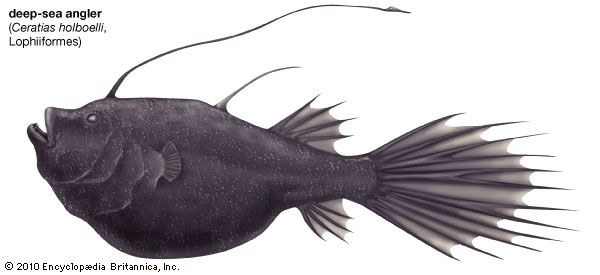
- Predation: Anglerfish use luminous lures to attract prey.79
- Defense: Some squids release luminous clouds to confuse predators.79
- Camouflage: Photophores on the underside of certain fish can match the intensity of sunlight from above, masking their shadows.9
- Communication: Light patterns assist in species recognition and mating.9
Sources
- salp — Encyclopædia Britannica
- salp — Merriam-Webster
- tunicate — Encyclopædia Britannica
- Chordate - Evolution and paleontology — Encyclopædia Britannica
- tunicate - Importance — Encyclopædia Britannica
- tunicate - General features — Encyclopædia Britannica
- Marine bioluminescence — Encyclopædia Britannica
- Bioluminescence - The role of bioluminescence in behavior — Encyclopædia Britannica
- luciferase — Encyclopædia Britannica
Published on · 3 min read