Sambhar Salt Lake
Sambhar Salt Lake is a significant economic asset in the Rajasthan region of India. The lake serves as a major source of salt, which is extracted through…
How does salt production at Sambhar Salt Lake impact the local economy and community?
Sambhar Salt Lake is a significant economic asset in the Rajasthan region of India. The lake serves as a major source of salt, which is extracted through evaporation pans and refining works located on its eastern shore.1
Beyond salt production, the site contributes to the local industrial landscape through a sulfur plant. These activities are part of a broader regional economy that relies on mineral extraction—including gypsum, silver ore, and feldspar—alongside agriculture and livestock raising. Historically, the lake’s salt supply has been a valuable resource, managed by the Mughal dynasty and later by the princely states of Jaipur and Jodhpur. While the provided information highlights the industrial and historical importance of these operations, it does not detail specific social impacts on the local community.21
What role did Sambhar Salt Lake play in ancient Indian trade routes?
The provided search results do not contain information regarding the specific role of Sambhar Salt Lake in ancient Indian trade routes. While the records confirm that the lake has been a significant source of salt and was managed by various dynasties—including the Mughal dynasty and the princely states of Jaipur and Jodhpur—the available data does not detail its function or influence within ancient trade networks.12
How did Sambhar Salt Lake form, and what is its geological significance?
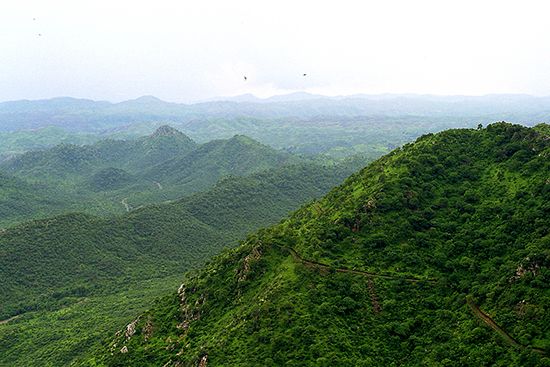
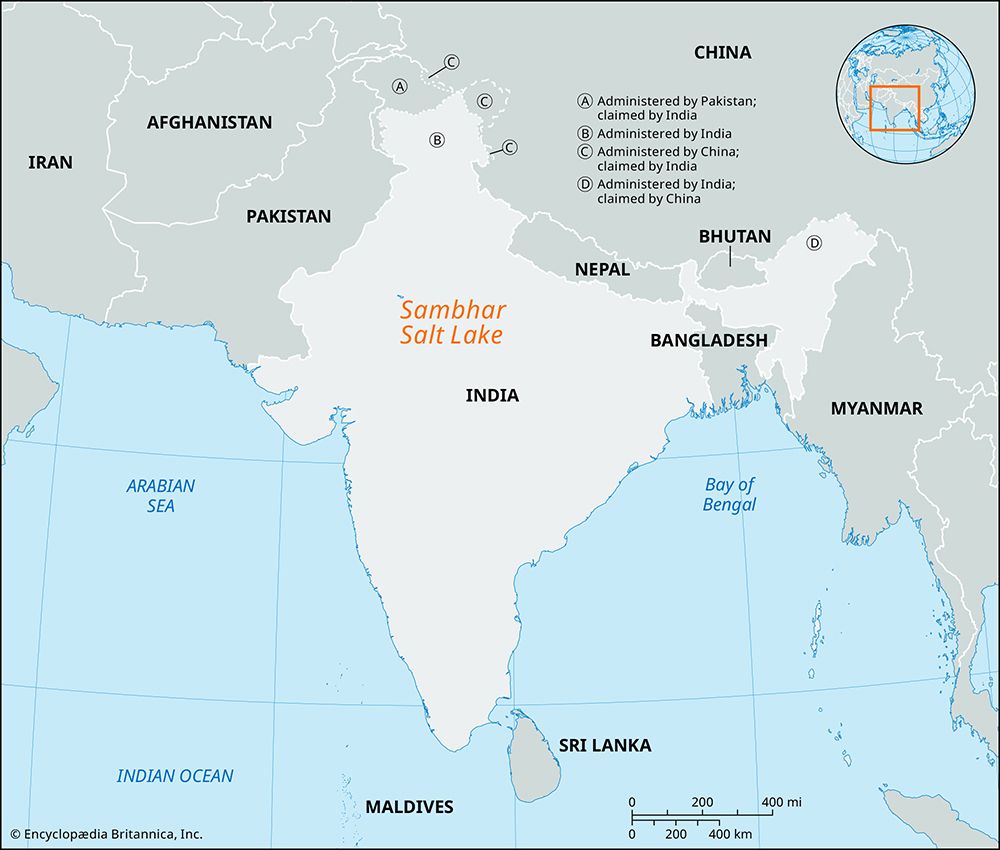
Sambhar Salt Lake is an ephemeral salt lake located in east-central Rajasthan, India. Geologically, the lake represents a depression within the Aravalli Range.1
Its formation and characteristics are tied to the region’s unique inland drainage pattern. The lake serves as a catchment area for annual river flooding; as the water evaporates during the hot, dry months, it leaves behind significant deposits of soluble sodium compounds in the underlying silt. This process is part of a broader regional phenomenon where the desert soils of the Rajasthan Steppe contain high percentages of soluble salts, contributing to the creation of several salt lakes in the area.123
While traditional folklore attributes the lake’s creation to the goddess Shakambari, its geological significance lies in its role as the largest salt lake in India and its function as a major mineral resource. The lake bed, which often appears as a white sheet of salt resembling snow, remains a vital site for salt extraction and refining.12
What is the total area covered by Sambhar Salt Lake, and how does it change seasonally?
Sambhar Salt Lake covers an area of approximately 90 square miles (230 square km).1
As an ephemeral body of water, its size and appearance fluctuate significantly with the seasons. During the monsoon season, the lake is replenished by annual river flooding. However, in the hot, dry months, the water evaporates, leaving behind a dry lake bed often covered in expansive sheets of salt that resemble snow.1
Sources
- Sambhar Salt Lake — Encyclopædia Britannica
- Rajasthan Steppe — Encyclopædia Britannica
- Rajasthan - Drainage — Encyclopædia Britannica
Published on · 2 min read