Sandbox Tree
The sandbox tree (Hura crepitans), a member of the Euphorbiaceae family, is a large, high-branching tree native to tropical America that can reach heights of…
What are the main characteristics of the sandbox tree?
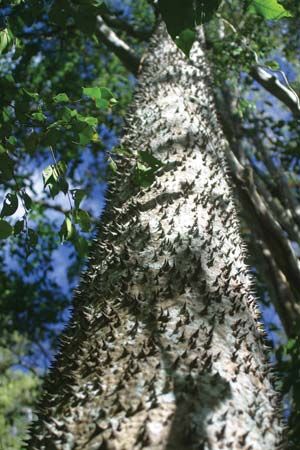
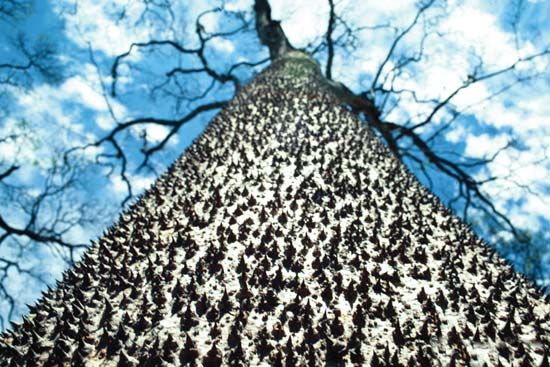
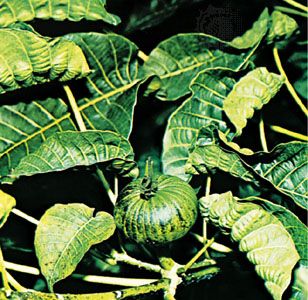
The sandbox tree (Hura crepitans), a member of the Euphorbiaceae family, is a large, high-branching tree native to tropical America that can reach heights of nearly 30 meters (100 feet). Its trunk is distinctively covered in short, conical prickles, and it features long-stalked, dark-green leaves.1
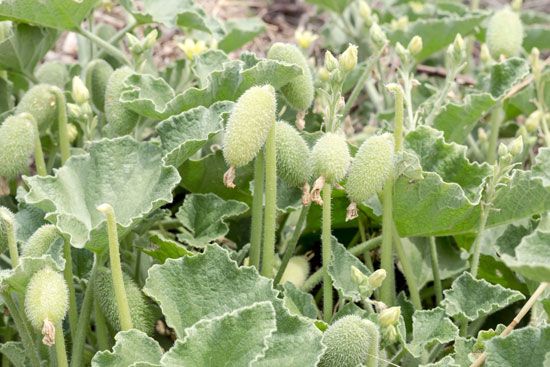
The tree is most notable for its pumpkin-shaped, woody capsules, which are about 7.6 cm (3 inches) in diameter and grooved into 15 sections. When these capsules dry, they explode with a loud report, forcibly ejecting seeds up to 14 meters (46 feet) away. This explosive force is significant enough to potentially injure people or livestock.123
While historically used in the British West Indies as sandboxes for blotting ink, the tree possesses toxic properties; its bark, seeds, and latex are poisonous. Some indigenous groups have utilized this toxic latex to stupefy fish.1
How has the sandbox tree been utilized by humans throughout history?
Throughout history, the sandbox tree (Hura crepitans) has been utilized by humans in several distinct ways, despite the inherent dangers posed by its toxic components:
- Ink Blotting: In the colonial British West Indies, the tree’s unique, pumpkin-shaped woody capsules were harvested and used as sandboxes. These containers held the sand used to blot wet ink on documents before the widespread availability of blotting paper.1
- Fishing: Certain indigenous groups have historically utilized the tree’s poisonous latex. By mixing this toxic substance with sand, they were able to stupefy fish, making them easier to catch.1
- Ornamental Planting: In modern contexts, the tree is sometimes cultivated as a boulevard tree due to its impressive size and structure, though its use is often limited by the risks associated with its poisonous leaves, bark, and seeds, as well as the explosive nature of its seed pods.1
Where is the sandbox tree native to, and in what types of environments does it grow?
The sandbox tree (Hura crepitans) is native to most of tropical America. While specific soil or climate requirements are not detailed in the provided information, it is characterized as a large, high-branching tree that thrives in tropical environments, often reaching heights of nearly 30 meters (100 feet). A related species, Hura polyandra, which is also referred to as a sandbox tree, is native to regions ranging from Mexico to Costa Rica.1
How tall can a sandbox tree grow, and what is its typical lifespan?
The sandbox tree (Hura crepitans) is a large, high-branching tree that can reach heights of nearly 30 meters (100 feet) with a trunk girth exceeding 1 meter (3.3 feet).1
Regarding its typical lifespan, the provided information does not contain data on how long these trees generally live.
Sources
- sandbox tree — Encyclopædia Britannica
- Seed dispersal - Self-dispersal — Encyclopædia Britannica
- sandbox tree — Merriam-Webster
Published on · 2 min read