Lizard Orchid
The lizard orchid (Himantoglossum hircinum) is a unique perennial terrestrial plant belonging to the Orchidaceae family. Found sporadically in dry European…
What is Lizard orchid?
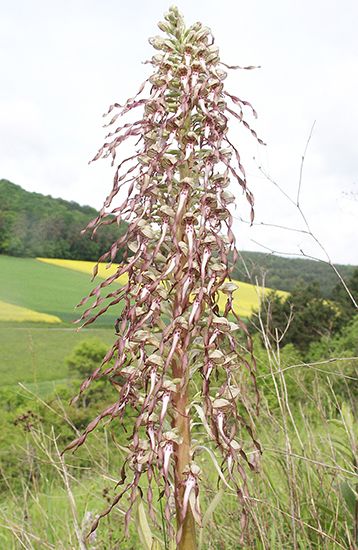
The lizard orchid (Himantoglossum hircinum) is a unique perennial terrestrial plant belonging to the Orchidaceae family. Found sporadically in dry European habitats, it is named for its distinctive flowers, which resemble a lizard, and its species name, hircinum, which refers to its goatlike odor.1
The plant features a dense spike of greenish-purple flowers measuring 10 to 50 cm in length. The flower’s central lip, or labellum, is shaped with twisted lobes that mimic a lizard’s hindlegs and tail, while the petals and sepals form the head and body. While these plants can live for over two decades, they typically flower only once.1
Additionally, the name “lizard orchid” is sometimes applied to Burnettia cuneata, an unrelated, minute species endemic to southeastern Australia that produces white to purple flowers.1
What makes orchids different from other types of flowers?
Orchids are distinguished from other flowering plants primarily by a unique combination of morphological characteristics, particularly within their floral structure and reproductive processes.23
Key Floral Distinctions
- The Column: Unlike most flowers where stamens and pistils are separate, orchids have these sexual organs fused into a single structure called the column.23
- Bilateral Symmetry: Most orchids exhibit bilateral symmetry (zygomorphy), largely due to the development of a specialized petal called the lip (or labellum), which serves as a landing platform for pollinators.24
- Resupination: Many orchids undergo a process called resupination, where the ovary or pedicel twists 180 degrees as the flower develops, typically orienting the lip downward.24
- Pollinia: Rather than shedding individual pollen grains, orchids typically package their pollen into cohesive masses called pollinia, which are designed for precise transfer by specific pollinators.254
Reproductive Differences
- Seed Structure: Orchid seeds are exceptionally small and dustlike, lacking the endosperm found in most other angiosperm seeds.367
- Mycorrhizal Dependence: Because they lack endosperm to nourish the developing embryo, orchid seeds require a symbiotic relationship with a fungus (mycorrhiza) to germinate and establish themselves in nature.67
How do perennial plants survive through different seasons?
Perennial plants survive through different seasons by adapting their growth cycles to environmental cues, such as changes in day length and temperature. These plants persist for several years by either maintaining permanent structures or renewing their growth from specialized parts.891011
Strategies for Survival
- Woody Plants: Trees and shrubs often enter a state of winter dormancy. They cease shoot growth, form protective resting buds, and, in the case of deciduous trees, shed their leaves to prevent water loss.89
- Herbaceous Perennials: In cold climates, the aboveground portions of these plants often die back in autumn. They survive the winter by relying on protected underground storage organs, such as bulbs, corms, tubers, or rhizomes, which remain dormant beneath the soil surface until conditions favor new growth.108
- Hormonal Control: Plants use signaling hormones like abscisic acid to induce dormancy and gibberellins to promote growth when spring returns.8
This ability to anticipate seasonal changes through environmental indicators is vital for their long-term survival.8
What are some other unique or strange-looking plants in nature?
Nature is full of plants with bizarre morphologies and specialized survival strategies that often defy conventional expectations. Here are some of the most unique examples:
- Welwitschia mirabilis: Native to the Namib desert, this long-lived gymnosperm produces only two permanent, straplike leaves that grow continuously throughout its life, which can span up to 2,000 years. It features a deep taproot resembling a giant radish.13
- Rafflesia: This genus of parasitic plants lacks visible roots, stems, or leaves. It exists primarily as a network of threads inside a host vine, emerging only to produce massive, foul-smelling flowers that mimic rotting flesh to attract carrion flies.14
- Carnivorous Plants: Species like the Venus flytrap and pitcher plants have evolved to trap and digest insects to obtain essential nutrients like nitrogen in poor soils. Their traps range from passive “pitfalls” to rapid “snap traps.”15
- Hydnora: This plant produces a bizarre, fleshy inflorescence that emerges from the ground, often appearing more like a fungus or an alien structure than a typical flower.16
- Explosive Dispersers: The sandbox tree utilizes explosive force to launch its seeds at speeds up to 160 mph, while plants like Ceratocaryum argenteum use “fecal mimicry” to trick dung beetles into burying their seeds.17
Sources
- lizard orchid — Encyclopædia Britannica
- orchid - Floral structure — Encyclopædia Britannica
- orchid - Structural diversity — Encyclopædia Britannica
- orchid - Pollination — Encyclopædia Britannica
- orchid - Natural history — Encyclopædia Britannica
- orchid - Seeds — Encyclopædia Britannica
- Asparagales - Flowers — Encyclopædia Britannica
- Is That Plant 'Perennial' or 'Annual'? — Merriam-Webster
- Plant development - Seasonal adaptations — Encyclopædia Britannica
- Plant development - Senescence in plants — Encyclopædia Britannica
- Perennial — Encyclopædia Britannica
- life span - Perennials — Encyclopædia Britannica
- Do Carnivorous Plants Eat Their Prey? — Encyclopædia Britannica
- Parasitic plant — Encyclopædia Britannica
- Welwitschiaceae — Encyclopædia Britannica
- Rafflesia — Encyclopædia Britannica
- Falling Far from the Tree: 7 Brilliant Ways Seeds and Fruits Are Dispersed — Encyclopædia Britannica
Published on · 3 min read