Sayan Mountains
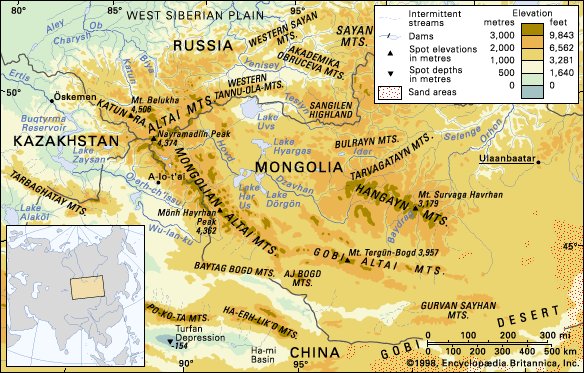
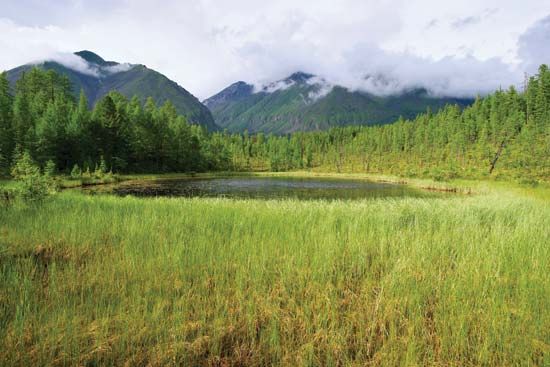
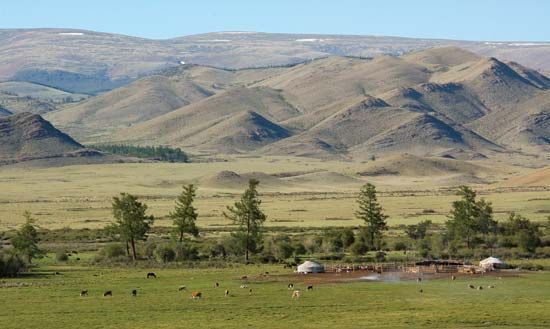
The Sayan Mountains are a vast upland region situated along the border between east-central Russia and Mongolia.
Where are the Sayan Mountains located, and what countries do they span?
The Sayan Mountains are a vast upland region situated along the border between east-central Russia and Mongolia.1
Within Russia, the range spans the southern portions of the Krasnoyarsk kray and Irkutsk oblast, the northern section of Tyva, and the western part of Buryatiya. The mountains form a large arc stretching from the Altai Mountains in the west to Lake Baikal in the east. The system is divided into western and eastern ranges, with the latter containing the highest peak, Mount Munku-Sardyk, which reaches an elevation of 11,453 feet (3,491 meters).1
Are there any notable protected areas or national parks within the Sayan Mountains?
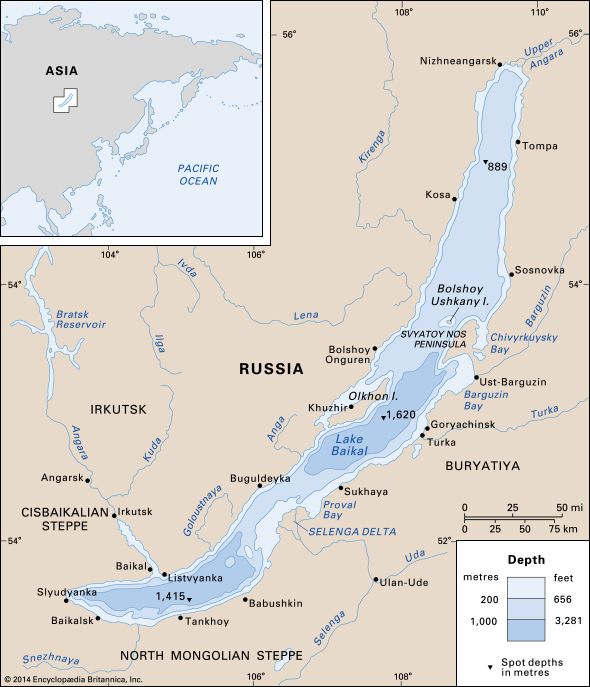
The provided search results do not contain specific information regarding protected areas or national parks located directly within the Sayan Mountains. While the Baikalsky Nature Reserve is situated on the southern shore of Lake Baikal and includes part of the Khamar-Daban mountain system, this range is distinct from the Sayan Mountains, though they are geographically connected in the Transbaikalia region.12
Similarly, the Barguzinsky Nature Reserve is located in the Barguzinsky Mountains to the northeast of Lake Baikal and is not part of the Sayan range.3
We could dive deeper into the geography of the surrounding regions or explore the biodiversity of the Lake Baikal area if you would like.
How were the Sayan Mountains formed, and what is their geological history?
The Sayan Mountains are a complex geological structure divided into two distinct ranges: the Western Sayan and the Eastern Sayan. These ranges possess different geological histories and meet at a central mountain knot where elevations exceed 10,000 feet (3,000 meters).1
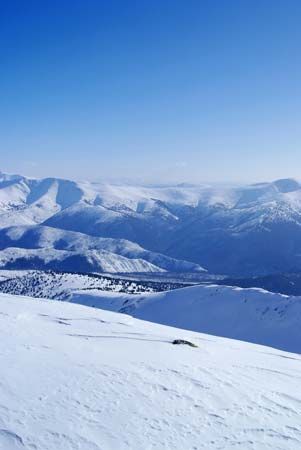
While the specific tectonic processes of their formation are not detailed in the provided records, the system is characterized by its significant height and rugged topography, with the Eastern Sayan being higher than the Western and featuring several glaciers. The range forms a large arc that stretches from the Altai Mountains in the west to Lake Baikal in the east, where it connects with the Khamar-Daban mountain system.1
How do the Sayan Mountains compare in size and elevation to other mountain ranges in Asia?
The Sayan Mountains form a significant mountain arc in east-central Asia, serving as a major relief region that connects the Altai Mountains in the west to Lake Baikal in the east.15
When compared to other prominent ranges in the region, the Sayan Mountains occupy a middle tier in terms of elevation:
- Altai Mountains: These reach a maximum elevation of 14,783 feet (4,506 meters), making them significantly higher than the Sayan range.5
- Sayan Mountains: The Western Sayan rises to 10,240 feet (3,121 meters), while the Eastern Sayan reaches 11,453 feet (3,491 meters) at Mount Munku-Sardyk.15
- Other Siberian Ranges: The Sayan peaks are comparable to the Chersky Range (10,325 feet) but are generally lower than the volcanic peaks of the Kamchatka Peninsula, such as Klyuchevskaya Volcano, which stands at 15,584 feet (4,750 meters).5
While the Sayan Mountains are not the highest in Asia, they are a vital part of the mountain barrier enclosing Russia, characterized by their rugged, glaciated eastern peaks and their role in enclosing the high Tyva Basin.15
Sources
- Sayan Mountains — Encyclopædia Britannica
- Baikalsky Nature Reserve — Encyclopædia Britannica
- Barguzinsky Nature Reserve — Encyclopædia Britannica
- Sayan Mountains — Merriam-Webster
- Russia - The mountains of the south and east — Encyclopædia Britannica
Published on · 3 min read