Scaup
Scaup are specialized diving ducks belonging to the genus Aythya that have evolved distinct physical and behavioral adaptations for foraging in deep water.
What are some interesting behaviors or adaptations that scaup have developed?
Scaup are specialized diving ducks belonging to the genus Aythya that have evolved distinct physical and behavioral adaptations for foraging in deep water.123
Unlike dabbling ducks, which feed by tipping forward in shallow water, scaup possess streamlined bodies and rear-set legs that make them highly efficient swimmers. These anatomical features allow them to dive to depths exceeding 20 feet to reach food sources located at the bottom of lakes, bays, and coastal waters.23
Their diet is primarily composed of clams and other shellfish, a preference so strong that the name “scaup” is thought to be an alteration of “scalp,” an old term for a bed of shellfish. By exploiting these benthic food sources, scaup occupy a unique ecological niche compared to surface-feeding waterfowl.1452
What are the physical characteristics that distinguish scaup from other duck species?
Scaup are distinguished from other diving ducks by several key physical characteristics, though they are often difficult to differentiate from one another in the field.1
Primary Physical Traits
- Size: Both the greater scaup and lesser scaup measure approximately 38–51 cm (15–20 inches) in length.1
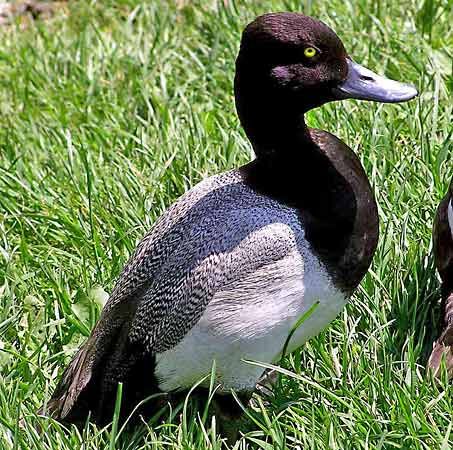
- Bill: A defining feature for both sexes is the blue bill, which is often surrounded by white patches in females.1
- Plumage: Males are characterized by dark breasts, black tails, and grayish backs. The head color varies by species: the greater scaup displays a dark green iridescence, while the lesser scaup is typically glossed with purple, though it may occasionally show green tinges.162
Distinguishing Features in Flight
One of the most reliable ways to identify these species is by observing the white stripe on the rear of the wing during flight:
- Greater Scaup: The white stripe extends almost to the wingtip.1
- Lesser Scaup: The white stripe extends only about halfway along the wing.1
What are the main differences between the Greater Scaup and the Lesser Scaup?
The greater scaup (Aythya marila) and lesser scaup are closely related diving ducks that are notoriously difficult to distinguish in the field. While both share similar sizes (38–51 cm) and general plumage patterns—such as dark breasts, grayish backs, and blue bills—they possess specific differences in head coloration and wing markings.1
Key Differences
Feature
Greater Scaup
Lesser Scaup
Head Iridescence
Dark green
Glossed with purple (may have green tinges)
Wing Stripe
Extends almost to the wingtip
Extends only halfway along the wing
Breeding Range
Eurasia and most of the Nearctic region
Northwest quadrant of North America
Common Name
Big bluebill
Little bluebill
While the greater scaup is generally slightly larger than the lesser scaup, these physical traits are subtle, making the white wing stripe the most reliable diagnostic feature during flight.16
Where are scaup typically found, and what are their preferred habitats?
Scaup are diving ducks that occupy distinct geographic ranges depending on the species. The greater scaup breeds across Eurasia and much of the Nearctic region, while the lesser scaup is a New World species that breeds primarily in the northwest quadrant of North America.1
During the winter months, both species are found along the coasts of the United States, with the lesser scaup extending its range as far south as central Mexico. A third species, the New Zealand scaup, is found in New Zealand.1
Regarding their preferred habitats, these birds are primarily aquatic, as evidenced by their classification as diving ducks. They are frequently found in environments where they can access their primary food source, which consists mainly of clams.1
Sources
- Scaup — Encyclopædia Britannica
- scaup — Merriam-Webster
- What do ducks eat? — Encyclopædia Britannica
- scaup duck — Merriam-Webster
- Diving duck — Encyclopædia Britannica
- greater scaup — Merriam-Webster
Published on · 3 min read