Royal Penguin
The royal penguin (Eudyptes schlegeli) is a species of crested penguin distinguished by a unique combination of physical traits and a highly localized…
How are royal penguins different from other penguin species?
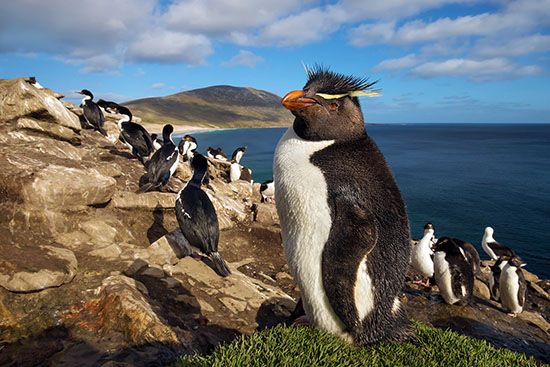
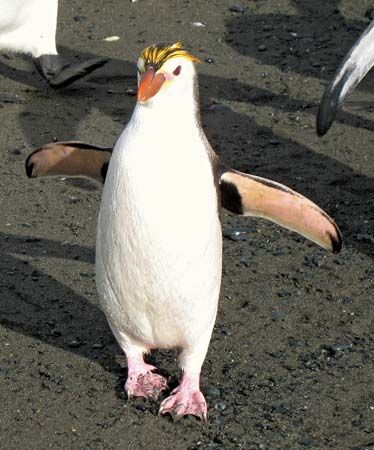
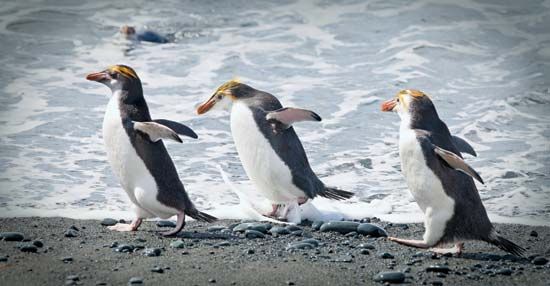
The royal penguin (Eudyptes schlegeli) is a species of crested penguin distinguished by a unique combination of physical traits and a highly localized breeding range. Unlike many other species, royal penguins possess a pale-colored face, a black head, and a large orange-colored bill, accented by a long crest of yellow-orange feathers that begins on the forehead and extends along the sides and top of the head.1
Standing up to 70 cm tall, they are among the largest members of the genus Eudyptes. While they are often compared to macaroni penguins, some experts classify them as a subspecies of that bird.1
Their most significant difference from other penguins is their restricted breeding habitat: nearly the entire global population congregates on Macquarie Island and its nearby islets. This extreme concentration makes them uniquely vulnerable to environmental disasters or invasive species, leading to their classification as a vulnerable species on the IUCN Red List.1
How do royal penguins behave during breeding season?
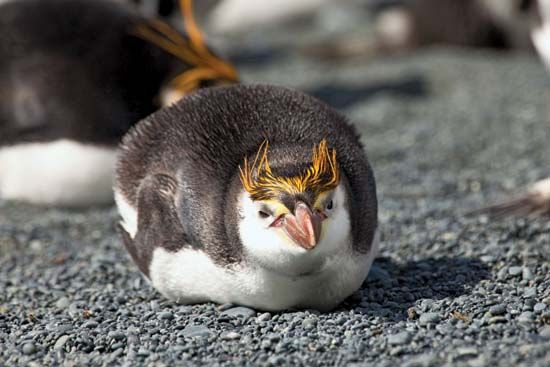
During the breeding season, which spans from September to February, royal penguins exhibit highly structured social and reproductive behaviors centered on their primary habitat, Macquarie Island.2
Nesting and Mating
The season begins with the arrival of males, who establish nesting sites by creating hollows in sand or vegetated slopes, or by constructing nests from small rocks and tussocks. Upon the arrival of females in October, mating occurs. Many breeding pairs are monogamous, and females typically lay a clutch of two eggs. A notable behavior is that the first egg is often smaller than the second and is frequently pushed out of the nest before the second egg is laid.2
Incubation and Chick Rearing
Both parents share the responsibility of incubating the second egg for 30–40 days. During the first three to four weeks after hatching, the father protects the chick while the mother forages at sea to provide food. As the chick grows, both parents alternate foraging trips, each lasting two to three days. During this time, the chick joins a crèche—a group of other young penguins—for protection, though it returns to its home nest to be fed by its parents. By February, at approximately 70 days old, the chick becomes independent and leaves the nest.2
How do climate change and ocean pollution affect royal penguin populations?
Climate change and ocean pollution pose significant threats to the long-term survival of royal penguins. Because nearly the entire global population of this species congregates to breed in one extremely small area on Macquarie Island, they are uniquely vulnerable to environmental shifts.1
Impacts of Climate Change
Ecologists are concerned that climate change may disrupt the marine ecosystems upon which royal penguins depend. Rising ocean temperatures and shifting environmental conditions could reduce the availability of their primary prey, including krill, small fish, and other crustaceans. Because penguins are highly sensitive to changes in ocean temperature and prey abundance, such declines could lead to significant population drops.14
Ocean Pollution and Other Risks
While royal penguins face specific risks from their concentrated breeding habits, they are also threatened by human-induced ocean pollution. A large oil spill near their breeding grounds could be catastrophic for the species. Furthermore, commercial fishing activities in the region may exacerbate food scarcity by competing with the penguins for the same marine resources.1
How do royal penguins communicate with each other?
Royal penguins, like many other penguin species, rely on a variety of visual and vocal displays to communicate within their colonies during the breeding season.9
Because royal penguins are nest-builders, they do not utilize the complex “two-voiced” call system found in species like the emperor penguin or king penguin, which must locate their mates and chicks in large, unorganized crowds without the aid of a fixed nesting site. Instead, royal penguins use their nesting sites as a primary reference point to find their partners.29
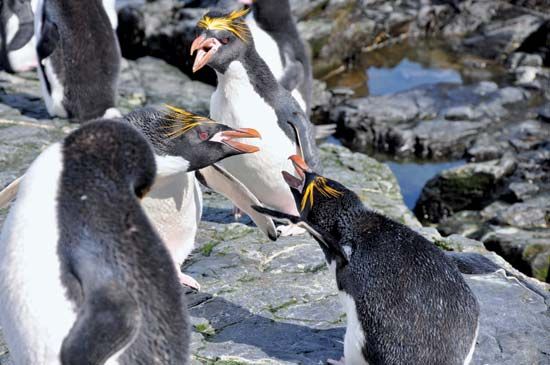
Communication among penguins generally involves diverse vocalizations, including trumpeting, croaking, cackling, and cooing, which are used during courtship, pairing, and when parents return to the nest to feed their chicks. When a parent returns from foraging to a crèche, it uses both voice and appearance to distinguish its specific chick from others in the group. These displays are essential for maintaining social bonds and ensuring successful reproduction within the colony.9
Sources
- Royal penguin — Encyclopædia Britannica
- penguin - Reproduction — Encyclopædia Britannica
- Sex - Courtship — Encyclopædia Britannica
- African penguin: Top Questions — Encyclopædia Britannica
- sea ice - The emerging impacts of recent changes to sea ice — Encyclopædia Britannica
- Macquarie Island — Encyclopædia Britannica
- African penguin — Encyclopædia Britannica
- penguin - General features — Encyclopædia Britannica
- How Do Penguins Tell Each Other Apart? — Encyclopædia Britannica
Published on · 3 min read