Scutellosaurus
Scutellosaurus is recognized by most paleontologists as the most primitive known member of the suborder Thyreophora, the group that includes armored…
What role did Scutellosaurus play in the evolution of armored dinosaurs?
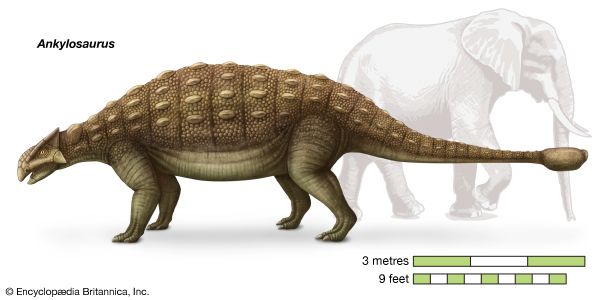
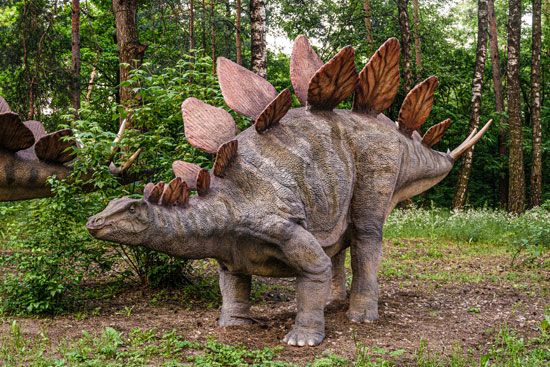
Scutellosaurus is recognized by most paleontologists as the most primitive known member of the suborder Thyreophora, the group that includes armored dinosaurs. Because it is so basal, it does not belong to either of the two major thyreophoran subgroups: ankylosaurs or stegosaurs.1
Its evolutionary significance lies in its early development of dermal armor. While Scutellosaurus possessed small scutes embedded in its skin, these were too small to provide significant defense or serve as thermoregulatory structures. Instead, they represent the ancestral state of the armor that later evolved into the massive, tanklike plating of ankylosaurs or the specialized plates and spikes of stegosaurs. By exhibiting these early features, Scutellosaurus provides a crucial link in understanding how the defensive adaptations of later armored dinosaurs originated during the early Jurassic Period.1
What does the name ‘Scutellosaurus’ mean, and why was it given this name?
The name Scutellosaurus is derived from the Latin word scutellum, which is a diminutive form of scutum, meaning “shield”. In biological contexts, a scutellum refers to a small, hard plate or scale.1
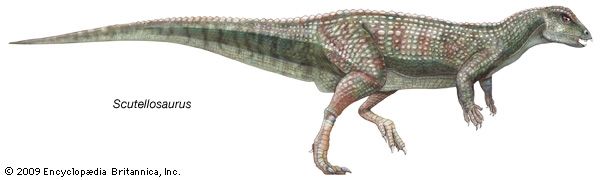
The dinosaur was given this name because of the distinctive physical characteristics observed in its fossils. Unlike other basal ornithischians of its time, Scutellosaurus was characterized by the presence of numerous small scutes embedded in its skin along its back and sides. These small, shield-like structures served as the primary inspiration for the genus name, highlighting the animal’s status as an early, armored member of the suborder Thyreophora.2
How did Scutellosaurus’ armor contribute to its survival?
The armor of Scutellosaurus likely played a minimal role in its survival compared to the specialized defenses of its later relatives. While the dinosaur featured small scutes embedded in its skin along its back and sides, these structures were far too small to provide significant physical protection against predators or to function as thermoregulatory devices. In fact, these scutes were likely barely visible, similar to those found on modern crocodiles.1
Because Scutellosaurus is the most primitive known member of the suborder Thyreophora, its armor represents an ancestral state rather than a highly evolved defensive adaptation. It was only in later descendants, such as ankylosaurs and stegosaurs, that these dermal structures were modified into the robust, tanklike plating or the elaborate plates and spikes that served clear defensive, thermoregulatory, or display purposes.14
What were the key physical characteristics of Scutellosaurus?
Scutellosaurus was a small ornithischian dinosaur that lived during the Early Jurassic Period. Its key physical characteristics include:
- Size: It reached lengths of approximately 1.5 to 2 meters (5 to 6.5 feet), with a skull measuring about 9 cm (3.5 inches) in length.1
- Body Armor: The body was covered in small, embedded scutes along the back and sides. These were likely barely visible and similar to those found on modern crocodiles.1
- Stance: It possessed small forelimbs and robust hind limbs, suggesting a bipedal stance, though some researchers believe its forearms were strong enough to support quadrupedal movement.1
- Dentition: The skull contained several broad incisors and a row of fluted, leaf-shaped cheek teeth, which were adapted for a plant-based diet.1
- Classification: As the most primitive member of the suborder Thyreophora, it represents an ancestral state that preceded the more specialized armor seen in stegosaurs and ankylosaurs.1
Sources
- Scutellosaurus — Encyclopædia Britannica
- scutellum — Merriam-Webster
- scutellar — Merriam-Webster
- Stegosaurus — Encyclopædia Britannica
Published on · 2 min read