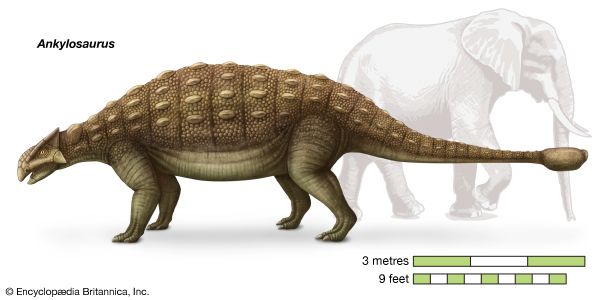
Ankylosaurus
Ankylosaurus was formally named and described by the American paleontologist Barnum Brown in 1908. The genus name, derived from Greek terms meaning "bent" or…
How was Ankylosaurus discovered and what have we learned from fossil evidence?
Ankylosaurus was formally named and described by the American paleontologist Barnum Brown in 1908. The genus name, derived from Greek terms meaning “bent” or “curved,” may also reference the medical term ankylosis to describe the fusion of bones, a feature Brown noted in the animal’s skeleton.1
Fossil evidence has provided significant insight into the biology of this Late Cretaceous Period herbivore:
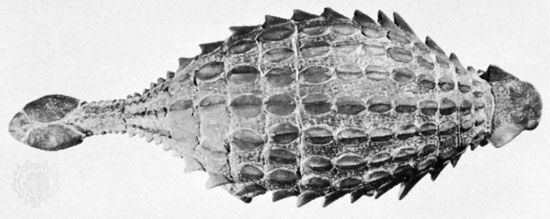
- Physical Structure: Reaching lengths of up to 10 meters (33 feet), Ankylosaurus was a heavily armored quadruped. Its body was protected by thick bony plates and spikes, while its skull was similarly reinforced.2
- Defense Mechanisms: The most distinct feature is the massive bony “club” at the end of its tail, formed by tightly nested vertebrae and bony plates, which the animal likely used for defense against predators.2
- Dietary Habits: Its small, leaf-shaped teeth and weak jaw structure suggest that it fed on soft, pulpy vegetation.23
- Locomotion: Like other members of the Ankylosauria infraorder, it possessed stout, columnar legs, indicating a slow, graviportal mode of movement.23
When and where did Ankylosaurus live?
Ankylosaurus lived in North America during the Late Cretaceous Period. Specifically, these armored ornithischian dinosaurs existed between 70 million and 66 million years ago.1
What other dinosaur species were closely related to Ankylosaurus?
Ankylosaurus belongs to the infraorder Ankylosauria, a group of heavily armored, herbivorous dinosaurs. These are broadly categorized into two main families: the more advanced Ankylosauridae and the more basal Nodosauridae.24
Ankylosauridae
As a member of this family, Ankylosaurus is closely related to other advanced ankylosaurs that share the characteristic tail club used for defense.24
- Euoplocephalus: A well-known relative that also featured a heavily armored body and a tail club. Notably, it even possessed protective bony coverings over its eyelids.2
- Palaeoscincus: Another genus within this group, sharing the characteristic broad, low-slung body form typical of the family.2
Nodosauridae
Nodosaurids are considered more primitive and are distinguished by their lack of a tail club and different armor patterns.24
- Nodosaurus: The namesake of the family, these dinosaurs relied on thick bony plates and knobs for protection rather than a tail weapon. They generally possessed narrower skulls than their ankylosaurid cousins.24
While these groups differ in their defensive adaptations, all were quadrupedal, slow-moving herbivores that flourished during the Cretaceous Period.21
How does Ankylosaurus compare to other armored dinosaurs like Stegosaurus?
Ankylosaurus and Stegosaurus are both members of the group Thyreophora, or “armored dinosaurs,” and share a common ancestry from smaller, early Jurassic relatives like Scutellosaurus and Scelidosaurus.1
Key Comparisons
- Armor and Defense: While both groups possess dermal armor, their defensive strategies differ. Ankylosaurus was encased in a mosaic of interlocking bony plates and spikes, featuring a massive bony tail club for defense. In contrast, Stegosaurus is defined by large, triangular bony plates along its back—likely used for display or thermoregulation—and two pairs of pointed tail spikes.251
- Body Structure: Both were quadrupedal herbivores with stout, columnar limbs indicating slow, graviportal locomotion. However, Stegosaurus had a characteristically arched back due to its hind limbs being much longer than its forelimbs. Ankylosaurus had a lower, broader, and more squat body shape, with limbs that were less disproportionate than those of Stegosaurus.512
- Feeding: Both groups possessed simple, leaf-shaped teeth, suggesting they fed on soft, pulpy vegetation.251
Sources
- Ankylosaurus — Encyclopædia Britannica
- dinosaur - Ankylosauria — Encyclopædia Britannica
- ankylosaurus — Merriam-Webster
- Nodosaurus — Encyclopædia Britannica
- Stegosaurus — Encyclopædia Britannica
Published on · 3 min read