Sea Dragon
A sea dragon is any of three species of small, slow-moving bony fishes belonging to the family Syngnathidae, which also includes seahorses. These unique…
What is a sea dragon?
A sea dragon is any of three species of small, slow-moving bony fishes belonging to the family Syngnathidae, which also includes seahorses. These unique creatures are found in temperate rocky reef environments along Australia’s southern coast.1
The three recognized species are:
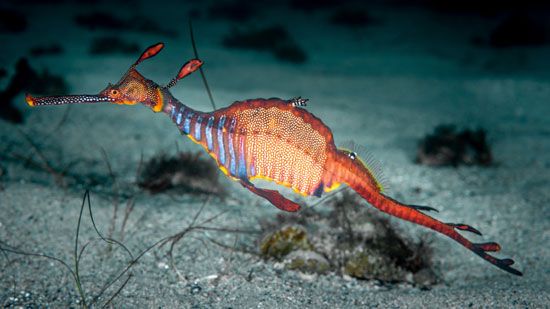
- Weedy (or common) sea dragon (Phyllopteryx taeniolatus): The most widespread species, ranging from Western Australia to Tasmania and New South Wales.1
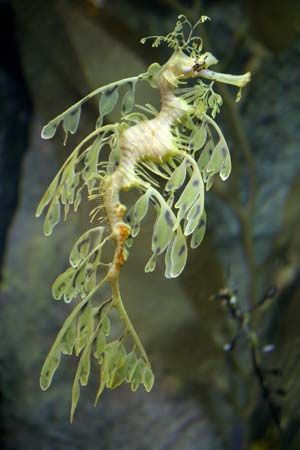
- Leafy (or Glauert’s) sea dragon (Phycodurus eques): Known for its elaborate, leaflike appendages that provide excellent camouflage among vegetation.1
- Ruby sea dragon (Phyllopteryx dewysea): A deeper-water species discovered in 2015, characterized by its red coloration.1
Sea dragons possess ringlike bony structures that make them difficult to digest. They feed by using a long, tubelike snout to suck in tiny crustaceans. Similar to seahorses, male sea dragons provide parental care by incubating eggs in a specialized brooding patch on their skin until they hatch.1
Where do sea dragons live?
Sea dragons are found exclusively in temperate rocky reef environments along the southern coast of Australia. Their specific distribution varies by species:
- Weedy sea dragon (Phyllopteryx taeniolatus): Has the largest range, extending from Western Australia to Tasmania and New South Wales.1
- Leafy sea dragon (Phycodurus eques): Found from Western Australia to western Victoria.1
- Ruby sea dragon (Phyllopteryx dewysea): Occurs in deeper waters near Perth and the Recherche Archipelago along the southern coast of Western Australia.1
Regarding depth, weedy and leafy sea dragons typically inhabit areas between 3 and 25 meters (10 to 82 feet). In contrast, the ruby sea dragon is found in deeper, darker waters at depths exceeding 50 meters (164 feet).1
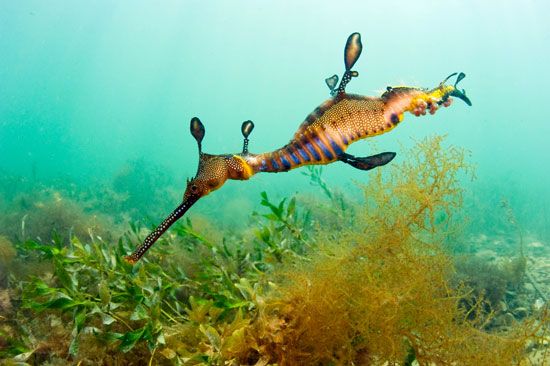
How do sea dragons look different from other fish?
Sea dragons are distinct from many other fish due to their specialized anatomy and unique survival strategies. While they share a family with seahorses, they are generally larger and possess prominent, ringlike bony structures throughout their head and body, which make them difficult for predators to consume or digest.2
Key physical differences include:
- Ornate Camouflage: Weedy and leafy sea dragons feature permanent, leaflike appendages that mimic the seaweed in their environment. These structures help break up their body shape, allowing them to blend in with surrounding vegetation to ambush prey and avoid predators.12
- Coloration: Unlike many fish that rely on scales or patterns, sea dragons use specific colors to hide. Leafy sea dragons are brown, yellow, and green, while ruby sea dragons utilize a deep red coloration to remain hidden in their darker, deep-water habitats.2
- Feeding Mechanism: They lack a stomach and feed using a long, tubelike snout that sucks in tiny crustaceans.2
- Locomotion: They move using tiny, transparent fins that are not strong enough to overcome ocean currents, often appearing to drift or hover in place.2
What do sea dragons eat?
Sea dragons are specialized predators that feed primarily on tiny shrimp and other small crustaceans.2
They utilize a long, tubelike snout to suck their prey into their digestive system. Notably, sea dragons lack a stomach, which is a distinct anatomical feature compared to many other vertebrates. Their feeding success is often aided by their ornate camouflage, which allows them to approach prey unnoticed while blending into the surrounding vegetation of their reef habitats.21
Sources
- sea dragon — Encyclopædia Britannica
- sea dragon — Merriam-Webster
- echinoderm - Reproduction and life cycle — Encyclopædia Britannica
- stomach — Encyclopædia Britannica
Published on · 3 min read