Echinoderm
The phylum Echinodermata is a diverse group of marine invertebrates that has been categorized into 21 distinct classes based primarily on differences in…
How many classes of echinoderms are there, and what are some examples of each?
The phylum Echinodermata is a diverse group of marine invertebrates that has been categorized into 21 distinct classes based primarily on differences in their skeletal structures. While many of these classes are now extinct and known only through the fossil record, there are six classes with living representatives.12
The extant classes of echinoderms include:
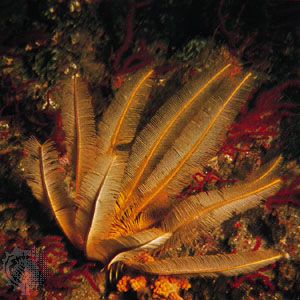
- Crinoidea: Includes sea lilies and feather stars.12
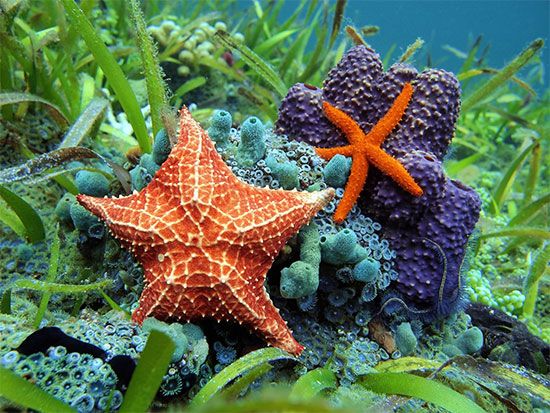
- Asteroidea: Includes starfishes or sea stars.12
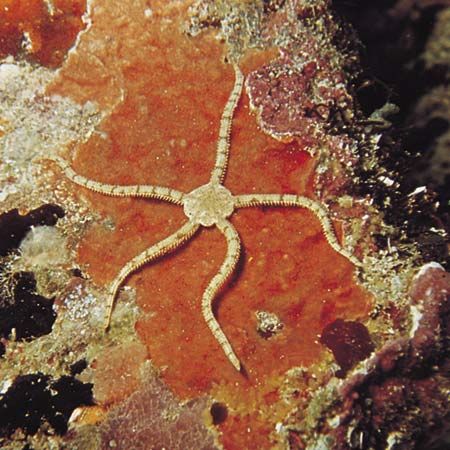
- Ophiuroidea: Includes brittle stars, basket stars, and serpent stars.12
- Concentricycloidea: Includes sea daisies, which are small, disk-shaped animals.12
- Holothuroidea: Includes sea cucumbers.12
- Echinoidea: Includes sea urchins, heart urchins, and sand dollars.12
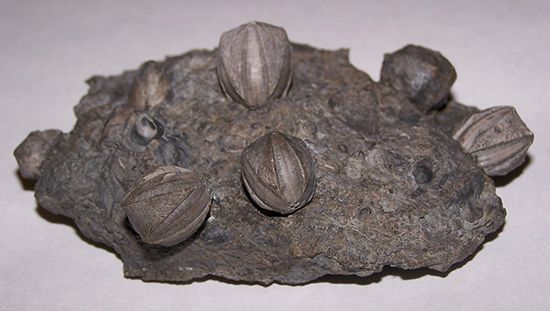
The remaining classes, such as Blastoidea and Stylophora, are entirely extinct.1
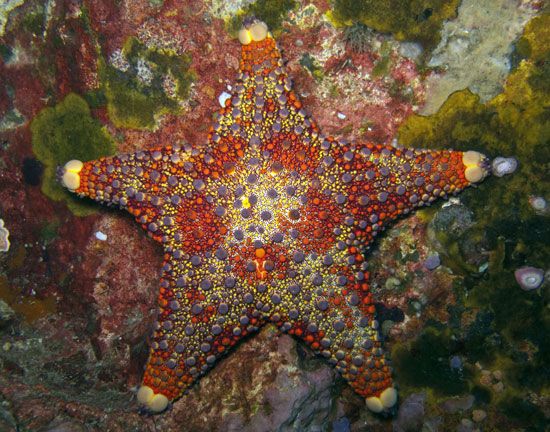
What types of locomotion do different echinoderms use?
Echinoderms utilize a variety of locomotor strategies, often relying on their unique water-vascular system and specialized body structures4.4
- Asteroids (Sea Stars) and Echinoids (Sea Urchins): These animals primarily use tube feet and spines to move. The tube feet act as levers to step along a surface or as suckers that pull the animal forward. They can move in any direction and reverse without turning. In sea urchins, mobile spines also assist in locomotion by articulating with stable skeletal ossicles.54
- Ophiuroids (Brittle Stars): These organisms typically move by thrashing their arms. This can involve a rowing motion where pairs of arms take strokes, while another arm may trail behind or point in the direction of travel.5
- Holothurians (Sea Cucumbers): Movement is generally sluglike, involving both tube feet and the contraction and expansion of the body. Some species use sticky tentacles as anchors to pull themselves along, and many are capable of efficient swimming.5
- Crinoids (Feather Stars and Sea Lilies): Stalked sea lilies are typically fixed to a surface by holdfasts, though some can detach to relocate. Unstalked feather stars swim by coordinating the up-and-down thrashing of their arms or pull themselves across surfaces using their arms.5
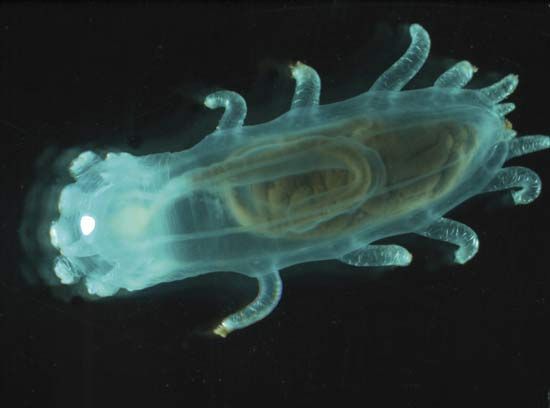
How do echinoderms regenerate lost body parts?
Echinoderms possess a remarkable ability to regenerate lost or destroyed body parts, a trait that is particularly well-developed in sea lilies, starfishes, and brittle stars.10
The process often begins with the sealing of the wound, followed by the regrowth of missing structures. For many asteroids (sea stars) and ophiuroids (brittle stars), successful regeneration is dependent on the presence of a portion of the central disk; if an arm is lost, a new one can grow as long as some of the disk remains attached. In some species, this process is linked to fragmentation, a form of asexual reproduction where the animal tears itself into pieces, each of which then regenerates the missing components to form a complete individual.10
Other echinoderms exhibit specialized regenerative behaviors:
- Sea cucumbers: These animals can perform autoevisceration, expelling their internal organs when threatened or under unfavorable conditions, and are capable of regenerating a complete new set of organs within several weeks.10
- Sea urchins: They readily replace lost spines, pincerlike pedicellariae, and small areas of their internal skeleton.10
How do echinoderms reproduce, and do they have any unique reproductive strategies?
Echinoderms employ both sexual and asexual reproductive strategies to ensure the survival of their species.
Sexual Reproduction
Most echinoderms are dioecious (having separate sexes) and reproduce sexually by spawning, where females release eggs and males release spermatozoa directly into the water column for external fertilization. To increase fertilization success, many species aggregate before spawning or perform specific behaviors, such as raising their bodies off the seafloor to prevent gametes from becoming trapped in sediment. Spawning is often synchronized by environmental cues like temperature, light, salinity, or even lunar phases.1015
Asexual Reproduction
Asexual reproduction typically occurs through fragmentation, where an individual divides into parts that subsequently regenerate into complete organisms. This is common in some asteroids, ophiuroids, and holothurians; in certain species, this is the primary or only known method of reproduction.16
Unique Developmental Strategies
Echinoderms exhibit diverse developmental paths:
- Indirect Development: Involves a free-swimming, planktonic larval stage (such as the bipinnaria or pluteus) that eventually undergoes metamorphosis into a juvenile.17
- Direct Development: Large, yolk-rich eggs develop directly into juveniles without a larval stage.17
- Brood Protection: A unique strategy where parents protect their young by carrying them on their body surface or within specialized pouches, a behavior most prevalent in Antarctic, Arctic, and deep-sea environments.17
Sources
- echinoderm - Annotated classification — Encyclopædia Britannica
- echinoderm — Encyclopædia Britannica
- List of echinoderms — Encyclopædia Britannica
- echinoderm - Locomotion — Encyclopædia Britannica
- Circulatory system - Echinodermata — Encyclopædia Britannica
- Locomotion - Bottom locomotion — Encyclopædia Britannica
- brittle star — Encyclopædia Britannica
- skeleton - Skeleton of echinoderms — Encyclopædia Britannica
- crinoid — Encyclopædia Britannica
- echinoderm - Asexual reproduction — Encyclopædia Britannica
- Regeneration - Polarity and gradient theory — Encyclopædia Britannica
- echinoderm - Nervous system and sense organs — Encyclopædia Britannica
- Regeneration - Origin of regeneration material — Encyclopædia Britannica
- annelid - Regeneration — Encyclopædia Britannica
- echinoderm - Development — Encyclopædia Britannica
- echinoderm - Sexual reproduction — Encyclopædia Britannica
- Animal reproductive system - Echinoderms and protochordates — Encyclopædia Britannica
Published on · 4 min read