Sea Gooseberry
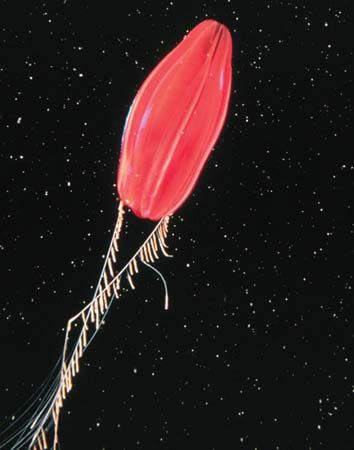
The sea gooseberry, a type of ctenophore (comb jelly), exhibits a bluish-white bioluminescence that can sometimes be seen coloring ocean waves at night.
How does the sea gooseberry’s bioluminescence work, and what purpose does it serve?
The sea gooseberry, a type of ctenophore (comb jelly), exhibits a bluish-white bioluminescence that can sometimes be seen coloring ocean waves at night.12
This light is a form of chemiluminescence, which occurs through an internal biochemical reaction involving the oxidation of a light-emitting organic compound called luciferin in the presence of an enzyme known as luciferase. While the mechanism of this light production is understood as a biological process, the specific purpose or evolutionary advantage of bioluminescence in sea gooseberries remains unclear, as is the case for many other marine organisms that display similar light-emitting traits.32
What adaptations do sea gooseberries have for survival in their marine environment?
Sea gooseberries possess several specialized adaptations that allow them to thrive as planktonic predators in marine environments:
- Locomotion: They move using eight longitudinal rows of comblike plates composed of fused cilia. These plates beat in a coordinated sequence, controlled by a sense organ called a statocyst, allowing the animal to propel itself through the water.14
- Prey Capture: To ensnare small planktonic prey, they utilize two long, extensile, and branched tentacles. These tentacles are equipped with unique adhesive cells known as colloblasts, which secrete a sticky substance that traps organisms upon contact.14
- Body Structure: Their gelatinous, transparent, and roughly spherical or pear-shaped bodies provide buoyancy and camouflage within the water column.14
- Digestive Efficiency: They possess a complex, branched gastrovascular cavity that serves both digestive and circulatory functions, enabling them to process food efficiently.4
- Life Cycle: As wholly planktonic organisms, they lack any sessile or attached stages, allowing them to remain suspended in the water throughout their entire life cycle.14
What are some interesting facts about the anatomy of sea gooseberries?
The anatomy of the sea gooseberry is characterized by several fascinating features that distinguish it as a unique marine invertebrate:
- Gelatinous Structure: Their bodies are transparent, gelatinous, and typically spherical or pear-shaped, which provides effective camouflage in the water column.1
- Locomotory Combs: They feature eight equally spaced longitudinal rows of comblike plates. Each plate is composed of thousands of fused cilia that beat in a coordinated sequence to propel the animal, guided by a sense organ called a statocyst located at one end of the body.14
- Specialized Prey Capture: Sea gooseberries are equipped with two long, retractable, and branched tentacles. These are covered in colloblasts—specialized adhesive cells unique to ctenophores—that secrete a sticky substance to ensnare prey.14
- Gastrovascular System: A mouth at the oral end leads to a tubular pharynx and a complex, branched gastrovascular cavity that performs both digestive and circulatory functions. Notably, they lack a true anus, instead utilizing small anal pores near the statocyst for egestion.14
- Advanced Tissue Layers: Between their outer ectoderm and inner endoderm lies a thick, gelatinous mesoglea. Because this layer contains specialized muscle cells, it functions as a true mesoderm, making them more complex than many other simple marine organisms.4
What is the geographical distribution of sea gooseberries in the world’s oceans?
Sea gooseberries, which include the genera Hormiphora and Pleurobrachia, are considered cosmopolitan organisms. This means they are widely distributed throughout all of the world’s oceans.
Because they are wholly planktonic throughout their entire life cycle and lack any sessile or attached stages, they are able to drift and thrive across diverse marine environments globally.1
Sources
- sea gooseberry — Encyclopædia Britannica
- Bioluminescence - The range and variety of bioluminescent organisms — Encyclopædia Britannica
- chemiluminescence — Encyclopædia Britannica
- ctenophore — Encyclopædia Britannica
Published on · 3 min read