Sea Star
Sea stars (class Asteroidea) utilize their tube feet as a primary hydraulic system for various essential life activities. This system operates via the…
How do sea stars use their tube feet for various activities?
Sea stars (class Asteroidea) utilize their tube feet as a primary hydraulic system for various essential life activities. This system operates via the water-vascular system, where fluid is moved into the tube feet from muscular sacs called ampullae, causing the feet to extend.123
Locomotion and Attachment
Tube feet are the main locomotor force for sea stars, enabling them to creep in any direction and cling to steep surfaces. When the feet make contact with a substrate, they create a partial vacuum, often aided by the secretion of adhesive mucus, which provides strong holding power. They may act as levers to step along a surface or as anchors to pull the animal forward.24135
Feeding and Sensory Functions
- Predation: Species with sucker-tipped feet can exert a continuous, powerful pull on the valves of shellfish like oysters and mussels. This eventually tires the prey’s muscles, forcing the shell open so the sea star can insert its stomach.14
- Sensory Perception: Tube feet are implicated in chemoreception and photoreception, helping the sea star navigate its environment.1
What is the feeding mechanism of sea stars and how do they digest their food?
Sea stars (class Asteroidea) employ diverse feeding strategies depending on their species and evolutionary complexity. Their feeding mechanisms generally fall into three categories:
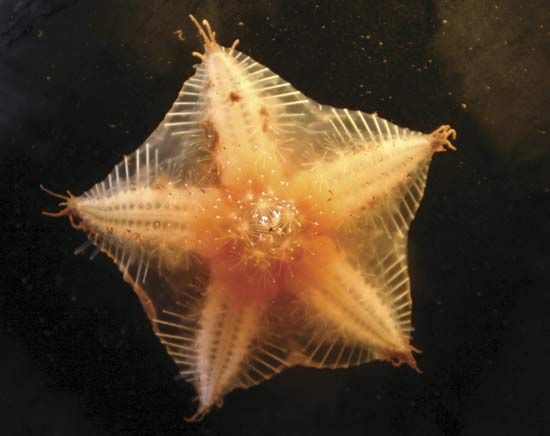
- Particle Feeding: Primitive sea stars collect organic particles along the grooves of their arms and sweep them into the mouth, which is located on the underside of the central disk.4
- External Digestion: Advanced species, such as those in the order Forcipulata, often prey on bivalve mollusks like clams, oysters, and mussels. They use their suction-tipped tube feet to exert a steady pull on the prey’s shell until the muscles tire and the shell opens. Once the shell is breached, the sea star everts (turns inside out) its stomach and extrudes it from its body to digest the soft tissues of the prey externally.46
- Ingestion: Some species are capable of swallowing their prey whole.4
Once the food is processed, nutrients are distributed throughout the body via the coelom, a large fluid-filled cavity that surrounds the internal organs.5
How do sea stars reproduce and what is the process of regeneration in these creatures?
Sea stars (class Asteroidea) exhibit diverse reproductive strategies and a remarkable capacity for regeneration.
Reproduction
Most sea stars reproduce sexually, typically through external fertilization. Females release eggs into the water, where they are fertilized by sperm released by males. Some species are hermaphroditic, and a few are capable of asexual reproduction through fragmentation, where the body divides into parts that grow into new individuals.7
Sexual reproduction is regulated by the endocrine system. A neuropeptide known as the gonad-stimulating substance is released from the radial nerves, triggering the ovaries to produce 1-methyladenine, which induces oocyte maturation and spawning. Following fertilization, many species undergo indirect development, passing through free-swimming larval stages—such as the bipinnaria and brachiolaria—before metamorphosing into juveniles. Some species provide parental care by brooding their eggs and young on their bodies.847
Regeneration
Sea stars possess a well-developed ability to regenerate lost or destroyed body parts, including arms and portions of the central disk. This process is essential for survival and recovery from injury. Successful regeneration generally requires that a portion of the central disk remains attached to the lost arm. In some species, such as those in the genus Linckia, a new individual can grow from a single detached arm.97
What are some common species of sea stars and where are they typically found?
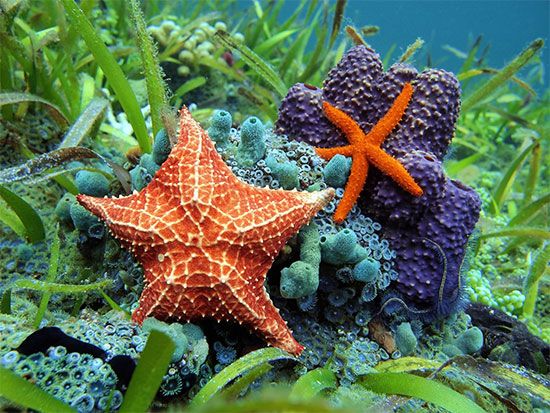
Sea stars are found in all oceans, with the greatest variety occurring in the northern Pacific. They are categorized into three orders, each containing diverse species adapted to specific environments:
Order Phanerozonia (Edged Sea Stars)
These are often found on mud bottoms or in deep-sea habitats.
- Mud star (Ctenodiscus crispatus): Abundant worldwide on the mud bottoms of northern coasts.
- West Indies sea star (Oreaster reticulatus): A large species found in the West Indies.
- Genus Linckia: Primarily found in the Indo-Pacific region.
Order Spinulosa (Spiny Sea Stars)
These typically inhabit stony-bottomed or northern waters.
- Gibbous starlet (Asterina gibbosa): Common in stony-bottomed European waters.
- Sea bat (Patiria miniata): Found along the Pacific coast from Alaska to Mexico.
- Sun stars (Crossaster and Solaster): Inhabit northern waters, with the spiny sun star (Crossaster papposus) being very common.
Order Forcipulata (Forceps Carriers)
These include many common shallow-water species worldwide.
- Genus Asterias: Includes A. rubens (northern Europe), A. vulgaris (Labrador to Long Island Sound), and A. forbesi (Maine to the Gulf of Mexico).
- Genus Pisaster: Includes the large P. brevispinus and the common P. ochraceus, both found on the western coast of North America.
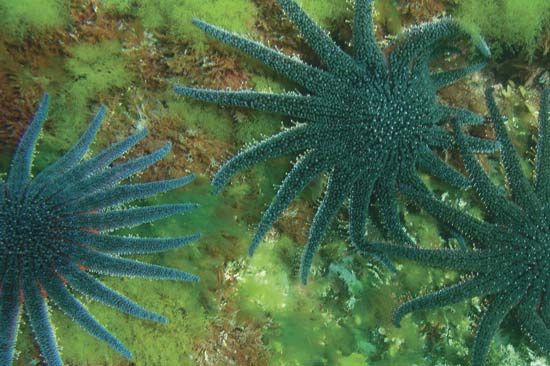
- Sunflower sea star (Pycnopodia helianthoides): Found from Alaska to California.
Sources
- echinoderm - Water-vascular system — Encyclopædia Britannica
- echinoderm - Locomotion — Encyclopædia Britannica
- Locomotion - Bottom locomotion — Encyclopædia Britannica
- sea star — Encyclopædia Britannica
- Circulatory system - Echinodermata — Encyclopædia Britannica
- stomach — Encyclopædia Britannica
- Endocrine system - Phylum Echinodermata — Encyclopædia Britannica
- echinoderm - Asexual reproduction — Encyclopædia Britannica
- echinoderm - Development — Encyclopædia Britannica
- Regeneration - Regulation of regeneration — Encyclopædia Britannica
- Reproduction - Life cycles of animals — Encyclopædia Britannica
Published on · 4 min read