Scallop
A scallop is any marine bivalve mollusk belonging to the family Pectinidae. These animals are widely distributed across the world's oceans, ranging from…
What is scallop?
A scallop is any marine bivalve mollusk belonging to the family Pectinidae. These animals are widely distributed across the world’s oceans, ranging from intertidal zones to deep waters. Unlike many other bivalves, scallops are capable of swimming by using their adductor muscle to clap their fan-shaped valves together, ejecting water in jets to propel themselves forward.12
As a food item, the scallop is highly valued, particularly for its large, tender adductor muscle. Their market price is often high due to the specialized, offshore nature of their harvesting, their perishability, and the fact that they are not as widely farmed as other shellfish like mussels or oysters. Common varieties include the large sea scallop and the smaller, more delicate bay scallop. Beyond their culinary use, the term “scallop” can also refer to the shell itself, a decorative border pattern, or a thin slice of meat.132
How do scallops use their adductor muscles to swim?
Scallops are unique among bivalve mollusks for their ability to swim through rapid, rhythmic clapping of their shells. This locomotion is powered by the adductor muscle, which forcefully closes the two valves to eject water in powerful jets.41
The mechanics of this movement involve several key components:
- Shell Dynamics: The hinge connecting the two valves is elastic, allowing the shell to snap open rapidly after each contraction.
- Muscular Action: Repeated, rapid contractions of the adductor muscle close the shell, creating a nearly continuous water jet that propels the animal forward.4
- Directional Control: The muscular mantle, a membranous fold beneath the shell, acts as a valve to control the direction of the water flow. Typically, water is ejected downward on either side of the hinge, which lifts the scallop and moves it toward the shell’s opening. In instances of escape, the scallop can reverse this flow to move in the opposite direction.4
- Aerodynamic Lift: The closed shell’s shape functions as an airfoil, providing additional lift during movement.4
What makes scallops different from other bivalves like oysters or mussels?
Scallops are distinct from other bivalves like clams, mussels, and oysters in several key ways:
- Locomotion: Scallops are the only bivalves capable of true swimming as adults. They move by using a powerful adductor muscle to rapidly clap their valves together, creating jet propulsion to dart through the water, typically as an escape response to predators.156
- Shell Shape: While other bivalves have varied shapes—such as the rounded or oval shells of clams or the irregular, rough shells of oysters—scallops are characterized by their distinctive, fan-shaped shells, which may be smooth or feature radial ribs.15
- Sensory Organs: Unlike many of their sedentary relatives, scallops possess numerous light-detecting eyes and short, sensitive tentacles along the edge of their mantle to detect changes in their environment.17
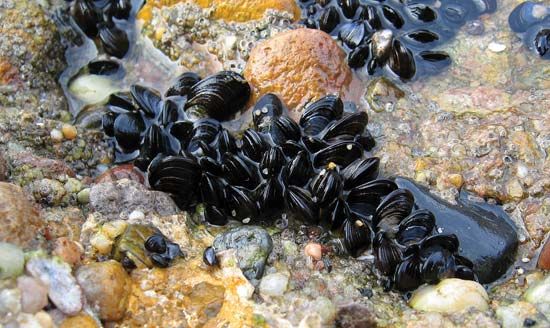
- Lifestyle: While oysters are sessile (permanently attached to hard surfaces) and mussels anchor themselves with byssal threads, scallops may remain attached or break free to become active swimmers.15
Why are starfish considered the primary predators of scallops?
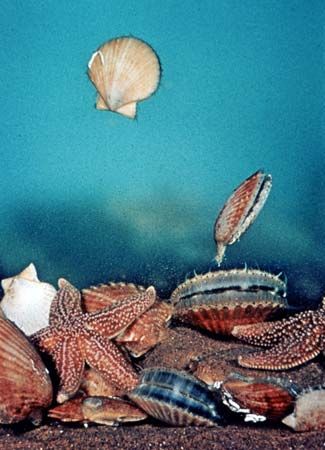
Starfish are considered a primary predator of scallops because they have evolved a highly effective method for overcoming the scallop’s defenses. When attacking, a starfish wraps its arms around the scallop’s valves and uses the suction from its tube feet to exert a steady, powerful pull that forces the shell apart.1
Once the valves are separated, the starfish inserts its stomach directly into the shell to digest the scallop’s soft tissues. This predatory pressure is significant enough that it is believed to have driven the evolution of various antipredation devices in bivalves, such as spines and ridges, or the habit of burrowing deep into the sediment. In response to such threats, scallops utilize their unique ability to swim, employing spasmodic clapping of their valves to jet away from predators.186
Sources
- scallop — Encyclopædia Britannica
- scallop — Merriam-Webster
- Why are scallops so expensive? — Encyclopædia Britannica
- Locomotion - Swimming — Encyclopædia Britannica
- What’s the difference between clams, mussels, and oysters? — Encyclopædia Britannica
- bivalve - Features of defense and aggression — Encyclopædia Britannica
- Pectinidae — Merriam-Webster
- bivalve - Ecology and habitats — Encyclopædia Britannica
Published on · 3 min read