Sheathbill
The reproductive cycle of sheathbills is characterized by specific courtship behaviors and an adaptive strategy regarding their offspring. During courtship…
What is the reproductive cycle of sheathbills like?
The reproductive cycle of sheathbills is characterized by specific courtship behaviors and an adaptive strategy regarding their offspring. During courtship, males engage in bowing, bobbing, strutting, and cooing displays.1
These birds construct bulky nests in sheltered locations such as holes, burrows, or rock crevices. They typically lay two or three off-white eggs, often in December. A key feature of their reproductive strategy is that the eggs are laid more than a week apart, yet incubation begins with the first egg. This results in chicks of different sizes; consequently, due to the fluctuating food supply in their Antarctic environment, it is rare for more than the largest chick to survive. This system is considered an adaptation that allows the parents to fledge the maximum number of young their resources can support. The young take up to nine weeks to fledge.12
What is the diet of sheathbills and how do they obtain their food?
Sheathbills are opportunistic feeders that occupy a unique ecological niche in the Antarctic. Their diet is highly varied, reflecting their role as both predators and scavengers.
Dietary Habits
During the breeding season, sheathbills act as aggressive predators, feeding on the eggs and young of penguins, petrels, and terns. They also function as scavengers, consuming the feces and afterbirths of seals and feeding on offal found near whaling stations. Outside of the breeding season, their diet shifts to include intertidal creatures and algae.1
Foraging Behavior
Sheathbills are known for their inquisitive nature and are often seen walking among expedition camps in search of food, behaving similarly to chickens. They are frequently encountered in small parties along the shore, though they may also be found at sea hundreds of miles from land. Their short, stout bills are well-suited for their varied scavenging and predatory lifestyle, allowing them to exploit food sources that other Antarctic birds may overlook.1
What is a sheathbill and where can it be found in the wild?
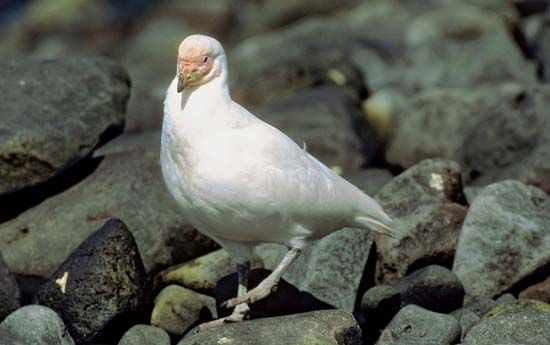
A sheathbill is a white, stout-billed shorebird belonging to the family Chionididae and the genus Chionis. They are the only bird family restricted to the south polar regions. Named for the rough, horny sheath that covers the base of their bill and protects their nostrils, these birds possess pink-rimmed eyes and blue-gray, unwebbed feet—a unique trait among birds in the Antarctic.14
There are two species of sheathbills:
- Snowy sheathbill (C. alba): Reaches about 40 cm (16 inches) in length and features a yellow bill.1
- Lesser sheathbill (C. minor): Slightly smaller at approximately 38 cm (15 inches) and has a black bill.1
Sheathbills are found in the colder regions of the Southern Hemisphere, specifically living around the borders of the Antarctic. While they are often encountered in small parties along the shore, they are also capable of traveling hundreds of miles out to sea. When not disturbed, they are known to be quite tame and inquisitive, often wandering through human expedition camps.14
How are sheathbills adapted to their harsh Antarctic environment?
Sheathbills are uniquely adapted to survive the harsh conditions of the Antarctic through a combination of specialized physical traits and highly flexible behavioral strategies. As the only bird family confined to south polar regions, they have evolved to exploit resources that other species often overlook.1
Physical Adaptations
- Bill Structure: Their short, stout bills are equipped with a rough, horny sheath at the base that shields their nostrils, protecting them from debris and the elements while scavenging.1
- Salt Regulation: Like many other Charadriiformes, sheathbills possess supraorbital (nasal) glands located in the skull above their eyes. These glands allow them to maintain ionic balance by excreting excess salt consumed from their marine-based diet.5
- Locomotion: They are the only Antarctic birds that lack webbed feet, which are instead thick and blue-gray, suited for walking across rocky terrain rather than swimming.1
Behavioral Strategies
- Opportunistic Feeding: Sheathbills are versatile scavengers and predators. They supplement their diet by consuming algae and intertidal creatures, while also aggressively preying on the eggs and young of other birds or scavenging offal and seal waste.13
- Social Adaptability: Their inquisitive and tame nature allows them to thrive near human activity, often foraging in expedition camps.1
Sources
- Sheathbill — Encyclopædia Britannica
- Charadriiform - Shorebirds (suborder Charadrii) — Encyclopædia Britannica
- Charadriiform - Adaptations for feeding — Encyclopædia Britannica
- sheathbill — Merriam-Webster
- Antarctica - Birds — Encyclopædia Britannica
Published on · 3 min read