Shire Highlands
The Shire Highlands are vital to Malawi’s economy and agriculture, serving as one of the country's most densely populated and intensely cultivated regions.
What is the significance of the Shire Highlands for Malawi’s agriculture and economy?
The Shire Highlands are vital to Malawi’s economy and agriculture, serving as one of the country’s most densely populated and intensely cultivated regions.1
Agricultural Significance
The plateau is a major hub for commercial and smallholder farming. It is particularly significant for the production of tea, which is grown on large plantations, and coffee, which is produced primarily in the highlands and parts of northern Malawi. Additionally, the region supports the cultivation of tobacco, tung, peanuts (groundnuts), and corn (maize).12
Economic Role
The highlands are well-integrated into the national infrastructure, served by extensive road and rail networks that facilitate the movement of goods. Major urban centers located on the plateau, such as Blantyre and Zomba, act as key economic nodes. Furthermore, the proximity of the southern industrial areas near Blantyre makes the region a primary consumer of electric power, which is essential for supporting the country’s industrial and agricultural processing activities.13
What are some of the major towns or cities located in the Shire Highlands region?
The Shire Highlands region is home to several significant urban centers that serve as hubs for commerce, administration, and education in southern Malawi. The major towns and cities located on this plateau include:
- Blantyre: Situated in a depression on the highlands, Blantyre is Malawi’s oldest municipality and its primary industrial and commercial center. It was formed through the amalgamation of Blantyre and the neighboring town of Limbe, which serves as a key center for wholesale commerce and tobacco auctions.567
- Zomba: Located at the foot of the Zomba Massif, this city served as the capital of Malawi until 1975. Today, it is recognized as a university town, housing a constituent campus of the University of Malawi, and remains an important administrative and agricultural center.517
- Thyolo: This town is a notable settlement on the plateau, situated within a region characterized by intense agricultural activity, particularly the cultivation of tea and other cash crops.7
What is the geographical location and extent of the Shire Highlands in Malawi?
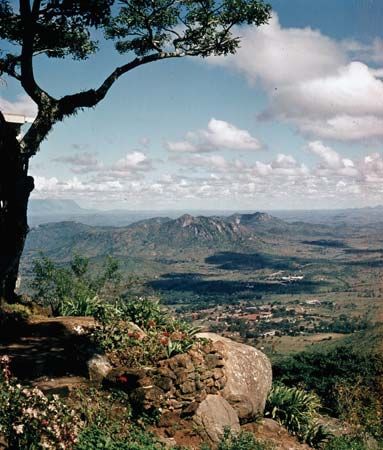
The Shire Highlands are a diamond-shaped plateau located in southern Malawi, covering an area of approximately 2,800 square miles (7,300 square km).1
The region is defined by the following geographical boundaries:
- Northwest and Southwest: The Shire River valley.1
- Southeast: The Ruo River valley.1
- Northeast: The Lake Chilwa–Phalombe Plain.1
The plateau serves as the drainage divide between the Shire River and the Lake Chilwa systems. Its elevation typically ranges from 2,000 to 4,000 feet (610–1,220 m), though it features significantly higher peaks, including the Zomba Massif (over 6,000 feet or 1,800 m) and the Mulanje Mountains, which reach over 9,000 feet (2,750 m) and represent the highest point in the country.12
How does the Shire River relate to the Shire Highlands?
The Shire River and the Shire Highlands are intrinsically linked through their shared geography in southern Malawi. The Shire River valley serves as a primary physical boundary for the Shire Highlands, flanking the plateau to both the northwest and the southwest.8
The relationship between the two is defined by several key factors:
- Drainage Divide: The Shire Highlands plateau acts as a critical drainage divide, separating the water systems of the Shire River from those of the Lake Chilwa basin.8
- Topographic Interaction: As the Shire River flows through its middle valley, it passes the Zomba Mountain scarp, which is a prominent feature of the highlands.1
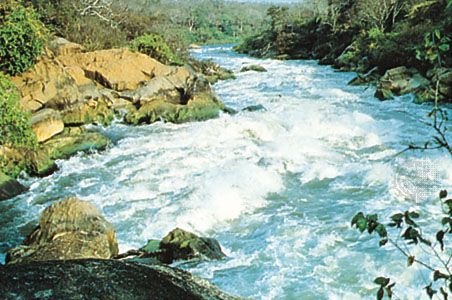
- Economic Infrastructure: The river’s descent through the middle valley, specifically between Matope and Chikwawa, creates a series of cataracts and gorges. Dams located at the Nkula and Tedzani Falls, situated northwest of the Shire Highlands near Blantyre, harness the river’s energy to provide essential hydroelectric power to the region.1
We could dive deeper into how the river’s hydroelectric capacity has supported the industrial development of the cities located on the highlands.
Sources
- Shire Highlands — Encyclopædia Britannica
- Malawi - Relief — Encyclopædia Britannica
- Malawi - Agriculture, forestry, and fishing — Encyclopædia Britannica
- Malawi - Resources and power — Encyclopædia Britannica
- Malawi - Settlement patterns — Encyclopædia Britannica
- Zomba — Encyclopædia Britannica
- Blantyre — Encyclopædia Britannica
- Shire River — Encyclopædia Britannica
- Lake Malombe — Encyclopædia Britannica
Published on · 3 min read