Shrike-vireo
Shrike-vireos (genus Vireolanius) are a group of about four species of tropical American songbirds belonging to the family Vireonidae. While they share a…
What are the different species of shrike-vireos, and how do they differ from each other?
Shrike-vireos (genus Vireolanius) are a group of about four species of tropical American songbirds belonging to the family Vireonidae. While they share a stout, hooked bill similar to true shrikes, their anatomical features align them with vireos. These birds typically range from 13 to 17.5 cm in length and inhabit forests from southern Mexico to central Brazil and Peru.1
The provided information highlights two specific species:
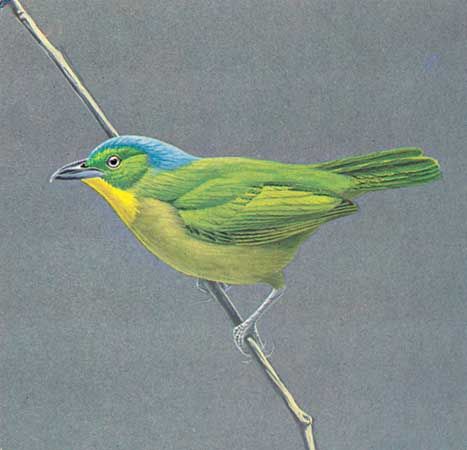
- Slaty-capped shrike-vireo (Vireolanius leucotis): Found in northern South America, this is a heavily built forest bird featuring an olive green back and a slaty gray head accented with yellow.1
- Chestnut-sided shrike-vireo (V. melitophrys): This species is more subdued in coloration, characterized by a greenish-brown back and white underparts. It possesses a gray head marked by distinct black and yellow stripes running through the eye.1
What are the physical characteristics and appearance of shrike-vireos?
Shrike-vireos (genus Vireolanius) are a group of approximately four species of tropical American songbirds within the family Vireonidae. They are physically distinguished by a stout, slightly hooked bill that resembles that of the true shrikes, though their overall anatomy aligns them with other vireos.1
These birds typically measure between 13 and 17.5 cm (5.1 to 7 inches) in length. Their appearance varies by species:1
- Slaty-capped shrike-vireo (Vireolanius leucotis): A heavily built forest bird featuring an olive green back and a slaty gray head accented with yellow.1
- Chestnut-sided shrike-vireo (V. melitophrys): A more subdued bird with a greenish-brown back and white underparts. Its gray head is marked by distinct black and yellow stripes running through the eye.1
Generally, these birds inhabit forest environments ranging from southern Mexico to central Brazil and Peru. While they were once classified as a separate family, they are now typically included within the broader vireo group.1
Are there any interesting adaptations or behaviors unique to shrike-vireos?
While shrike-vireos (genus Vireolanius) are recognized for their distinct, stout, and slightly hooked bills—which resemble those of true shrikes—the available scientific literature does not detail specific behavioral or adaptive traits unique to this genus beyond their general classification within the vireo family.1
In the broader context of the family Vireonidae, many species are known for being somewhat shy and plain in appearance, often foraging in trees and bushes for insects and berries. Vireos frequently engage in distinctive courtship displays that include swaying and fluttering, and they are known for constructing cup-shaped nests suspended from the forks of branches. While some passerine birds exhibit complex behaviors like antiphonal singing, such specific behavioral data is not documented for the shrike-vireo.23
What is a shrike-vireo and how is it different from other bird species?
A shrike-vireo (genus Vireolanius) is a tropical American songbird belonging to the family Vireonidae. While they were once classified as a distinct family, they are now generally included within the broader vireo group.1
Shrike-vireos are distinguished from other bird species primarily by their unique combination of features. They possess a stout, slightly hooked bill that resembles that of the true shrikes in the family Laniidae, yet their internal anatomy aligns them with other vireos. Compared to typical vireos, which are often described as shy, plain-colored birds, shrike-vireos are noted for their specific, often striking plumage patterns, such as the slaty-capped shrike-vireo’s gray head with yellow accents or the chestnut-sided shrike-vireo’s distinct black and yellow eye stripes.12
While they share the general Passeriformes order and foraging habits—such as searching trees and bushes for insects and berries—with other vireos, their robust build and specialized bill set them apart within the family.12
Sources
- Shrike-vireo — Encyclopædia Britannica
- Vireo — Encyclopædia Britannica
- Passeriform - Sound production — Encyclopædia Britannica
- Vanga-shrike — Encyclopædia Britannica
Published on · 3 min read