Peppershrike
The peppershrike (family Cyclarhidae) refers to either of two species of stout-billed tropical American songbirds belonging to the order Passeriformes. While…
What is Peppershrike?
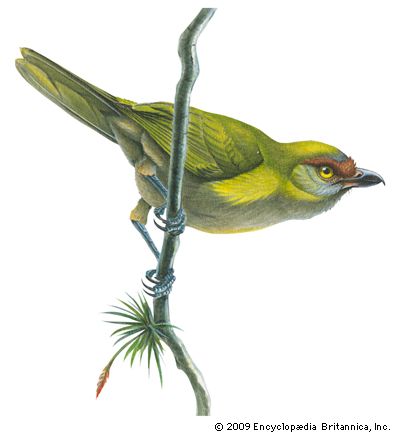
The peppershrike (family Cyclarhidae) refers to either of two species of stout-billed tropical American songbirds belonging to the order Passeriformes. While some authorities classify them within the vireo family (Vireonidae), they are distinct for their olive-green plumage, yellow and white underparts, and a high, terminally hooked bill. Measuring approximately 15 centimetres (6 inches) in length, these birds inhabit open woodlands ranging from southern Mexico to Argentina and Paraguay. They are primarily insectivorous, feeding on large insects and some fruit while foraging through foliage, and are known for their frequently repeated, sweet warbling song.1
How do peppershrikes differ from other vireos?
While peppershrikes are sometimes classified within the vireo family (Vireonidae), they are distinguished from other vireos primarily by their unique bill structure.
- Bill Morphology: Unlike the typical vireo, which possesses a stout but narrow bill that is slightly notched and hook-tipped, the peppershrike features a notably high and terminally hooked bill.12
- Taxonomy: While standard vireos belong to the family Vireonidae, peppershrikes are sometimes categorized in their own distinct family, Cyclarhidae.1
In other respects, they share similarities with their relatives, such as their olive-green and yellow-white coloration, their insectivorous diet, and their tendency to forage through foliage in open woodlands.12
What role does the hooked bill play in their feeding habits?
The hooked bill of the peppershrike is a specialized adaptation that facilitates its diet of large insects and fruit as it moves through foliage. While bill shape in passerines is often evolutionarily plastic and reflective of specific food preferences, the terminal hook serves as a functional tool for handling these food items.14
In the broader context of avian morphology, a hooked tip is frequently associated with insectivorous or predatory feeding strategies, allowing birds to better grasp, manipulate, or tear apart their prey. Although peppershrikes are not classified as “toothed” birds—a category reserved for those with a specific notch on the cutting edge of the mandible, such as shrikes—the hook on the peppershrike’s bill provides the necessary leverage to process the larger insects and tougher plant materials they encounter in their woodland habitats.41
What other bird species share the same tropical habitats?
Peppershrikes inhabit open woodlands across the Americas, from southern Mexico to Argentina and Paraguay, where they share their environment with a diverse array of other bird species that have evolved to exploit specific ecological niches.
Common inhabitants of these tropical and subtropical regions include:
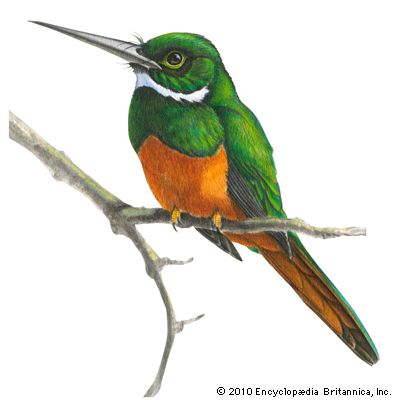
- Piciformes: This order includes several families that occupy distinct niches within the same forests. Jacamars and puffbirds are notable for their fly-catching behavior, often sitting on perches in forest openings to capture insects. Toucans and barbets are also prevalent, frequently feeding on fruit and insects in the canopy or woodland fringes.
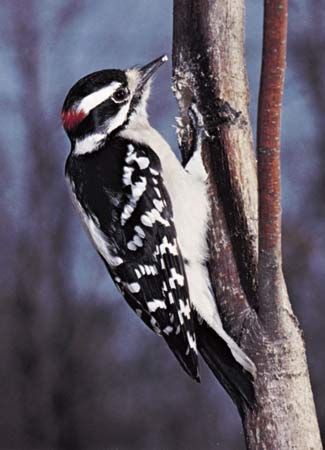
- Woodpeckers: Members of the family Picidae are abundant in South American forests. They typically forage by gleaning insects from tree trunks and branches, often utilizing specialized bills to probe or chisel into wood.
- Vireos: Related species, such as the shrike-vireo, also inhabit these tropical forests, sharing similar woodland habitats while maintaining their own specialized feeding behaviors.
These species coexist by partitioning resources, ensuring that each bird species uniquely exploits the available food and nesting sites within the community.1678
Sources
- Peppershrike — Encyclopædia Britannica
- Vireo — Encyclopædia Britannica
- Pandanales - Cyclanthaceae — Encyclopædia Britannica
- Passeriform - Bill — Encyclopædia Britannica
- Ciconiiform - Bill shape — Encyclopædia Britannica
- Piciform - Annotated classification — Encyclopædia Britannica
- Coraciiform - Habitat selection and ecological diversity — Encyclopædia Britannica
- Shrike-vireo — Encyclopædia Britannica
- Piciform - Distribution and ecology — Encyclopædia Britannica
- Woodpecker — Encyclopædia Britannica
- community ecology - Ecological niches — Encyclopædia Britannica
Published on · 2 min read