Sicily
Historically, Sicily’s economy has been rooted in agriculture, serving as a staple for long-distance trade since the 16th century under Spanish rule. For…
How has Sicily’s economy evolved over time, and what are its main industries today?
Historically, Sicily’s economy has been rooted in agriculture, serving as a staple for long-distance trade since the 16th century under Spanish rule. For centuries, the island’s land was largely controlled by noblemen, with a majority of the population working as laborers on large estates. Following the Land Reform Acts of 1950, land was redistributed to create smaller, family-operated farms, though the region has remained relatively underdeveloped compared to other parts of Italy.123
In the latter decades of the 20th century, the economy shifted as heavy industry expanded significantly. Today, Sicily’s economy is a mix of traditional and modern sectors:3
- Industry: Major activities include oil refining, chemical manufacturing, food processing, shipbuilding, textiles, and salt extraction.34
- Agriculture: The region remains a significant producer of wheat, barley, corn, olives, citrus fruit, almonds, and wine grapes.3
- Resources: The island produces natural gas and sulfur, though sulfur production has declined.3
What is the significance of Sicily’s strategic location in the Mediterranean Sea?
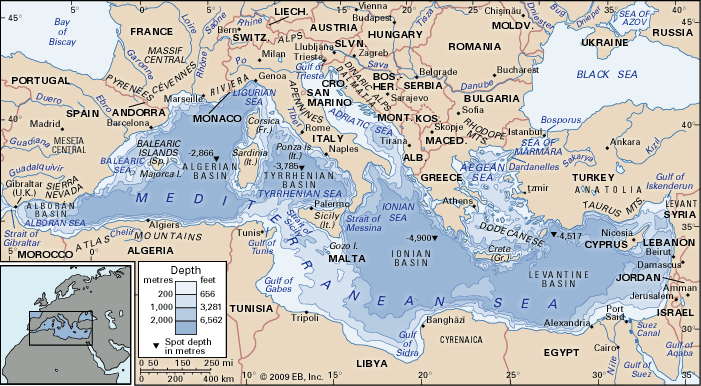
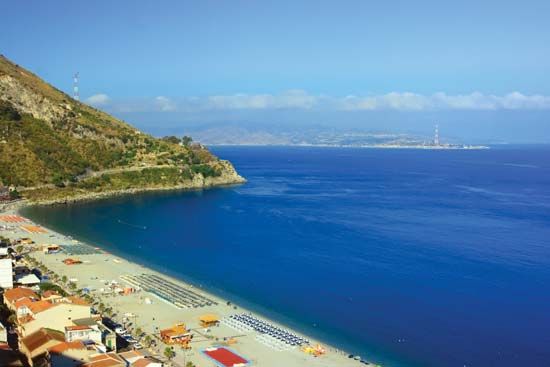
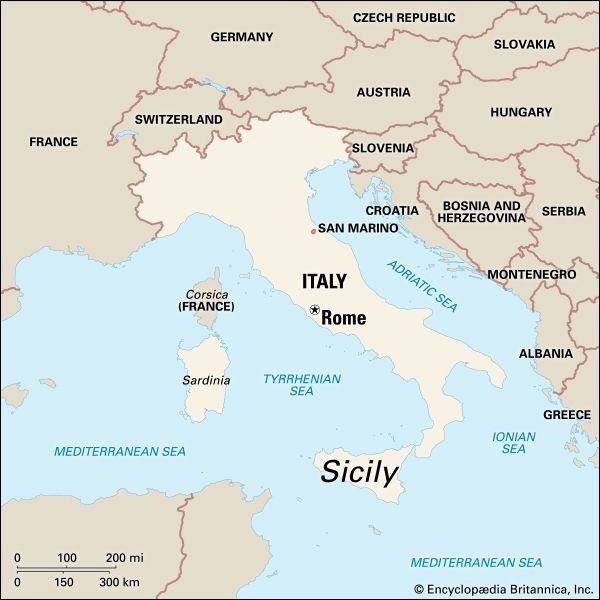
Sicily’s position at the center of the Mediterranean Sea has made it a vital crossroads throughout history. Its location, situated approximately 100 miles from North Africa and separated from the Italian mainland by the narrow Strait of Messina, has rendered the island a strategic focal point for various civilizations.1
Because of this geography, Sicily has served as a:
- Crossroads of History: The island has functioned as a meeting point for diverse cultures, acting as a melting pot for numerous ethnic groups, warriors, and merchants who sought its shores.1
- Pawn of Conquest: Its central location made it a frequent target for empires seeking to control Mediterranean trade and military routes. Over the centuries, it has been occupied or ruled by the Greeks, Romans, Byzantines, Arabs, Normans, and the Bourbons, among others.1
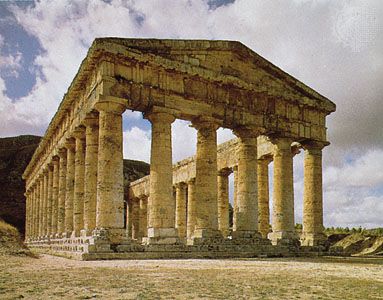
- Economic Hub: The island’s position facilitated significant commercial interactions. For example, ancient cities like Selinus grew wealthy through trade with Carthage, and the island remained a key site for economic and cultural exchange between the Greek world and North Africa.15
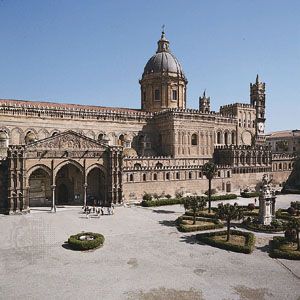
What are some of the major cities and landmarks in Sicily?
Sicily is home to several historically and culturally significant cities, each offering unique landmarks that reflect the island’s diverse past.
Major Cities
- Palermo: As the capital of Sicily, Palermo is a hub of government and trade. It is renowned for its distinct Islamic-Norman architecture, which blends various cultural influences from the Middle Ages.2
- Catania: Located on the Ionian coast, this city is known for its 18th-century Baroque appearance, largely due to rebuilding efforts following a devastating earthquake in 1693. It serves as a major industrial and transportation center.6
- Agrigento: Situated on the southern coast, this city is world-famous for its extraordinary collection of ancient Greek remains, particularly its well-preserved Doric temples.7
Notable Landmarks
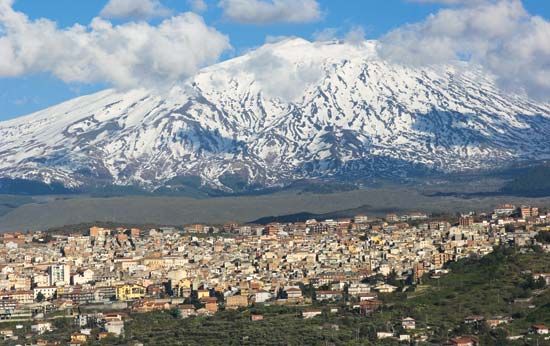
- Mount Etna: Europe’s highest active volcano, located on the east coast. It is a dominant natural landmark that has shaped the island’s geology and history for millennia.18
- Valley of the Temples (Agrigento): An archaeological area featuring seven Doric temples, including the Temple of Concordia, which is remarkably well-preserved.7
- Palatine Chapel (Palermo): Located within the Royal Palace, this chapel is a masterpiece of medieval art, featuring a carved wooden ceiling in the Islamic style and intricate Byzantine mosaics.2
- Ursino Castle (Catania): A 13th-century fortress built for Frederick II, now housing a civic museum with significant archaeological collections.6
How has the Sicilian language evolved, and how does it differ from standard Italian?
The linguistic history of Sicily is characterized by a rich tapestry of regional dialects that have persisted alongside the development of Standard Italian.
Evolution and Background
Historically, the island was home to the Siculi, an ancient Indo-European people who spoke the Sicel language. However, following the arrival of Greek colonists, the local population became Hellenized and largely adopted Greek. Over centuries of subsequent rule by various powers, Sicily developed a distinct set of regional dialects. While Standard Italian—based on the dialect of Florence—eventually became the national administrative and literary language, many Italians continued to identify strongly with their local parlance. The supremacy of the standard language was only solidified in the 20th century through the influence of education, emigration, and mass media like television.
Differences from Standard Italian
Sicilian dialects are categorized within the southern and eastern Italian dialect groups. Key distinctions include:
- Divergence: Sicily is noted for having some of the greatest linguistic divergence from Standard Italian, a result of its geographic isolation as an island.
- Persistence: Despite the dominance of the national language, Sicilian dialects remain resilient as “home languages” in many communities.
- Historical Influence: In the 13th century, a conventionalized Sicilian dialect was used for early lyric poetry, which significantly influenced the development of the Italian literary tradition in Tuscany.
Sources
- Sicily — Encyclopædia Britannica
- Catania — Encyclopædia Britannica
- Italy - The kingdom of Sicily — Encyclopædia Britannica
- Italy - Agriculture, forestry, and fishing — Encyclopædia Britannica
- North Africa - Trade — Encyclopædia Britannica
- Agrigento — Encyclopædia Britannica
- Palermo — Encyclopædia Britannica
- Mount Etna — Encyclopædia Britannica
- list of cities and towns in Italy - Sicily — Encyclopædia Britannica
- Sicel language — Encyclopædia Britannica
- Italy - Languages of Italy — Encyclopædia Britannica
- Sardinian language — Encyclopædia Britannica
- Siculi — Merriam-Webster
- Italian language — Encyclopædia Britannica
- Siculi — Encyclopædia Britannica
- Siculan — Merriam-Webster
Published on · 4 min read