Stromboli Island
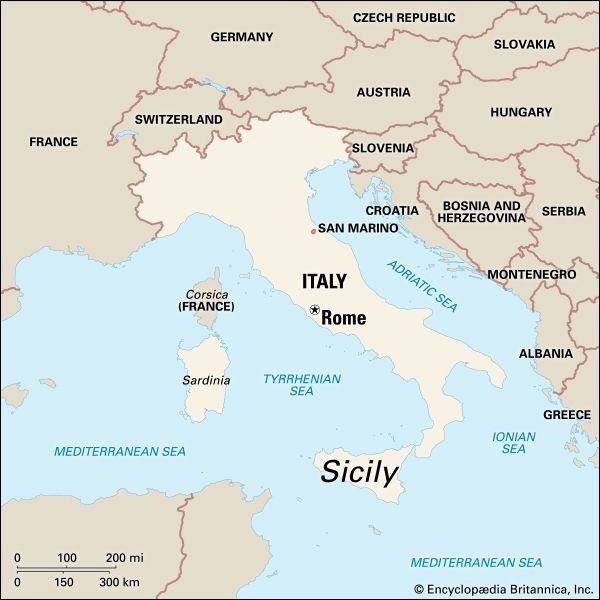
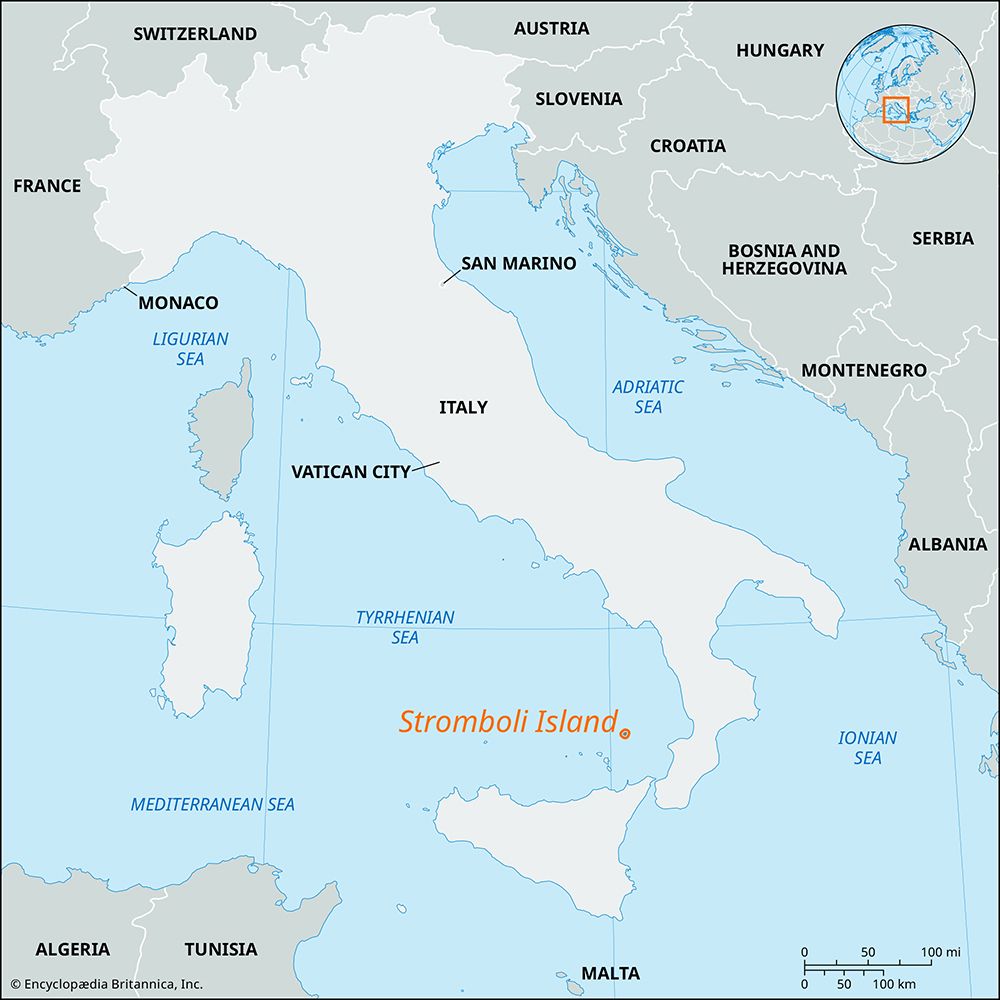
Stromboli Island is the northeasternmost of the Eolie (Lipari) Islands, located in the Tyrrhenian Sea off the coast of northeastern Sicily. Covering an area…
What is Stromboli Island?
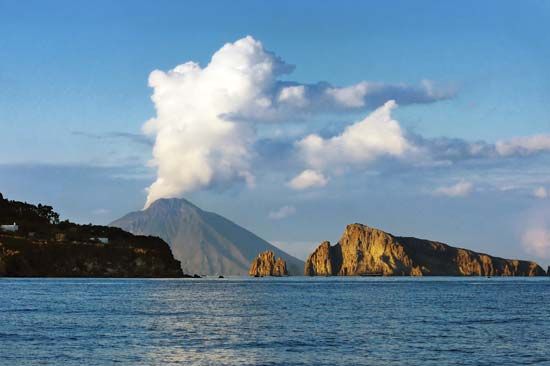
Stromboli Island is the northeasternmost of the Eolie (Lipari) Islands, located in the Tyrrhenian Sea off the coast of northeastern Sicily. Covering an area of approximately 5 square miles (12 square km), the island is of volcanic origin and remains active today.1
The island is home to a volcano that reaches a height of 3,038 feet (926 meters). While fluid lava flows continuously from its crater toward the sea, the last major eruption occurred in 1921. Beyond its geological significance, the island supports the cultivation of dates, olives, and various fruits, and it serves as a popular destination for tourism, drawing visitors with its unique volcanic landscape, pleasant climate, and beaches.21
How do scientists monitor active volcanoes?
Scientists monitor active volcanoes using a variety of specialized techniques to detect signs of impending eruptions and mitigate risks to human life. Because volcanic activity is often preceded by the upward movement of magma, researchers rely on several key methods:34
- Seismology: Seismographs are used to detect swarms of earthquake tremors. An increase in the frequency and intensity of these quakes often signals magma rising from the asthenosphere.34
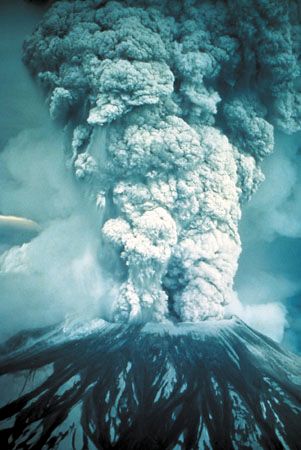
- Deformation Monitoring: As magma fills subsurface chambers, volcanoes may inflate. Scientists use tiltmeters to measure changes in slope angles and laser beams to track surface deformation, such as the bulging observed at Mount St. Helens prior to its 1980 eruption.34
- Gas and Environmental Analysis: Gas detectors monitor emissions from fumaroles to analyze changes in volcanic gases like sulfur dioxide and carbon dioxide. Additionally, instruments sensitive to variations in magnetic and gravity fields provide further data on internal changes.35
Permanent volcano observatories are established at high-risk sites to ensure continuous monitoring and early warning.3
What are the different types of volcanic eruptions?
Volcanic eruptions are generally categorized as either effusive (outpouring of low-viscosity, low-gas magma) or explosive (involving viscous, gas-rich magma). Scientists further classify them into six major types, listed here in order of increasing explosiveness:6
- Icelandic: Effusions of molten basaltic lava flowing from long, parallel fissures.
- Hawaiian: Fluid lava flows from a summit or radial fissures, forming large shield volcanoes.
- Strombolian: Moderate, cyclical bursts of expanding gases that eject clots of incandescent lava.
- Vulcanian: Moderate explosions of gas-laden ash, creating dark, turbulent eruption clouds.
- Pelean: Explosive outbursts that generate highly destructive, fast-moving pyroclastic flows.
- Plinian: Intensely violent, continuous jetting blasts that can propel ash and gas into the stratosphere.
The degree of explosiveness depends on factors such as magma viscosity, gas content, the rate of decompression, and the presence of nucleation sites like crystals.6
What other islands make up the Eolie archipelago?
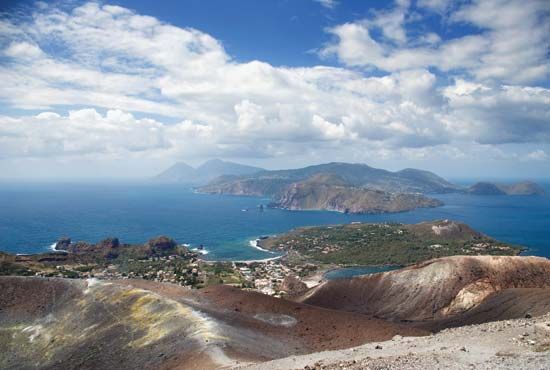
The Eolie Islands (also known as the Lipari Islands) consist of seven major volcanic islands located in the Tyrrhenian Sea off the coast of Sicily.
In addition to Stromboli and Vulcano, the archipelago includes the following major islands:7
- Alicudi
- Filicudi
- Lipari
- Panarea
- Salina
These islands are arranged in a general “Y” shape and represent the summits of a submerged mountain chain.7
Sources
- Stromboli Island — Encyclopædia Britannica
- Stromboli — Merriam-Webster
- geology - Volcanology — Encyclopædia Britannica
- volcano - Gas clouds — Encyclopædia Britannica
- volcano - Volcano forecasting and warning — Encyclopædia Britannica
- volcano - Six types of eruptions — Encyclopædia Britannica
- Eolie Islands — Encyclopædia Britannica
- Vulcano Island — Encyclopædia Britannica
- Aegean Islands — Encyclopædia Britannica
Published on · 2 min read