Sierra Nevada
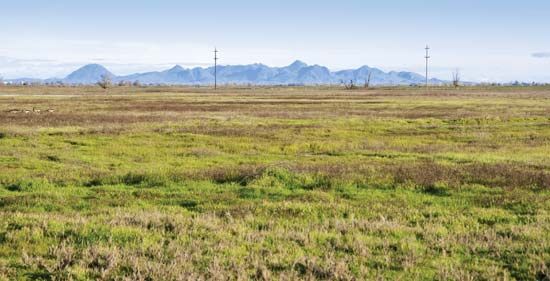
The Sierra Nevada is vital to agriculture in California, primarily by serving as a massive natural water reservoir for the Central Valley. The range’s…
What impact does the Sierra Nevada have on agriculture in the surrounding regions?
The Sierra Nevada is vital to agriculture in California, primarily by serving as a massive natural water reservoir for the Central Valley. The range’s western slopes receive significant precipitation, which is stored as snowpack and released as meltwater during warmer months.12
This water is captured by complex systems of dams and canals, such as the California State Water Project, to irrigate the Central Valley. This irrigation has transformed the region into one of the most productive agricultural areas in the United States, supporting the cultivation of over 300 crops, including fruits, nuts, grains, and vegetables.324
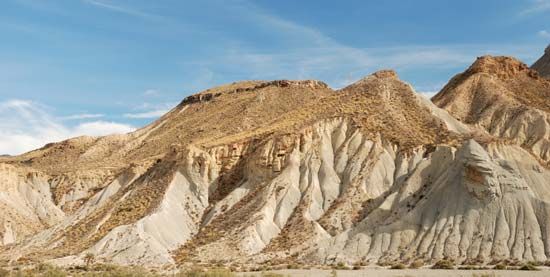
Conversely, the range’s influence is not universally positive for all surrounding areas. The rain-shadow effect on the eastern slopes creates arid conditions, and water diversion projects have historically endangered ecosystems in regions like the Owens Valley. While the mountains provide the essential resources for the state’s agricultural success, the management of this water remains a subject of environmental and developmental debate.134
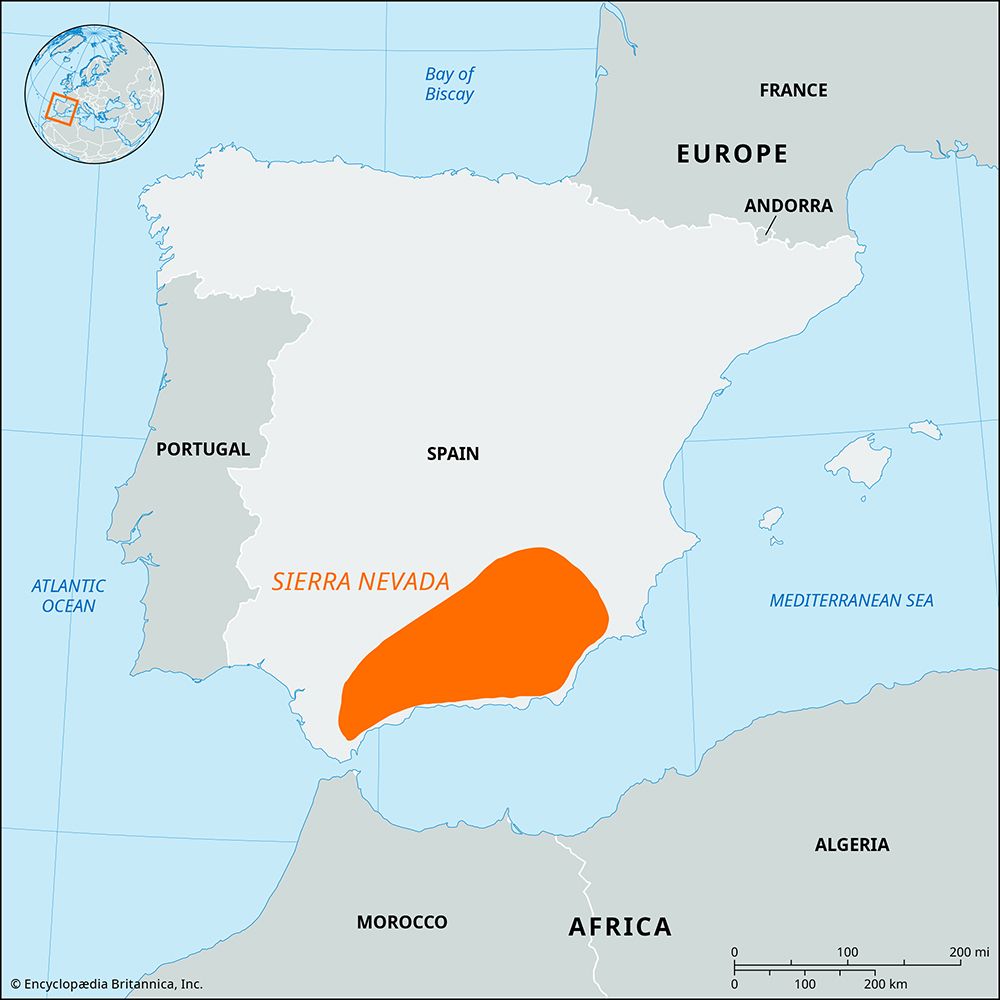
What are the highest peaks in the Sierra Nevada, and how tall are they?
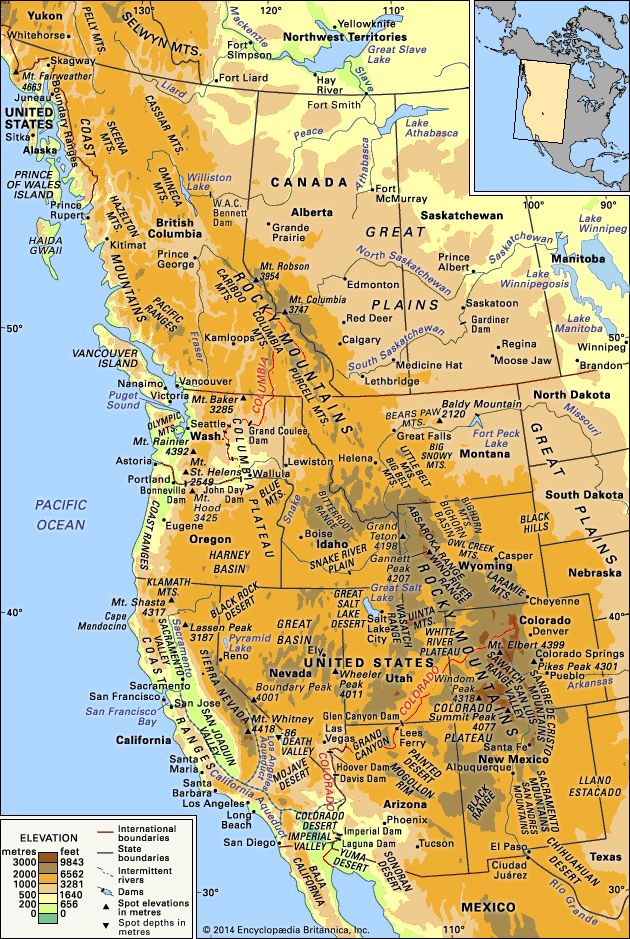
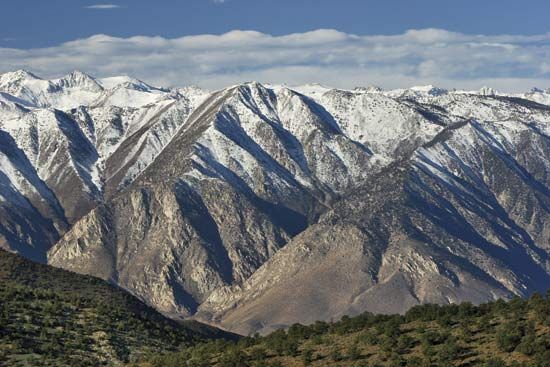
The Sierra Nevada is an asymmetrical mountain range characterized by a high, eastern-facing crest where the tallest peaks are concentrated.67
The highest peak in the Sierra Nevada—and the highest in the 48 conterminous United States—is Mount Whitney, which reaches an elevation of 14,494 feet (4,418 metres).867
Generally, the peaks throughout the high Sierra range from 11,000 to 14,000 feet (3,350 to 4,270 metres) above sea level. However, the elevation of the range is not uniform; the summits in the northern portion of the Sierra Nevada, specifically those north of Lake Tahoe, are significantly lower, typically reaching altitudes between 7,000 and 9,000 feet.6
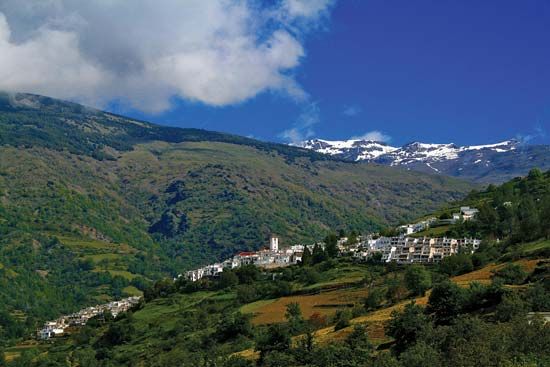
What types of flora and fauna can be found in the Sierra Nevada ecosystem?
The Sierra Nevada ecosystem hosts a diverse array of flora and fauna, distributed across distinct elevation zones and slopes.1112
Flora
The western slopes feature five primary vegetation zones:
- Lower Foothills: Deciduous trees, shrubs, and interior live oak.12
- Upper Foothills: Black oak, Ponderosa pine, and incense cedar.12
- Montane Forest: The primary timber zone, featuring Douglas fir, red fir, Jeffrey pine, and the giant sequoia.121
- Subalpine Forest: Lodgepole pine, mountain hemlock, Sierra juniper, and western white pine.12
- Alpine Zone: Mosses, lichens, and low-flowering plants.12
The arid eastern slopes are characterized by sagebrush, bitterbrush, juniper, piñon pine, and aspen. Additionally, chaparral—a shrubland of manzanita, scrub oak, and ceanothus—grows throughout the range, excluding alpine areas.12
Fauna
The range supports various wildlife, though populations of large mammals have been impacted by human presence:11
- Mammals: Black bears, mule deer, and mountain lions are present, with mountain sheep found in the south. Smaller species include bobcats, coyotes, American badgers, and northern flying squirrels. Pikas and marmots inhabit the highest elevations.114
- Birds: The region is home to diverse birdlife, including the mountain chickadee, spotted owl, California quail, and various woodpeckers and hawks.11
- Aquatic Life: Native and introduced trout species inhabit the streams, while salmon and steelhead migrate through the rivers during spawning seasons.114
How does the Sierra Nevada influence the climate of the surrounding areas?
The Sierra Nevada exerts a profound influence on the climate of the surrounding region, primarily by acting as a massive barrier to atmospheric moisture moving from the Pacific Ocean.
Precipitation and the Rain-Shadow Effect
The range’s northwest-southeast orientation places it directly in the path of winter storm tracks. As moist air masses from the Pacific rise over the windward (western) slopes, they cool and release copious amounts of precipitation, with annual totals reaching 70–80 inches in some northern areas.
Conversely, the leeward (eastern) face experiences a sharp rain-shadow effect. By the time air masses cross the high crest, much of their moisture has been depleted, resulting in a significantly drier, semiarid climate for the areas to the east, such as the state of Nevada. In these regions, annual precipitation is often limited, sometimes falling below 4 inches in the driest basins.
Temperature and Atmospheric Patterns
The range also influences local temperatures and wind patterns. While the Pacific Ocean provides a moderating influence, the mountains themselves create distinct elevation-based temperature gradients. Furthermore, the Pacific High anticyclone dominates the region in summer, drawing dry air across the mountains and occasionally causing multi-year droughts when the high-pressure system prevents winter storm tracks from reaching the area.
Sources
- Sierra Nevada - Climate of the Sierra Nevada — Encyclopædia Britannica
- California - Drainage — Encyclopædia Britannica
- Central Valley — Encyclopædia Britannica
- Sierra Nevada — Encyclopædia Britannica
- Sierra Nevada - The people and economy — Encyclopædia Britannica
- Mount Whitney — Encyclopædia Britannica
- Sierra Nevada - Physiography — Encyclopædia Britannica
- Whitney, Mount — Merriam-Webster
- United States - The Western Cordillera — Encyclopædia Britannica
- Sierra Nevada - Geology — Encyclopædia Britannica
- Sierra Nevada - Animal life — Encyclopædia Britannica
- Sierra Nevada - Plant life — Encyclopædia Britannica
- Sierra Madre - Plant and animal life — Encyclopædia Britannica
- Sierra National Forest — Encyclopædia Britannica
- Nevada - Climate — Encyclopædia Britannica
- Peru - Mountain climates — Encyclopædia Britannica
Published on · 4 min read