Silky Oak
The term "silk oak" is a common variant of silky oak, which refers to the Grevillea robusta, a large tree native to Australia. It is a member of the…
What is silky oak?
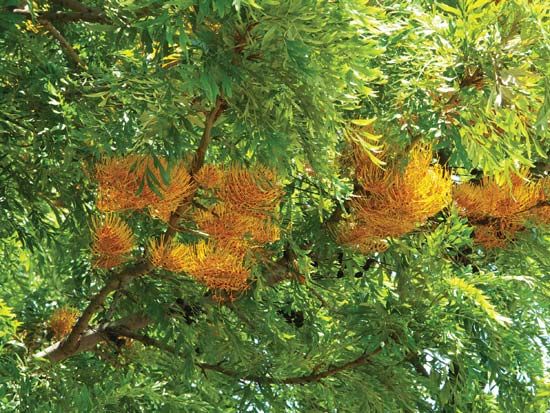
The term “silk oak” is a common variant of silky oak, which refers to the Grevillea robusta, a large tree native to Australia. It is a member of the Proteaceae family, which falls under the order Proteales.12
In its native Australia, the tree is harvested for its timber, which is known for its mottled appearance and is frequently utilized in cabinetmaking and veneering. Outside of its native range, the tree is often cultivated as an ornamental street tree in warmer climates due to its graceful, feathery foliage and clusters of orange flowers that bloom at the ends of leafless branches. Additionally, in its juvenile stage, the silky oak is commonly kept as an indoor pot plant.12
What are the unique characteristics of the Proteaceae plant family?
The Proteaceae family, a prominent group within the order Proteales, consists of woody trees and shrubs primarily distributed across the Southern Hemisphere, with significant diversity in Australia and South Africa.3
Key characteristics of the family include:
- Floral Structure: Flowers are typically small individually but aggregate into dense, often showy inflorescences. They feature a four-parted perianth with four stamens attached to the tips of the segments.3
- Water Conservation: Many species exhibit adaptations to survive in regions with long dry seasons. These include leaves that are often densely hairy or possess a thick cuticle, and stomata sometimes restricted to deep, protected pits to minimize water loss.3
- Fire Adaptations: Members of the family have evolved specific survival strategies for fire-prone environments, such as developing massive underground woody tubers or producing seeds held in woody follicles that only release after a fire event.3
- Foliage: The plants generally feature alternately arranged leaves that can be simple or much-divided.3
How is silky oak timber used in woodworking and furniture design?
Silky oak timber, derived from trees in the genus Grevillea, is highly valued in woodworking and furniture design primarily for its distinct aesthetic qualities. Its most notable characteristic is a striking, mottled grain pattern that provides a unique visual texture to finished pieces.2
Because of this decorative appearance, the wood is most frequently utilized in:
- Cabinetmaking: The timber is a popular choice for high-quality cabinetry where the grain can serve as a focal point.2
- Veneering: Due to the beauty of its figure, silky oak is often sliced into thin veneers to cover other surfaces, allowing the wood’s natural patterns to be showcased efficiently across larger furniture items.2
The wood’s durability and workability have made it a staple in fine woodworking since its commercial use became established in the mid-19th century.2
What are some other native Australian trees known for their timber?
Beyond the silky oak, Australia is home to several other native trees highly regarded for their timber:
- Eucalyptus: This vast genus, commonly known as gum or stringybark trees, is one of the most economically significant groups in Australia. Their timber is extensively used in construction, building, and fencing. Notable timber-yielding species include the karri (E. diversicolor), jarrah (E. marginata), and Tasmanian bluegum (E. globulus).5
- Huon Pine: Found along Tasmanian river systems, this conifer is prized for its fragrant, soft, and durable wood. Its light yellow, wavy-grained timber is historically significant for shipbuilding and is currently favored for fine furniture, cabinetry, and intricate carving.67
These species demonstrate the diversity of Australian timber, ranging from the robust, structural utility of various eucalypts to the specialized, aromatic qualities of the Huon pine.
Sources
- silky oak — Encyclopædia Britannica
- silk oak — Merriam-Webster
- Proteales — Encyclopædia Britannica
- Proteaceae — Merriam-Webster
- eucalyptus — Encyclopædia Britannica
- Huon pine — Merriam-Webster
- Huon pine — Encyclopædia Britannica
Published on · 3 min read