Sitatunga
The sitatunga (Tragelaphus spekei) is uniquely adapted as the most aquatic antelope, possessing specialized physical traits that allow it to thrive in swampy…
What are the unique physical characteristics of the sitatunga?
The sitatunga (Tragelaphus spekei) is uniquely adapted as the most aquatic antelope, possessing specialized physical traits that allow it to thrive in swampy environments.1
Physical Adaptations
- Hooves and Feet: The sitatunga features elongated, splayed hooves and flexible foot joints, which provide stability and traction when traversing boggy, soft ground.1
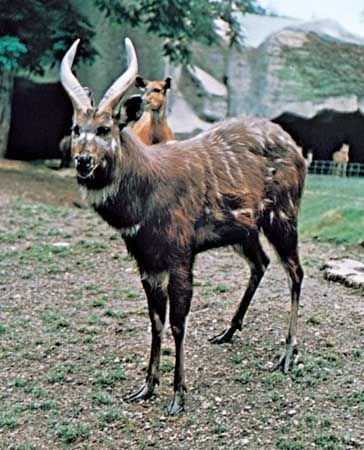
- Pelage: They develop a shaggy, water-repellent pelage. The coat color ranges from brown to chestnut in females and gray-brown to chocolate-brown in males.1
- Markings: Both sexes typically display a woolly, bright rufous coat marked with 8–10 white stripes, spots on the flanks and cheeks, and patches on the neck and legs, along with a white-to-brown spinal crest.1
- Horns: Only males possess horns, which measure 45–90 cm (18–35 inches) in length and feature one to one and a half spiral turns.1
These physical characteristics, combined with a powerful bounding gait, enable the sitatunga to navigate deep swamps and evade predators in water, though they are notably clumsy when running on dry land.1
What role does the sitatunga play in its ecosystem?
The sitatunga (Tragelaphus spekei) serves as a significant herbivore within its swamp and wetland ecosystems across sub-Saharan Africa. By inhabiting these highly productive environments, they act as primary consumers that utilize a diverse range of vegetation, including aquatic plants, grasses in nearby pastures, and foliage from adjacent woodlands.1
Their presence and movement patterns influence the structure of their habitat. Sitatungas create platforms of trampled vegetation, which they use as resting areas, and maintain regular passageways between their feeding and resting sites. As a member of the Bovidae family, they also function as a prey species for large African predators, including lions, spotted hyenas, and wild dogs, thereby supporting the local food web.1
While the provided information highlights their dietary habits and role as prey, specific details regarding their broader ecological impact, such as seed dispersal or nutrient cycling, are not explicitly detailed in the current records.
How do sitatungas navigate through their swampy habitat?
The sitatunga (Tragelaphus spekei) is uniquely adapted to navigate its swampy habitat through specialized physical traits and behavioral strategies.
Physical Adaptations
The sitatunga possesses elongated, splayed hooves and flexible foot joints, which provide the necessary stability and traction to traverse boggy, soft ground that would be impassable for many other animals. Additionally, they utilize a powerful bounding gait that allows them to move effectively through both water and soft mud to evade predators.1
Behavioral Strategies
To navigate and survive in the deepest, densest parts of the swamp, the sitatunga employs several stealthy behaviors:
- Slow Movement: They move slowly and deliberately to remain inconspicuous.1
- Submergence: When threatened, they can stand in water up to their shoulders or submerge themselves entirely, leaving only their noses above the surface to avoid detection.1
- Pathways: They maintain regularly used passageways between their feeding and resting areas, which helps them navigate efficiently through the dense vegetation.1
- Resting Platforms: They create platforms of trampled vegetation to rest above the water during the day.1
What is the diet of a sitatunga, and how does it obtain its food?
The sitatunga (Tragelaphus spekei) is a versatile herbivore that thrives by exploiting the high productivity of its wetland environment. Its diet is varied, consisting of:
- Swamp Vegetation: They feed directly on aquatic plants found within the deep, dense parts of their swamp habitats.1
- Pasture and Foliage: To supplement their diet, they often emerge from the water at night to graze on green pastures and enter nearby woodlands to browse on various foliage and herbage.1
To obtain this food, the sitatunga relies on its specialized anatomy and behavioral patterns. They utilize their elongated, splayed hooves and flexible foot joints to traverse boggy, soft ground that would be difficult for other animals to navigate. They maintain regularly used passageways between their resting platforms—which they construct from trampled vegetation—and their feeding areas. While these paths allow them to move efficiently through dense cover, they also make the animals vulnerable to poachers’ snares and nets.1
Sources
- sitatunga — Encyclopædia Britannica
- sitatunga — Merriam-Webster
Published on · 3 min read