Skunk
Skunks utilize their potent spray as a highly effective defense mechanism to deter predators. This liquid, produced in specialized anal glands, contains…
How do skunks use their infamous spray as a defense mechanism?
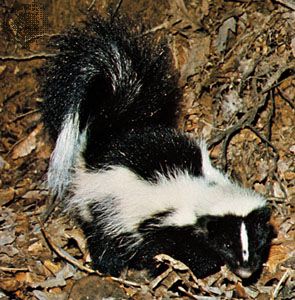
Skunks utilize their potent spray as a highly effective defense mechanism to deter predators. This liquid, produced in specialized anal glands, contains sulfur compounds known as thiols and thioacetates, which create a notoriously strong and persistent odor.12
Before resorting to spraying, skunks typically perform warning behaviours to encourage threats to retreat, which helps conserve their limited supply of the liquid. These displays vary by species and include stamping front paws, hissing, or performing handstands.12
When a skunk does spray, it uses precise muscle control to aim the liquid. If the predator is visible, the skunk can direct a stream at the animal’s face; if the predator is chasing from behind, the skunk may release an atomized cloud to create a barrier. Because it can take 10 days or more to replenish their scent glands, skunks rely on these warnings to avoid unnecessary depletion of their primary defense.12
What is the typical habitat and range of different skunk species?
Skunks are a diverse family of mammals found in a wide variety of habitats, including deserts, forests, and mountains. While 10 of the 12 known species reside in the Western Hemisphere, the family’s range is global in distribution.3
Habitat and Range by Genus
- Striped Skunks (Mephitis): Found from central Canada through the United States to northern Mexico. They are primarily terrestrial and less agile than other species.34
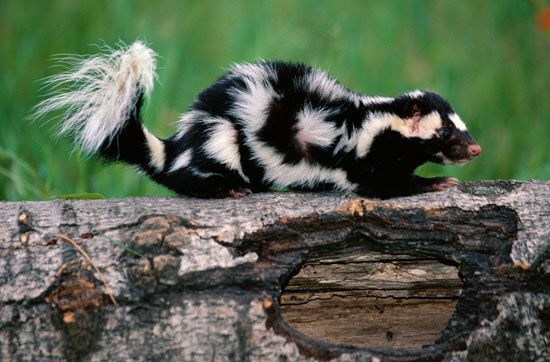
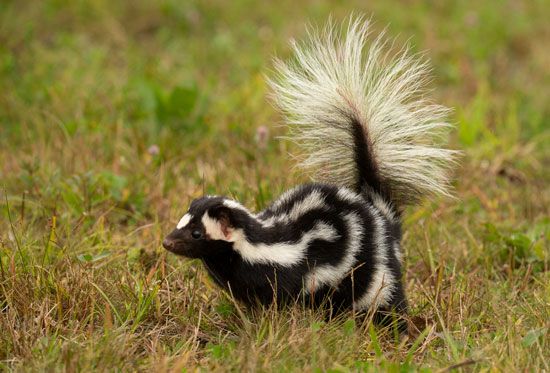
- Spotted Skunks (Spilogale): Distributed from southwestern Canada to Costa Rica. These are the most agile skunks, capable of climbing trees with squirrel-like dexterity.34
- Hog-nosed Skunks (Conepatus): Ranging from North America down to South America, these skunks are powerful diggers with elongated snouts adapted for rooting in soil.34
- Stink Badgers (Mydaus): Unlike their Western Hemisphere relatives, these are found exclusively in the Philippines, Malaysia, and Indonesia.3
While most species are considered of least concern, the pygmy spotted skunk and eastern spotted skunk are classified as vulnerable due to habitat loss and other environmental pressures.4
How many different species of skunks exist, and how do they differ from each other?
The skunk family, Mephitidae, consists of 12 recognized species categorized into four distinct genera. While they share the characteristic ability to release a noxious odor from specialized anal glands, they exhibit significant diversity in their physical traits, behaviors, and geographic distribution.354
Genera and Species Diversity
- Genus Mephitis (2 species): This group includes the well-known striped skunk and the hooded skunk. Striped skunks are primarily terrestrial and widespread across North America, while hooded skunks are distinguished by long hairs at the back of the neck that form a “hood” and a gray appearance due to interspersed black and white fur.35
- Genus Spilogale (4 species): Known as spotted skunks, these are the most agile members of the family and are capable of climbing trees. Their markings consist of interrupted stripes that appear as spots. They are the smallest skunks, with the pygmy spotted skunk being the smallest of all.354
- Genus Conepatus (4 species): These are hog-nosed skunks, characterized by powerful bodies and elongated snouts adapted for rooting in the soil for insects and grubs. They range from North to South America.354
- Genus Mydaus (2 species): Known as stink badgers, these were formerly classified with badgers but are now recognized as skunks. They are found exclusively in Southeast Asia and resemble small hog-nosed skunks with shorter tails.356
What is a skunk?
A skunk is a black-and-white mammal belonging to the family Mephitidae, a name derived from the Latin word for “bad odour.” Primarily nocturnal and found mostly in the Western Hemisphere, these carnivores are best known for their highly developed anal glands, which they use to spray a noxious, sulfur-based odour as a defense mechanism.315
The family consists of 12 species divided into four genera:31
- Mephitis: Includes the common striped skunk and the hooded skunk, both found in North America.31
- Spilogale: Known as spotted skunks, these are the smallest and most agile members of the family, capable of climbing trees.34
- Conepatus: Hog-nosed skunks, which possess elongated snouts for rooting in the soil.34
- Mydaus: Stink badgers, which are found in Southeast Asia and were historically classified as badgers before genetic evidence confirmed their place within the skunk family.31
Skunks inhabit diverse environments, including deserts, forests, and mountains. While most are considered of least concern, some species face threats from habitat loss and disease.34
Sources
- skunk - Scent — Encyclopædia Britannica
- Why do skunks spray? — Encyclopædia Britannica
- skunk — Encyclopædia Britannica
- skunk - Natural history — Encyclopædia Britannica
- skunk - Paleontology and classification — Encyclopædia Britannica
- badger — Encyclopædia Britannica
Published on · 4 min read