Slick
Several major historical oil spill incidents have caused significant environmental damage through the release of massive slicks. These events often resulted…
What are some notable historical oil spill incidents that led to significant slick pollution?
Several major historical oil spill incidents have caused significant environmental damage through the release of massive slicks. These events often resulted from tanker accidents or offshore drilling failures, leading to long-term ecological and economic consequences.
Notable Historical Incidents
- Ixtoc 1 (1979): An offshore drilling blowout in the Bay of Campeche, Mexico, released between 126 million and 140 million gallons of crude oil into the Gulf of Mexico. The oil reached as far as the Texas coast, severely impacting tourism and commercial fishing.12
- Amoco Cadiz (1978): This tanker disaster off the coast of Brittany, France, spilled 223,000 metric tons of crude oil and ship fuel. It contaminated over 300 km of coastline and resulted in the death of tens of thousands of marine animals and birds.3
- Torrey Canyon (1967): Running aground off Cornwall, England, this vessel spilled 119,000 metric tons of oil. The incident is notable for the use of harmful solvents that caused more environmental damage than the oil itself.3
- Exxon Valdez (1989): Striking Bligh Reef in Prince William Sound, Alaska, this tanker released nearly 11 million gallons of crude oil. The spill affected 1,300 miles of coastline and caused widespread wildlife mortality, including hundreds of thousands of seabirds.45
These disasters have fundamentally shaped modern maritime regulations and emergency response strategies, such as the use of floating booms and skimming techniques to manage oil slicks.36
How does slick pollution impact marine ecosystems and wildlife?
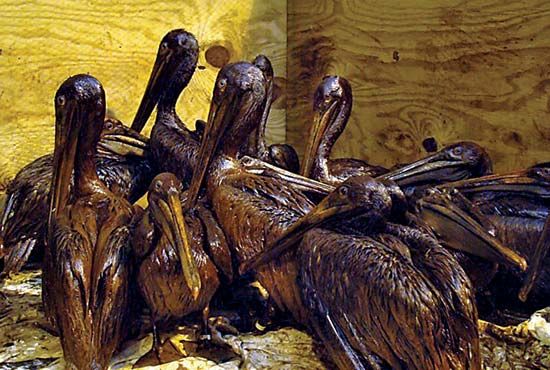
Slick pollution from oil spills inflicts severe, multifaceted damage on marine ecosystems and wildlife. By coating the ocean surface, oil prevents sunlight from penetrating the water and reduces levels of dissolved oxygen, creating hazardous conditions for aquatic life.10
Impact on Wildlife
- Physical Impairment: Oil ruins the insulating and waterproofing properties of feathers and fur, leading to fatal hypothermia in birds and marine mammals. Animals often ingest toxic oil while attempting to clean themselves, which can cause internal organ damage and reproductive failure.1011
- Toxic Exposure: Exposure to polycyclic aromatic hydrocarbons can cause heart defects in fish larvae and lung or adrenal disorders in cetaceans. Contaminants can even be passed to offspring, as seen in migratory birds producing eggs containing traceable oil compounds.11
- Habitat Destruction: Shoreline ecosystems like saltwater marshes and mangroves are highly vulnerable. On the seafloor, oil by-products can create “dead zones” where sedentary organisms suffocate, while coral reproduction is significantly hindered by the presence of oil and chemical dispersants.1011
These impacts disrupt the entire food web, as the loss of microorganisms and smaller species ripples through the ecosystem, often leading to long-term population declines.11
What exactly is slick pollution, and how does it form on water surfaces?
A slick is a glassy patch or streak that appears on the surface of a lake or ocean when the water is relatively undisturbed. It forms when surface tension is reduced by a monomolecular layer of organic matter. This layer can be produced naturally by plankton or result from human activity, such as the release of hydrocarbon pollutants, which are the primary source of slicks near shorelines.13
The physical appearance of a slick is influenced by wind conditions:
- Patchy Slicks: When wind speeds are below approximately 13 kilometers per hour (7 knots), slicks remain in patchy formations.13
- Windrows: At higher wind velocities, the slick is broken into narrow, closely spaced rows that align parallel to the direction of the wind.13
- Internal Waves: Slicks can also form in elongated, parallel shapes that migrate along with the trailing slopes of internal waves.13
An oil slick specifically refers to a film of oil floating on the water’s surface.14
What are the main sources of oil spills that lead to slick pollution?
Oil pollution leading to slick formation originates from a variety of human activities and natural processes. While major, high-profile incidents involving supertankers or oil rigs often garner the most attention, they represent only a portion of the total volume of oil released into the environment annually.715
The primary sources of oil spills include:
- Extraction and Transport: Petroleum exploration and production on continental shelves and the operation of tankers and pipelines are significant contributors. Spills can occur due to equipment failure, human error, or accidents during the extraction and movement of oil to refineries.75
- Surface Runoff: A major, often overlooked source is the oil washed from roads and parking lots into water bodies via surface runoff.15
- Industrial and Individual Negligence: The unintentional or negligent disposal of used gasoline solvents and crankcase lubricants by industries and individuals contributes significantly to the total amount of oil entering waterways.7
- Natural Seepage: Beyond human activity, natural seepage from the ocean floor releases substantial quantities of oil into the marine environment every year.7
Collectively, these sources introduce millions of metric tons of oil into the world’s oceans annually.7
Sources
- Alternative energy - March 24, 1989 - Exxon Valdez disaster in Alaska becomes the largest oil spill in U.S. waters — Encyclopædia Britannica
- Exxon Valdez oil spill — Encyclopædia Britannica
- oil spill - Largest oil-tanker spills in history — Encyclopædia Britannica
- Deepwater Horizon oil spill - The explosion — Encyclopædia Britannica
- 9 of the Biggest Oil Spills in History — Encyclopædia Britannica
- 9 of the Biggest Oil Spills in History - The Ixtoc 1 Oil Spill (1979) — Encyclopædia Britannica
- oil spill — Encyclopædia Britannica
- oil spill - Oil-spill cleanup — Encyclopædia Britannica
- Bay of Campeche — Encyclopædia Britannica
- oil spill - Oil-spill damage — Encyclopædia Britannica
- Deepwater Horizon oil spill - Environmental costs — Encyclopædia Britannica
- water pollution: Top Questions — Encyclopædia Britannica
- slick — Encyclopædia Britannica
- oil slick — Merriam-Webster
- water pollution - Petroleum (oil) pollution — Encyclopædia Britannica
- water pollution - Effects of water pollution on groundwater and oceans — Encyclopædia Britannica
Published on · 4 min read