Smaller Water Strider
The provided search results do not contain specific information regarding the diet or hunting methods of the family Veliidae, commonly known as smaller water…
What is the diet of smaller water striders, and how do they catch their prey?
The provided search results do not contain specific information regarding the diet or hunting methods of the family Veliidae, commonly known as smaller water striders. While the water strider (family Gerridae) is known to capture insects that fall onto the water’s surface and occasionally prey on one another, this behavior is not explicitly attributed to the smaller water strider in the available data.
Because the Britannica knowledge base does not currently provide details on the feeding habits of the Veliidae family, I cannot answer your question regarding their specific diet or prey-capture techniques.
How have smaller water striders adapted to survive in various water environments?
Smaller water striders, belonging to the family Veliidae, have evolved several specialized adaptations to thrive in diverse aquatic environments, ranging from bogs and shorelines to rapid streams.
- Locomotion: These insects are well-adapted for surface movement. While many species are found in swarms along shores, they are capable of running across the water’s surface when disturbed. The genus Rhagovelia is particularly notable for its ability to navigate rapid currents; it utilizes a fan-shaped arrangement of bristles on its second pair of legs to move effectively against the flow.1
- Diving Capabilities: Unlike some other surface-dwelling insects, certain smaller water striders, such as those in the genus Rhagovelia, possess the physical capability to dive and swim underwater.1
- Morphological Diversity: Within the same species, these insects often exhibit different wing forms—long-winged, short-winged, or entirely wingless—allowing them to adapt to the specific dispersal needs of their environment. Their stout bodies and evenly spaced legs provide stability, though the spacing of the middle and hind legs varies by genus to suit their specific movement patterns.1
What species of smaller water striders exist, and how are they classified?
Smaller water striders are classified within the insect family Veliidae, which belongs to the order Heteroptera (true bugs). There are approximately 300 species of these insects found throughout the world.156
Classification and Characteristics
Veliidae are closely related to the family Gerridae (common water striders). They are distinguished from other aquatic bugs by specific details regarding the form and placement of their legs, as well as the presence of a 3-jointed proboscis. While they share similar habits and structures with Gerridae, smaller water striders are generally stouter and smaller, typically measuring less than 5 millimeters (0.2 inches) in length.761
Notable Genera
The family includes several distinct genera, each with unique adaptations:
- Rhagovelia: Known for its ability to navigate rapid currents using a fan-shaped arrangement of bristles on its second pair of legs. Unlike many other surface-dwelling insects, members of this genus can also dive and swim underwater.1
- Velia: Typically found inhabiting areas around bogs and moderately rapid streams.1
- Microvelia: Generally smaller than Rhagovelia and often observed in swarms along shorelines.1
- Trochopus: A genus within the family that is marine-dwelling, though it does not inhabit the open sea.6
What are the unique physical characteristics of smaller water striders that allow them to walk on water?
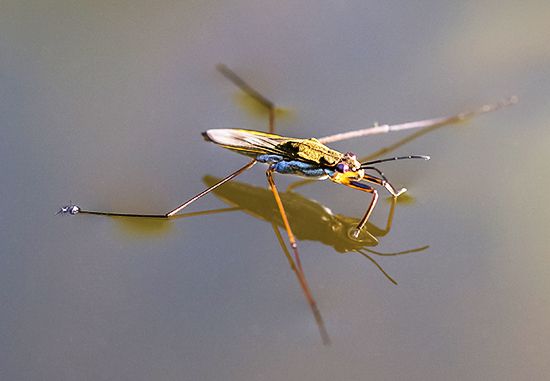
Smaller water striders (family Veliidae) are able to walk on water because they are supported by the surface film of the water. Their physical characteristics are specifically adapted to this environment in several ways:
- Body Structure: These insects have small, slender, and lightweight bodies, which minimizes the amount of weight the surface film must support.1
- Leg Distribution: They possess long, thin middle and hind legs that spread their weight across multiple points of contact. When these legs touch the water, they create only a slight indentation in the surface film rather than breaking through it.1
- Hydrofuge Pile: To prevent wetting and sinking, their bodies are covered in a fine, dense layer of water-repellent (hydrofuge) hairs. This layer traps a thin film of air, which keeps the insect buoyant and dry even if it becomes submerged.1
- Specialized Appendages: While their front legs are primarily used for capturing and holding prey, their other legs are adapted for movement. For instance, the genus Rhagovelia features a fan-shaped arrangement of bristles on its second pair of legs, which provides the necessary traction to run against rapid currents.91
Sources
- smaller water strider — Encyclopædia Britannica
- water strider — Encyclopædia Britannica
- Respiratory system - Trachea — Encyclopædia Britannica
- insect - Aquatic insects — Encyclopædia Britannica
- Veliidae — Merriam-Webster
- list of true bugs — Encyclopædia Britannica
- heteropteran - Annotated classification — Encyclopædia Britannica
- List of insects - hemipterans (order Hemiptera) — Encyclopædia Britannica
- heteropteran - Habitats — Encyclopædia Britannica
- Locomotion - Tetrapodal vertebrates — Encyclopædia Britannica
Published on · 3 min read