Weevil
Weevils (family Curculionidae) are highly specialized insects that utilize their distinctive snouts for both feeding and reproduction. The snout is a…
How do weevils reproduce and what is their life cycle like?
Weevils (family Curculionidae) are highly specialized insects that utilize their distinctive snouts for both feeding and reproduction. The snout is a critical tool for the female, who uses it to bore holes into plant tissues—such as flower heads, seeds, fruits, stems, or roots—to deposit her eggs.12
The life cycle of a weevil follows a pattern of complete metamorphosis, consisting of the egg, larval, pupal, and adult stages.34
- Larvae: Upon hatching, the fleshy, legless larvae typically remain within the plant part where the egg was laid, feeding exclusively on that tissue. They are generally white, soft-bodied, and thicker in the abdominal region.134
- Development: The larvae and pupae often complete their entire development inside the plant, which can make them difficult to control with external insecticides.3
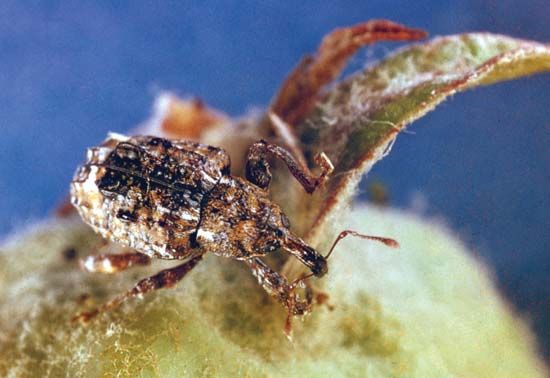
- Generations: Depending on the species and environmental conditions, the development from egg to adult can be quite rapid; for example, the boll weevil can complete this cycle in two to three weeks, allowing for up to 10 generations per year.3
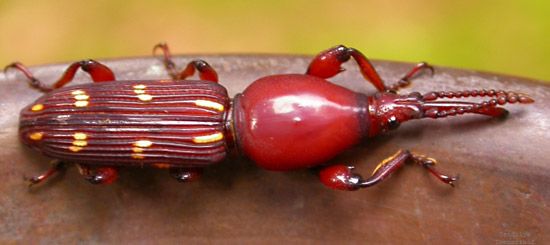
What adaptations have weevils developed for their specific feeding habits?
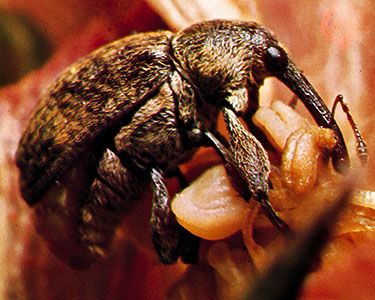
Weevils have evolved highly specialized adaptations to thrive on diverse plant diets, primarily centered around the development of the snout, or rostrum. This structure allows them to access plant tissues that are otherwise protected, serving as a tool for both feeding and reproduction.1
Key adaptations include:
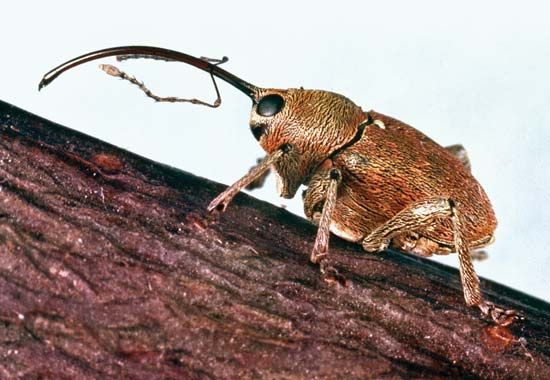
- The Snout (Rostrum): This elongated head structure features mandibles at its tip, enabling weevils to bore into tough materials like seeds, nuts, and stems. In some species, such as the acorn and nut weevil, the snout is exceptionally long and slender—sometimes twice the length of the body—to reach deep into plant structures.15
- Specialized Antennae: Most true weevils possess distinctly elbowed antennae that can fold into specialized grooves on the snout, protecting them while the insect bores into plant material.1
- Host Specificity: Larvae are often highly specialized, feeding exclusively on specific plant parts—such as flower heads, roots, or fruits—and frequently limiting their diet to a single plant species or closely related ones.1
- Environmental Interaction: Some species, like the plum curculio, exhibit complex behaviors such as making precise, crescent-shaped cuts in fruit to facilitate their life cycle.6
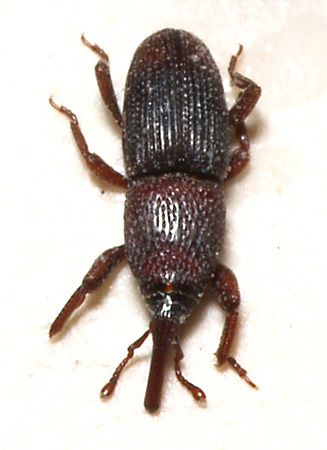
What are the defining characteristics of weevils that distinguish them from other insects?
Weevils are members of the order Coleoptera and are primarily distinguished by their specialized head structure and unique antennae. While they are often grouped together, “true weevils” (family Curculionidae) possess specific traits that set them apart from other beetles and related families:
- The Snout (Rostrum): The most defining characteristic is the extension of the head into a snout-like projection. This structure houses the mouthparts at its tip and is used for both feeding and boring holes into plant tissues for egg-laying.18
- Elbowed Antennae: True weevils are characterized by distinctly elbowed antennae that are often capable of folding into specialized grooves on the snout for protection. This distinguishes them from fungus weevils, whose antennae are not elbowed.14
- Larval Specialization: The larvae of most true weevils are fleshy, legless, and highly specialized, typically feeding exclusively on specific plant parts—such as seeds, roots, or stems—of a single plant species or closely related ones.1
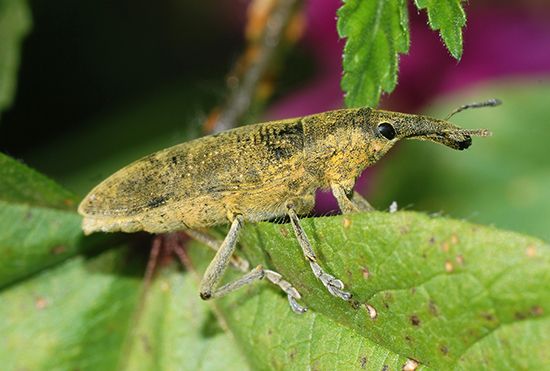
- Body Diversity: While they range from slender to stout and egg-shaped, their mouth placement on the end of the snout remains a consistent identifier, unlike bark beetles, which lack a distinct snout.8
How many species of weevils exist, and where are they commonly found?
The family Curculionidae, commonly known as true weevils, is one of the largest families within the order Coleoptera, comprising approximately 40,000 known species.1
Regarding their distribution, weevils are found in nearly all climates and latitudes, ranging from the Arctic to subantarctic islands. While they are present in diverse environments, the number of distinct species is greatest in the tropics.9
Weevils occupy a wide variety of habitats, often living in association with the specific plants they feed upon. They may be found in:
- Plant tissues: Larvae frequently live inside seeds, fruits, stems, roots, or flower heads.1
- Woody environments: Many species bore into the wood of living or dead trees and stumps.10
- Stored products: Certain species are commonly found in grain, meal, and other stored plant products.10
- Soil and debris: Some species develop in soil or rotting vegetation.10
While many adult weevils are capable of flight, non-flying forms are notably more abundant on small oceanic islands. Unlike some other beetle groups that form large aggregations, weevils are more apt to be found alone.1109
Sources
- weevil — Encyclopædia Britannica
- Boll weevil — Encyclopædia Britannica
- Coleoptera - Larvae — Encyclopædia Britannica
- primitive weevil — Encyclopædia Britannica
- fungus weevil — Encyclopædia Britannica
- Curculio — Encyclopædia Britannica
- acorn and nut weevil — Encyclopædia Britannica
- Coleoptera - Size range and diversity of structure — Encyclopædia Britannica
- Coleoptera - Feeding habits and habitats — Encyclopædia Britannica
- Coleoptera - Distribution and abundance — Encyclopædia Britannica
Published on · 4 min read