Water Strider
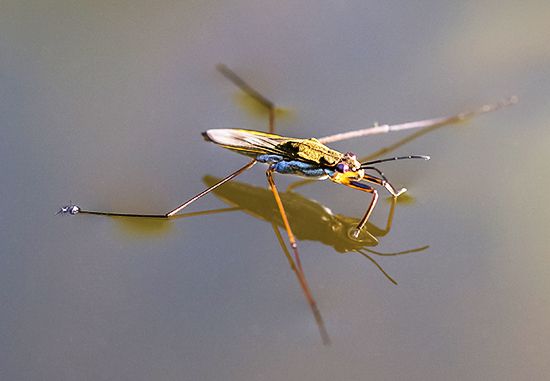
Water striders communicate primarily through the use of vibrational signaling transmitted across the surface of the water.
How do water striders communicate with each other?
Water striders communicate primarily through the use of vibrational signaling transmitted across the surface of the water.12
These insects utilize the water’s surface as a medium to send and receive mechanical vibrations. In the context of mating, male water striders of the genus Gerris have evolved a strategy of producing specific vibrational signals to attract females. This behavior is also used to influence mate selection; because these vibrations can attract predators, the signals are believed to intimidate females into consenting to copulation more quickly to avoid the increased risk of predation.21
Beyond mating, water striders are highly sensitive to surface waves and ripples, which they use for broader environmental awareness, such as locating prey or detecting movement on the water’s surface. These signals are detected through specialized sensory structures, including tactile hair receptors.3
What is the typical habitat and distribution of water striders?
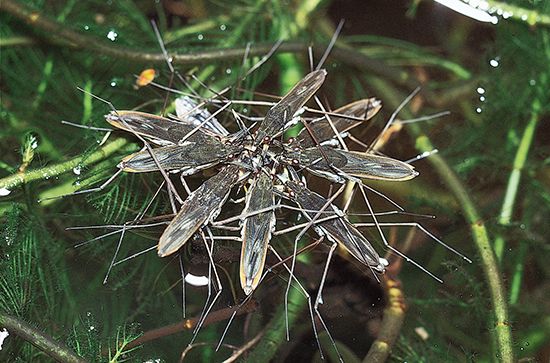
Water striders, belonging to the family Gerridae, are widely distributed across all zoogeographical regions and intervening oceans between 40° north and 40° south latitudes.1
Habitat
Water striders are primarily semiaquatic insects that live on the surface film of water. Their habitat preferences include:41
- Water Types: They are found on both quiet and flowing fresh water, ranging from ponds and streams to rapids where they use their strength to navigate currents.541
- Marine Environments: While most species are restricted to fresh water, the genus Halobates is unique as the only true saltwater-inhabiting insect. These oceanic water striders are found on open ocean surfaces, sometimes hundreds of miles from land.51
- Overwintering: During the winter, adults typically leave the water to survive beneath objects on land, either near or at a distance from their aquatic habitats.4
Distribution and Characteristics
There are approximately 350 species of water striders. They are characterized by their slender bodies and long legs, which allow them to remain supported by the water’s surface film using fine, water-repellent (hydrofuge) hairs. While they are surface dwellers, they are highly adaptable and can be found in diverse aquatic environments globally.514
What are some common predators of water striders?
Water striders face predation from a variety of sources, including other members of their own family. Common predators and predatory behaviors include:
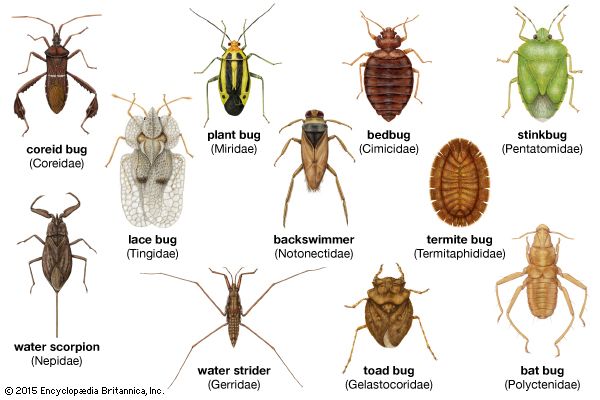
- Cannibalism: In crowded conditions, water striders have been observed preying upon one another.1
- General Predators: Because water striders use vibrational signaling to attract mates, they inadvertently draw the attention of various predators that detect these surface disturbances.1
- Vulnerability during Mating: During copulation, the female is particularly susceptible to predation while the male is mounted on her back. This increased risk is a significant factor in their reproductive behavior, as females often consent to mating more quickly to minimize the time spent in this vulnerable state.1
While the provided information highlights these specific predatory interactions, water striders generally occupy a niche where they must balance the need for communication and reproduction with the constant threat of being detected by those hunting on or near the water’s surface.1
What are the unique physical adaptations that allow water striders to walk on water?
Water striders (family Gerridae) possess specialized physical adaptations that allow them to exploit surface tension, a property of water that acts like a stretched elastic membrane.17
Their ability to “walk” on water is facilitated by several key features:
- Leg Structure: Water striders have long, slender middle and hind legs that distribute their body weight over a larger surface area, preventing them from breaking through the water’s surface film. The middle pair of legs is primarily used for propulsion, while the hind pair functions as a rudder for steering.41
- Hydrofuge Hairs: The feet (tarsi) and the rest of the insect’s body are covered in a dense, fine layer of water-repellent (hydrofuge) hairs. These hairs trap a thin layer of air, which prevents the insect from becoming wet or sinking when in contact with water.41
- Body Mass: Their small, slender bodies have very little bulk, which minimizes the pressure exerted on the surface film, allowing them to remain supported solely by the water’s surface tension.1
Sources
- water strider — Encyclopædia Britannica
- Animal communication - Signal production — Encyclopædia Britannica
- Mechanoreception - Surface waves — Encyclopædia Britannica
- heteropteran - Habitats — Encyclopædia Britannica
- heteropteran - Annotated classification — Encyclopædia Britannica
- smaller water strider — Encyclopædia Britannica
- insect - Aquatic insects — Encyclopædia Britannica
- Locomotion - Tetrapodal vertebrates — Encyclopædia Britannica
- surface tension — Encyclopædia Britannica
Published on · 3 min read