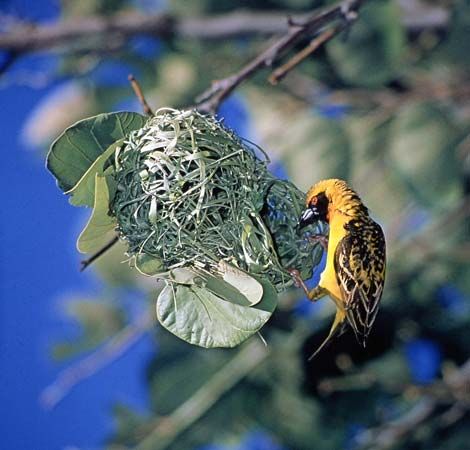
Social Weaver
The social weaver (specifically Philetairus socius) is a highly gregarious bird belonging to the family Ploceidae. These small, black-chinned birds are…
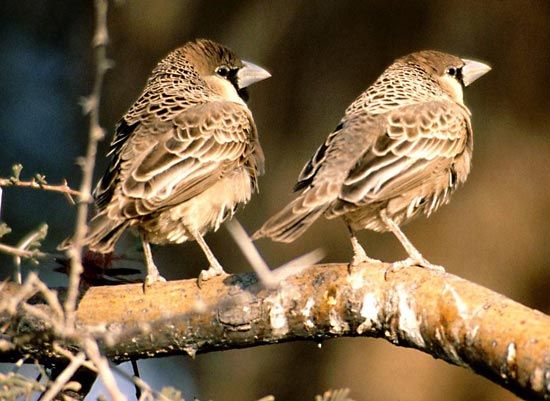
What is Social weaver?
The social weaver (specifically Philetairus socius) is a highly gregarious bird belonging to the family Ploceidae. These small, black-chinned birds are native to southern Africa and are best known for their remarkable cooperative nesting behavior.12
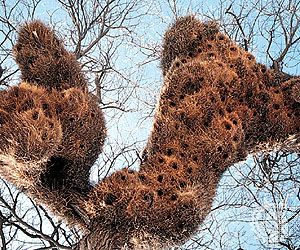
Rather than building individual nests, dozens of pairs work together year-round to construct and maintain a massive, communal “apartment house” made of grass and thatch in a tree. This umbrella-shaped structure can reach up to 7.5 meters (25 feet) in width and 1.5 meters in height, housing as many as 300 individual nesting chambers. Each cluster of chambers features a common tunnel entrance located at the bottom, providing a protected environment for the colony.12
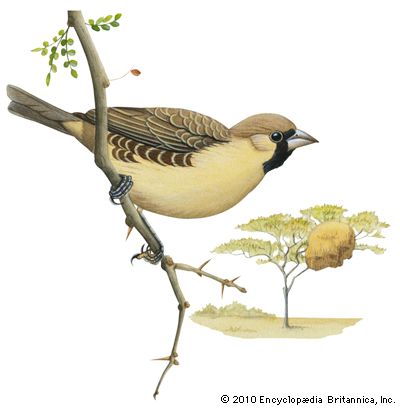
How do these birds build such large communal nests?
Social weavers (Philetairus socius) build their massive communal nests through the persistent, year-round cooperation of dozens of pairs of birds. These birds work together to construct and maintain a large, thatchlike roof over the entire colony, typically situated in a sturdy tree such as an acacia.13
The construction process involves the following key elements:
- Cooperative Effort: Unlike many other bird species that build individual nests, social weavers function as a colony to maintain a shared “apartment house” structure.1
- Materials: They utilize grass stems and other plant fibers to weave and thatch the structure, demonstrating the sophisticated nest-building techniques characteristic of the Ploceidae family.435
- Structural Design: The resulting nest is an umbrella-shaped mass that can reach up to 7.5 meters (25 feet) in width. Within this structure, the birds create hundreds of individual nesting chambers—sometimes more than 100 to 300—each with its own common tunnel entrance located at the bottom of the nest.13
What are the benefits of living in a large colony?
Living in a large colony offers several evolutionary and survival advantages, particularly when resources or suitable habitats are limited. The benefits of colonial living include:
- Enhanced Protection: Colonial nesting allows species, such as gulls, to coordinate their efforts in defending nests against predators. By living in close proximity, individuals can collectively monitor for threats and defend their territory more effectively than they could alone.67
- Reproductive Stimulation: For many bird species, the presence of a large number of conspecifics (members of the same species) is necessary to stimulate reproductive activities.6
- Habitat Optimization: In environments where high-quality breeding sites are scarce, colonial living allows many individuals to occupy a limited area. This is common among species that defend only their immediate nest site rather than a large territory.687
- Cooperative Care: In some social species, living in a group facilitates cooperative breeding, where individuals other than the parents help raise the young. This can increase the survival and growth rates of offspring through behaviors like “babysitting” and shared feeding.89
- Inclusive Fitness: For species with complex social structures, such as eusocial insects, living in a colony allows individuals to maximize their inclusive fitness—passing on their genes by helping close relatives reproduce—especially when opportunities for personal reproduction are constrained by factors like predation or a short breeding season.89
What other types of birds belong to the weaver family?
The weaver family, Ploceidae, includes a diverse range of species known for their intricate nest-building skills. Beyond the well-known social weavers, other notable members include:
- Genus Ploceus: This group contains 57 species, such as the village weaver and the baya weaver. These birds are typically small insectivores that build flask-shaped nests with bottom entrances.4
- Bishop Birds (Euplectes): These weavers are known for constructing nests with side entrances, typically located in wet, grassy environments.4
- Buffalo Weavers: These birds belong to their own subfamily, Bubalornithinae, and are distinct from other ploceids.4
- Red-billed Weavers (Quelea quelea): Also known as queleas, these birds are highly gregarious and can form massive colonies that span several square miles.4
- Cassin’s Weaver (Malimbus cassini): Found in central African rain forests, this species builds unique hanging nests using long palm-leaf strips.4
- Whydahs (Vidua): These are social parasites that lay their eggs in the nests of other weaver species, which then raise the whydah chicks.4
It is important to note that while some birds are called “weaver-finches,” they belong to a different family, Estrildidae, and include species such as waxbills and mannikins.411
Sources
- Social weaver — Encyclopædia Britannica
- sociable weaverbird — Merriam-Webster
- Passeriform - Nesting — Encyclopædia Britannica
- Weaver — Encyclopædia Britannica
- Nest — Encyclopædia Britannica
- colony — Encyclopædia Britannica
- Animal social behavior - Social interactions involving cooperative breeding and eusociality — Encyclopædia Britannica
- Reproductive behaviour - Group care — Encyclopædia Britannica
- Reproductive behaviour - Birds — Encyclopædia Britannica
- Passeriform - Territoriality and courtship — Encyclopædia Britannica
- Weaver-finch — Encyclopædia Britannica
Published on · 3 min read