Spectacled Owl
The spectacled owl (Pulsatrix perspicillata) serves as a significant predator within the tropical American forests it inhabits. By hunting small rodents…
What role do spectacled owls play in their ecosystem?
The spectacled owl (Pulsatrix perspicillata) serves as a significant predator within the tropical American forests it inhabits. By hunting small rodents, sleeping birds, and reptiles, these owls help regulate the populations of these prey species within their expansive home ranges, which can span 50 to 200 hectares or more.1
As a nocturnal bird of prey, the spectacled owl typically hunts from perches in the forest understory, demonstrating a specialized role in the ecosystem’s structure. Their presence is indicative of mature tropical forest environments, where they rely on large tree cavities—often created by natural disturbances like windstorms—for nesting.1
What are the hunting and feeding habits of spectacled owls?
The spectacled owl (Pulsatrix perspicillata) is a nocturnal predator that primarily hunts small rodents, sleeping birds, and reptiles within its tropical forest habitat.1
Its hunting strategy is characterized by a “sit-and-wait” approach. Rather than hunting via sustained flight, these owls typically remain stationary on a perch within the forest understory, where they may wait for several days and nights to ambush their prey. This method is common among many woodland owls, which secure food by dropping from perches located near forest openings.12
Once prey is captured, owls generally swallow it whole. Indigestible components such as fur, bones, and feathers are later regurgitated as a compact pellet. Because they occupy large territories ranging from 50 to 200 hectares, their feeding habits are closely tied to the resources available within these expansive home ranges.21
Where is the spectacled owl typically found in the wild?
The spectacled owl (Pulsatrix perspicillata) is native to the tropical forests of the Americas. Its range is extensive, stretching from Mexico in the north down through Central and South America to Bolivia and Brazil.1
Within these regions, the species specifically inhabits mature tropical forests. They require large territories to support their hunting needs, with individual pairs often occupying home ranges of 50 to 200 hectares (approximately 125 to 495 acres) or more. These owls are typically found in the understory layer of the forest, where they utilize large tree cavities—often created by wind damage—as nesting sites.1
What are the distinctive physical characteristics of the spectacled owl?
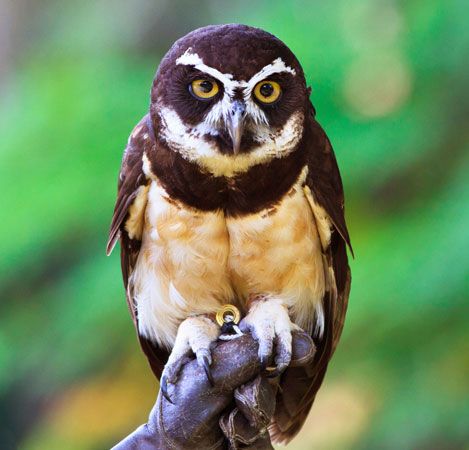
The spectacled owl (Pulsatrix perspicillata) is the largest tropical American owl, reaching lengths of up to 48 cm (19 inches). Its name is derived from the distinctive white feathers that surround its eyes, creating a spectacle-like appearance.
The adult plumage is primarily chocolate brown, contrasted by a much lighter chest that is marked by a dark band. In contrast, juveniles possess a significantly different appearance, characterized by a mostly buff-coloured body, brown wings, and a black face.1
Beyond these visual traits, the species is often identified by its vocalizations, which consist of a low-pitched, rhythmic series of accelerating hoots, as well as a single catlike cry emitted by both adults and young.1
Sources
- Spectacled owl — Encyclopædia Britannica
- Owl - Ecology — Encyclopædia Britannica
- Owl - Reproduction and development — Encyclopædia Britannica
Published on · 2 min read