Owl
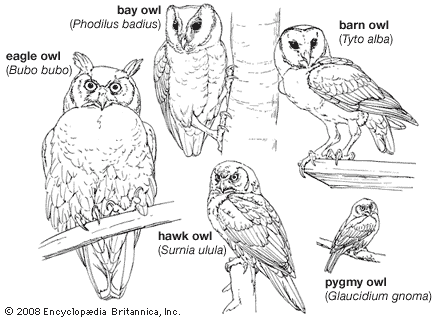
Owls possess several distinctive physical characteristics that distinguish them from other birds, primarily adapted for their nocturnal, predatory lifestyle:
What are the distinctive physical characteristics of owls that set them apart from other birds?
Owls possess several distinctive physical characteristics that distinguish them from other birds, primarily adapted for their nocturnal, predatory lifestyle:
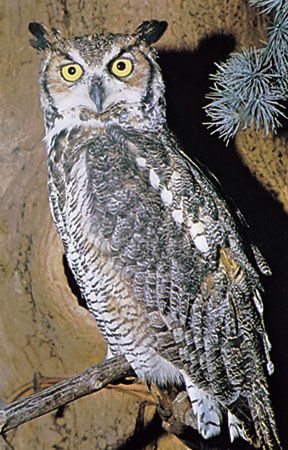
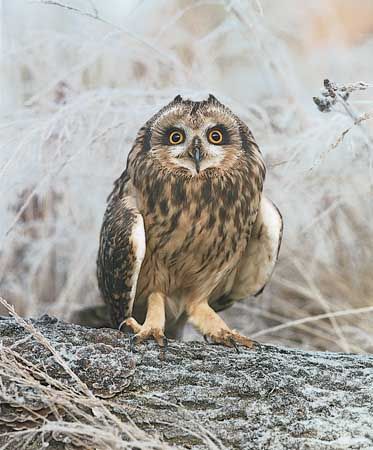
- Facial Structure and Vision: Owls have a broad, flat face often featuring a facial disk that helps concentrate sound. Their large, forward-facing eyes are rigidly encased in bony tubes, making them immobile; however, owls compensate with extreme neck flexibility, allowing them to rotate their heads more than 180°. Unlike many diurnal birds, their retinas are dominated by rods, providing superior light sensitivity and visual acuity in low-light conditions.123
- Specialized Hearing: Owls exhibit exceptional hearing, often aided by asymmetrical ear openings that allow them to localize sound sources in two planes simultaneously. While some species have feather tufts known as “ears” or “horns,” these are purely decorative and do not function in hearing.14
- Silent Flight: Their plumage is soft and loose, with flight feathers featuring a specialized nap that muffles sound, enabling them to hunt silently.1
- Talons: Like other birds of prey, they have strong feet equipped with needle-sharp, curved talons for grasping prey.12
What are the different types of vocalizations owls use, and what do they mean?
Owls utilize a diverse array of vocalizations that vary by species, ranging from deep hoots to chirps, whistles, and warblings. These sounds serve several critical functions in their survival and social structure:89
- Territorial Defense: Owls use specific calls to mark and defend their territory, warning rivals to stay away, particularly during the breeding season.89
- Mating and Pair Bonding: Males often sing to attract females. In species like the screech owl, pairs engage in duets to strengthen their pair bond.89
- Communication and Coordination: Vocalizations help owls communicate about the presence of predators or the location of food. Females may use distinct calls to prompt fledglings to reveal their location, while young owls use food-soliciting calls to beg for nourishment.89
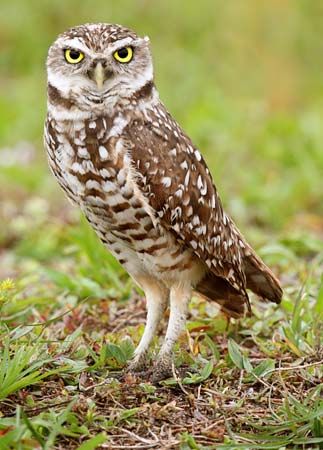
- Defense: Some species use specialized sounds for protection. For example, burrowing owl nestlings emit a warning buzz that mimics a rattlesnake to deter threats.9
Beyond vocalizations, owls also communicate through non-vocal sounds, such as bill-snapping and wing-clapping, often used during defensive displays.9
What types of habitats do different owl species typically inhabit around the world?
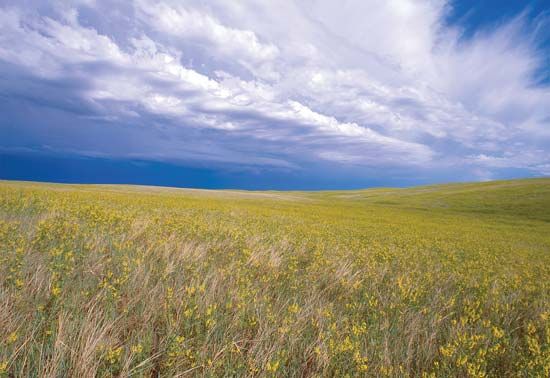
Owls are remarkably adaptable birds found on every continent except Antarctica and across most oceanic islands. They occupy a vast range of environments, from dense forests and grasslands to tundra and deserts.610
Their habitat selection is often dictated more by the availability of suitable nesting sites than by the density of prey. Common nesting locations include:10
- Woodlands and Forests: Many species, such as wood owls, prefer broad-leaved or coniferous woodlands. The spotted owl, for instance, is strongly associated with old-growth forests.1112
- Cavities and Structures: Owls frequently utilize natural tree hollows, woodpecker holes, or crevices in cliffs. Some species, like the barn owl, also nest in buildings.111
- Ground and Burrows: Grassland and tundra owls often nest on the ground. The burrowing owl specifically inhabits prairie lands, where it occupies holes abandoned by other animals.131
- Desert Environments: In arid regions, smaller owls often rely on cavities created by woodpeckers in large cacti.1
What are some of the smallest and largest owl species, and how do their sizes affect their behavior?
Owls exhibit a significant range in size, with lengths spanning approximately 13 to 70 cm (5 to 28 inches) and wingspans from 0.3 to 2.0 metres (1 to 6.6 feet). These physical dimensions play a crucial role in shaping their ecological niches and behaviors.6
Size Extremes
- Smallest: The elf owl (Micrathene whitneyi) is the smallest owl species, roughly the size of a sparrow.16
- Largest: The great gray owl (S. nebulosa) is among the largest, often exceeding 70 cm (2.3 feet) in length, though much of this size is attributed to its dense plumage.10
Impact on Behavior
Size directly influences an owl’s diet and hunting strategy:
- Dietary Differences: While most owls feed on animals, there is a clear correlation between size and prey selection. Larger species typically hunt small mammals, such as rodents and hares, whereas smaller species frequently specialize in insects.610
- Hunting Techniques: Small owls, like the elf owl, may use specialized foraging behaviors, such as hovering near blossoms to startle insects into flight. Conversely, larger owls often hunt by dropping from perches or engaging in sustained flight to capture larger prey.14
- Population Density: Small, insectivorous species often achieve the highest population densities, with pairs spacing themselves about 200 metres apart in suitable habitats.6
- Defense: Large owls utilize their size for intimidation, spreading their wings and rotating them forward to appear more formidable when threatened.9
Sources
- Owl - Form and function — Encyclopædia Britannica
- How Do Birds Hear? — Encyclopædia Britannica
- facial disk — Merriam-Webster
- sound reception - Uses of hearing in birds — Encyclopædia Britannica
- Photoreception - Diversity of eyes — Encyclopædia Britannica
- Owl - General features — Encyclopædia Britannica
- Owl - Locomotion — Encyclopædia Britannica
- Why do owls hoot? — Encyclopædia Britannica
- Owl - Behaviour — Encyclopædia Britannica
- Wood owl — Encyclopædia Britannica
- Owl - Ecology — Encyclopædia Britannica
- Burrowing owl — Encyclopædia Britannica
- Spotted owl — Encyclopædia Britannica
- Owl - Reproduction and development — Encyclopædia Britannica
- Spotted owl: Top Questions — Encyclopædia Britannica
- Elf owl — Encyclopædia Britannica
Published on · 4 min read