Sunbird
A sunbird is any of approximately 95 species of songbird belonging to the family Nectariniidae. These birds are typically 9 to 15 cm long and are known for…
What is Sunbird?
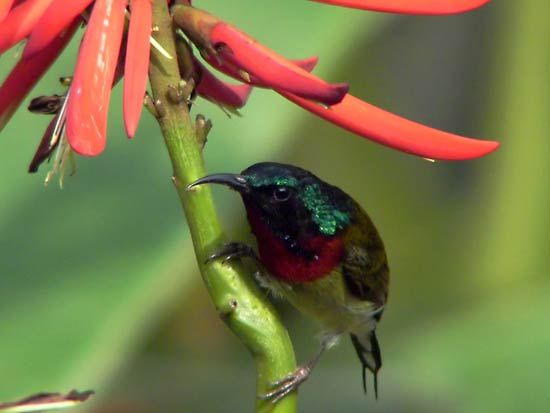
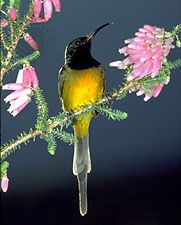
A sunbird is any of approximately 95 species of songbird belonging to the family Nectariniidae. These birds are typically 9 to 15 cm long and are known for the brilliant plumage displayed by breeding males.1
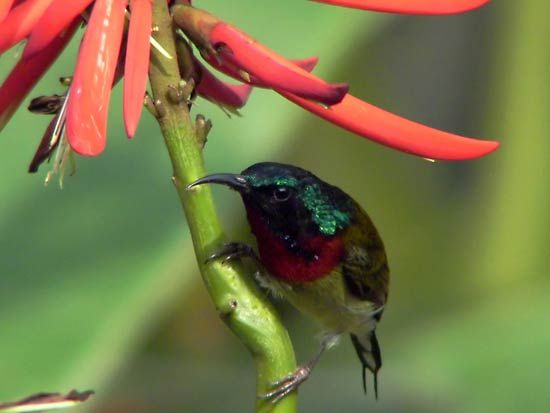
Primarily found in Africa, their range extends eastward to the Pacific islands. While they feed chiefly on nectar, they differ from hummingbirds in that they generally perch on flower stalks to feed rather than hovering. A related group, the spider hunters, are found in Southeast Asia and are characterized by their plainer appearance, longer bills, and shorter tails.1
How do sunbirds differ from hummingbirds?
Although sunbirds and hummingbirds share a similar diet of nectar and often display brilliant plumage, they are distinct groups that evolved independently in different parts of the world.
Key differences include:
- Geographic Distribution: Sunbirds (family Nectariniidae) are primarily found in Africa and eastward to the Pacific islands. In contrast, hummingbirds (family Trochilidae) are restricted to the New World, with the greatest diversity occurring in South America.123
- Feeding Behavior: While hummingbirds are famous for their ability to hover in front of flowers while feeding, sunbirds rarely hover. Instead, they typically perch on a flower stalk to access nectar.1
- Classification: Hummingbirds are often placed in the order Apodiformes, though some scientists argue for a separate order, Trochiliformes. Sunbirds are songbirds belonging to the order Passeriformes.341
- Physical Adaptations: Hummingbirds possess unique wing structures that allow for specialized flight, including hovering and flying backward. Sunbirds are generally 9 to 15 cm long and lack these specific hovering adaptations.31
What role do sunbirds play in pollination?
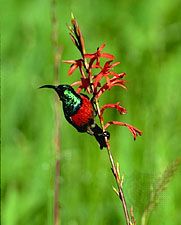
Sunbirds play a vital role as pollinators, particularly in the tropics and southern temperate zones, where they are as significant as insects in facilitating plant reproduction. As specialized nectar-feeders, they possess physical adaptations such as slender, curved beaks and brush-tipped or tubular tongues that allow them to access nectar from various flowers.15
Unlike hummingbirds, which typically hover while feeding, sunbirds generally perch on flower stalks or specialized landing platforms to reach the nectar. As they feed, their heads or breasts come into contact with the flower’s reproductive structures, picking up sticky pollen that is often clumped or chained together. This interaction ensures that pollen is transferred between flowers, often resulting in the fertilization of hundreds of ovules in a single visit.615
Plants that rely on sunbirds for pollination have evolved specific “bird-loving” (ornithophilous) traits, such as producing copious amounts of nectar, lacking scent, and featuring sturdy, tubular flowers in bright colors—often red—that are easily visible to the birds’ keen eyesight.15
What are spider hunters and how are they related to sunbirds?
Spider hunters are a group of birds belonging to the same family as sunbirds, the Nectariniidae. While sunbirds are known for their brilliant plumage, spider hunters are characterized by their plain appearance, longer bills, and shorter tails.18
Both groups are small songbirds within the order Passeriformes and share similar physical traits, such as slender, downcurved bills and partially tubular tongues used for sipping nectar from flowers and feeding on small insects for sipping nectar from flowers and feeding on small insects.18
The primary distinction lies in their geographic distribution and appearance: sunbirds are most numerous in Africa and extend to the Pacific islands, whereas spider hunters are found primarily in the Orient and Southeast Asia. Despite the name, these birds are not spiders themselves, nor are they related to arachnids like the giant huntsman spider.189
Sources
- Sunbird — Encyclopædia Britannica
- Apodiform - Distribution and abundance — Encyclopædia Britannica
- Hummingbird — Encyclopædia Britannica
- Apodiform - Critical appraisal — Encyclopædia Britannica
- Pollination - Birds — Encyclopædia Britannica
- Major types of pollinators - Birds — Encyclopædia Britannica
- Nectary — Encyclopædia Britannica
- Nectariniidae — Encyclopædia Britannica
- spider - Stalking prey — Encyclopædia Britannica
- giant huntsman spider: Top Questions — Encyclopædia Britannica
- giant huntsman spider — Encyclopædia Britannica
Published on · 3 min read