Tityra
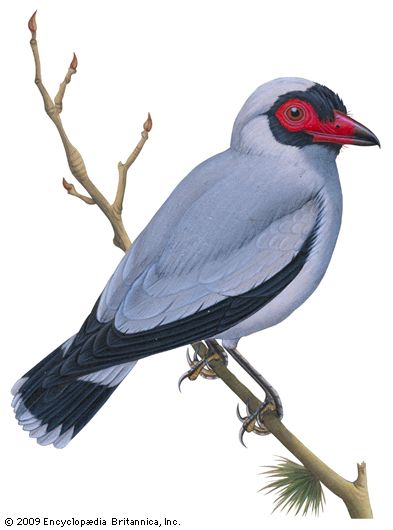
Tityra is a genus of three species of tropical American birds belonging to the cotinga family (Cotingidae). These birds are found across regions ranging from…
What is Tityra?
Tityra is a genus of three species of tropical American birds belonging to the cotinga family (Cotingidae). These birds are found across regions ranging from Mexico to South America, including countries like Brazil.1
The three species include:
- Masked tityra (Tityra semifasciata): Found in woods and open country.1
- Black-tailed tityra (T. cayana): Distributed throughout tropical South America.1
- Black-crowned tityra (T. inquisitor): Ranges from Mexico to Argentina.1
Physically, these birds measure about 20 cm (8 inches) in length and possess a stout, slightly hooked bill. Males are typically pale gray with black markings on the head, wings, and tail, while females exhibit a similar pattern but with browner hues. Known for their froglike vocalizations, they nest in tree holes. Notably, the masked tityra is known to usurp nesting sites from other birds, such as woodpeckers or toucans, by filling the hole with leaves until the original owner abandons it.1
What are some other birds in the cotinga family?
The Cotingidae family, commonly known as cotingas, encompasses about 90 species of passeriform birds native to tropical America. These birds are known for their diverse vocalizations and striking male ornamentation.
Beyond the tityra, other notable members of this family include:
- Umbrellabird: Distinguished by an umbrella-like crest and an inflatable throat wattle used during displays.2
- Bellbird: Named for their loud, ringing calls that resemble the sound of a bell.1
- Cock-of-the-rock: Famous for their vivid plumage and elaborate courtship displays.1
- Becard: A group of small, often elusive birds within the family.1
Other common names for birds in this group include fruiteaters, berryeaters, mourners, chatterers, and pihas. Many of these species are solitary forest dwellers that primarily feed on fruit or insects in the treetops.1
How do birds like the masked tityra compete for nesting sites?
The masked tityra (Tityra semifasciata) employs a unique and aggressive strategy to secure nesting sites. Rather than excavating its own cavity, it often usurps existing tree holes from other birds, such as toucans or woodpeckers.12
To force the original occupants to abandon their home, the masked tityra engages in a persistent process of stuffing leaves into the chosen tree hole. This behavior effectively makes the site unsuitable for the current owners, eventually causing them to vacate the cavity so the tityra can take it over for its own use. This practice of taking over established cavities is a known survival strategy among various species in the rainforest, where suitable nesting hollows are highly sought-after refuges for many creatures.12
What are the main differences between tropical and temperate bird habitats?
Tropical and temperate bird habitats differ significantly in their ecological structure, resource availability, and the environmental pressures that shape bird behavior.
Ecological Niches and Resource Availability
In temperate forests, vegetation structure often dictates similar ecological niches across different regions, though specific species vary. A notable difference lies in food sources: Northern Hemisphere temperate forests contain more trees with large seeds, such as oaks, supporting seed-eating guilds like squirrels and pigeons. Conversely, tropical forests often feature sporadic availability of ripe fruit, leading to the evolution of specialized fruit-eating birds, such as fruit pigeons, which must travel across large areas to find food. In many tropical regions, the absence of certain competitors—such as monkeys—has allowed birds to occupy niches that are filled by mammals in other parts of the world.78
Environmental Pressures and Adaptations
Birds in tropical and temperate zones face distinct environmental challenges:
- Temperature Regulation: Tropical birds, particularly those nesting in exposed areas, have evolved physiological adaptations to prevent overheating, such as throat fluttering and panting to facilitate evaporative cooling.9
- Migration: Temperate habitats are characterized by seasonal shifts in day length and temperature. Many temperate birds are migratory, relying on internal rhythms and environmental cues to move to warmer regions as food sources dwindle and winter approaches.1011
- Competition: In both habitats, birds compete for limited resources. In tropical environments, the high diversity of species often leads to complex partitioning of feeding and nesting niches.1213
Sources
- Tityra — Encyclopædia Britannica
- Cotingidae — Encyclopædia Britannica
- Umbrellabird — Encyclopædia Britannica
- Cuculiform - Nesting — Encyclopædia Britannica
- Passeriform - Nesting — Encyclopædia Britannica
- Apartments in the rainforest — Encyclopædia Britannica
- Temperate forest - Fauna — Encyclopædia Britannica
- How do birds know when to fly south? — Encyclopædia Britannica
- Migration - Physiological stimulus of migration — Encyclopædia Britannica
- Pelecaniform - Physiological adaptations — Encyclopædia Britannica
- Coraciiform - Habitat selection and ecological diversity — Encyclopædia Britannica
- Coraciiform - Similarities to birds of other orders — Encyclopædia Britannica
- Columbiform - General habits — Encyclopædia Britannica
- Galliform - Habitat selection and food habits — Encyclopædia Britannica
- Bird - General features — Encyclopædia Britannica
Published on · 3 min read