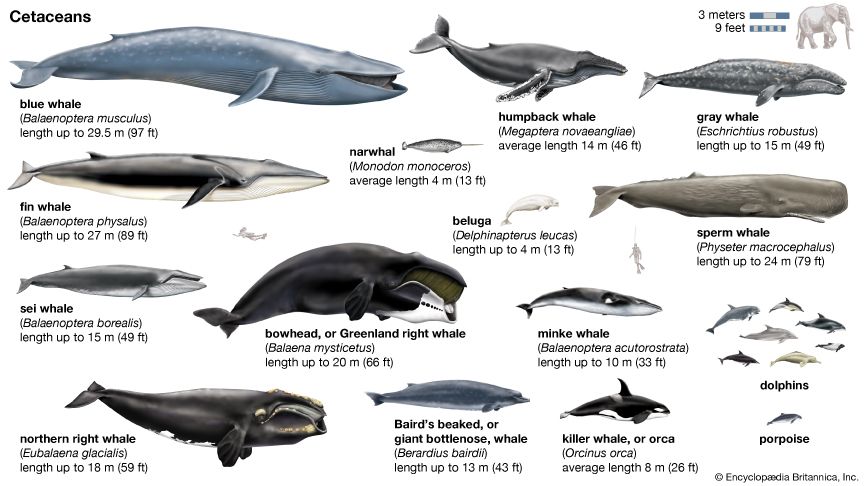
Sperm Whale
Sperm whales are active hunters that primarily feed on cephalopods, including the giant squid. Their diet is varied and can also include fish.
What is the diet of sperm whales, and how do they hunt their prey?
Sperm whales are active hunters that primarily feed on cephalopods, including the giant squid. Their diet is varied and can also include fish.12
To hunt, these whales utilize echolocation, a sophisticated method of navigation and prey detection. They produce powerful, pulsed clicks—the loudest sounds made by any animal on Earth—which allow them to map their surroundings and locate prey with high precision in the deep, dark ocean. These clicks are so intense that they can reach 230 decibels.23
Sperm whales are exceptional deep divers, frequently reaching depths of 350 meters or more to pursue their prey, and they may remain submerged for an hour or longer during these hunts. Once they capture their food, they use their large conical teeth to secure it.21
What is the significance of the sperm whale’s large head and spermaceti organ?
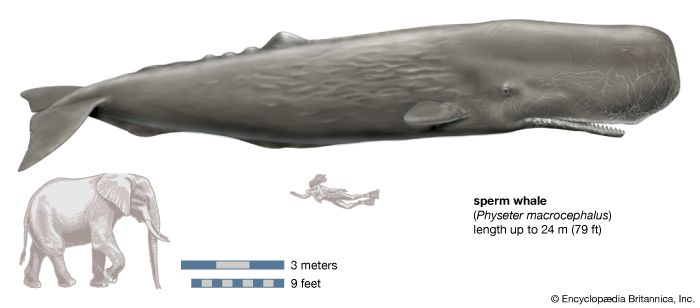
The sperm whale’s head is a massive structure, accounting for one-third of its total body length and over a third of its weight. Its most prominent feature is the spermaceti organ, a fluid-filled cavity that can hold up to 2,000 liters of spermaceti and extend through 40 percent of the whale’s length.42
While the exact function of this organ has not been conclusively proven, scientists believe it serves several critical roles, particularly regarding the whale’s deep-diving capabilities and sensory perception:
- Diving and Buoyancy: The organ may act as a hydrostatic regulator, helping the whale manage buoyancy during descent and ascent. It may also assist in lung evacuation before deep dives or help absorb nitrogen under extreme pressure.4
- Sound Production: The head is highly specialized for echolocation and communication. The spermaceti organ and a fatty cushion known as the “junk” likely function as a sound-emission system, potentially acting as a reverberation chamber for the whale’s powerful, pulsed clicks.45
Historically, this organ was the primary target of the commercial whaling industry, as the fluid within was processed into sperm oil and wax for lubricants, cosmetics, and lighting.24
What are some interesting facts about sperm whale vocalizations and echolocation?
Sperm whales are remarkable for their sophisticated vocalizations and reliance on echolocation. Here are some key facts regarding these abilities:
- Record-Breaking Volume: The sperm whale is the loudest animal on Earth, producing clicks that can reach 230 decibels. This intensity is significantly higher than that of a jet engine, making these vocalizations potentially harmful to humans at close range.3
- Echolocation Mechanics: To navigate and hunt in the deep, dark ocean, sperm whales use their massive heads as a specialized sound-emission system. The spermaceti organ and a fatty structure known as the “junk” likely function as a reverberation chamber to focus and project these powerful, pulsed clicks.52
- Communication and Dialects: Beyond navigation, these whales use specific click patterns called “codas” to communicate. Research indicates that different sperm whale communities possess distinct regional accents and dialects. There is even evidence suggesting that pods can share defensive behaviors—such as how to avoid whaling vessels—with other, more naive groups.2
- Anatomical Asymmetry: The production of these high-frequency sounds is linked to the whale’s extreme skull asymmetry, as the right side of the head is highly modified to house the tissues necessary for sound generation.5
How long do sperm whales live, and what is their reproductive cycle like?
Sperm whales have a long lifespan, with individuals recorded living up to 62 years. Their development toward maturity is a gradual process: they reach sexual maturity between 7 and 13 years of age, while physical maturity—the point at which skeletal growth concludes—is not attained until they are between 25 and 45 years old.6
Regarding their reproductive cycle, sperm whales follow patterns typical of cetaceans:
- Breeding: Mating is generally seasonal, typically occurring during the winter months.2
- Gestation and Birth: Females undergo a gestation period of approximately one year, though some toothed whales can have pregnancies lasting up to 18 months. They typically give birth to a single calf, which is delivered tail-first.2
- Nursing: Mothers provide their young with extremely rich milk, which can contain up to 50 percent fat. Calves are usually weaned between six months and one year of age, though they continue to grow rapidly for several years afterward.2
- Frequency: Females generally calve once every two years.2
Sources
- What do whales eat? — Encyclopædia Britannica
- sperm whale — Encyclopædia Britannica
- What is the loudest animal on Earth? — Encyclopædia Britannica
- How Did the Sperm Whale Get Its Name? — Encyclopædia Britannica
- cetacean - Sound production and communication — Encyclopædia Britannica
- cetacean - Age and growth — Encyclopædia Britannica
- cetacean - Reproduction — Encyclopædia Britannica
Published on · 3 min read