Spiny-headed Worm
Spiny-headed worms, which belong to the phylum Acanthocephala, are primarily parasites of vertebrates, such as fish, and arthropods. While they possess a…
Are there any economic or medical implications of spiny-headed worm infestations?
Spiny-headed worms, which belong to the phylum Acanthocephala, are primarily parasites of vertebrates, such as fish, and arthropods. While they possess a hooked proboscis used to attach to the intestinal walls of their hosts, they generally cause minimal damage to the animals they infect.1
Regarding your query on their impact, these parasites are considered to be of no economic importance. Furthermore, while they can infect various vertebrates, human infections are rare and occur only accidentally. Because they typically do not cause significant harm to their hosts, they do not present notable medical or economic implications for humans or livestock.1
What are the unique physical characteristics of spiny-headed worms?
Spiny-headed worms, members of the phylum Acanthocephala, possess several distinct physical characteristics:
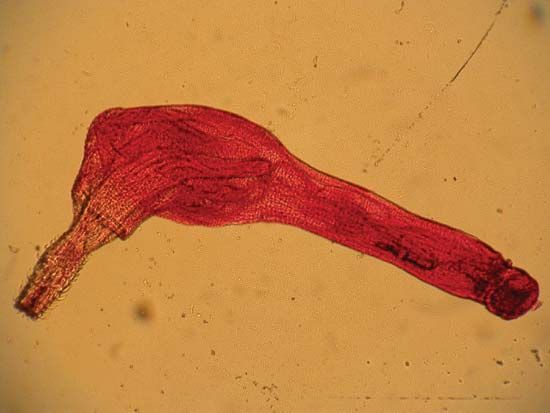
- Body Structure: The body is divided into an elongated, cylindrical trunk and a proboscis. This snout-like structure is typically armed with backward-pointing hooks and can be retracted into the trunk, which may also feature hooks or spines.1
- Size and Coloration: While most adults are less than 1 cm (0.4 inch) long, some species can reach lengths of 50 cm (about 20 inches). They are usually white but can occasionally appear yellow, orange, or red.1
- Internal Anatomy: Their internal structure is notably simple, characterized by a complete lack of a gut. The majority of the trunk is occupied by the proboscis receptacle and the associated muscles used for retraction. Other internal features include ligament sacs, which in males enclose two testes and cement glands.1
- Reproductive Features: Externally, males are distinguished by an eversible copulatory bursa, while females possess a simple vagina.1
How do spiny-headed worms compare to other parasitic worms like flatworms or roundworms?
Spiny-headed worms (Acanthocephala) differ significantly from flatworms in both their biological structure and their evolutionary classification.
Structural Differences
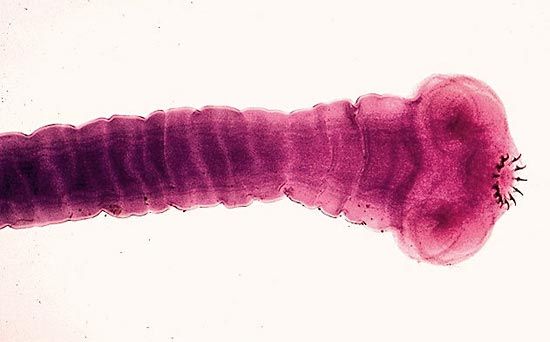
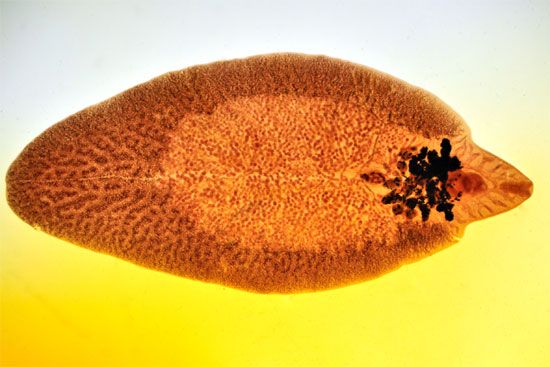
- Body Cavity and Gut: A primary distinction is that spiny-headed worms lack a gut entirely, absorbing nutrients directly through their body wall. In contrast, while flatworms also lack a body cavity (coelom), many possess a gastrovascular cavity, though parasitic forms like tapeworms have lost their alimentary canal and rely on absorption through a modified epidermis.123
- Body Plan: Spiny-headed worms are characterized by a cylindrical trunk and an eversible, hook-bearing proboscis used for attachment. Flatworms are typically soft-bodied, bilaterally symmetrical, and dorsoventrally flattened, lacking the specialized proboscis found in acanthocephalans.123
Life Cycles and Classification
- Host Requirements: Both groups often utilize complex life cycles involving intermediate hosts. Spiny-headed worms require an arthropod (such as an insect or crustacean) as an intermediate host and a vertebrate as a definitive host. Flatworms, particularly flukes and tapeworms, also frequently involve multiple hosts, though their specific intermediate hosts—such as mollusks for many flukes—differ from those of acanthocephalans.134
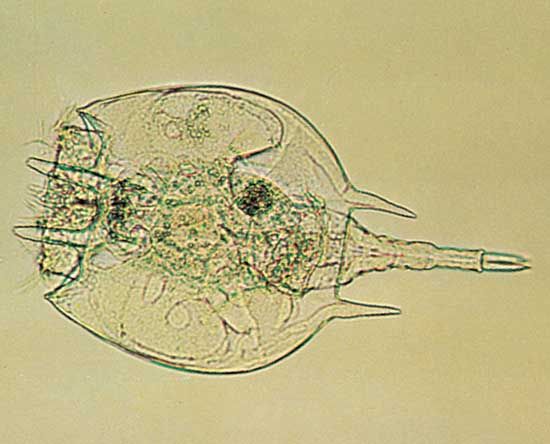
- Evolutionary Affinities: While flatworms are considered primitive invertebrates within the phylum Platyhelminthes, the evolutionary position of spiny-headed worms is distinct; molecular evidence suggests they may be closely related to rotifers, potentially evolving from a rotifer ancestor.12
How do scientists classify spiny-headed worms within the animal kingdom?
Scientists classify spiny-headed worms as members of the invertebrate phylum Acanthocephala. While their exact evolutionary placement remains a subject of scientific uncertainty, modern molecular evidence and morphological studies suggest that they are closely related to rotifers, potentially having evolved from a rotifer ancestor.1
In some classification systems, Acanthocephala is grouped within the phylum Introverta, alongside other groups such as Kinorhyncha, Loricifera, and Priapulida. Within the phylum Acanthocephala, the group is further divided into orders based on physical characteristics, such as the arrangement of hooks on the proboscis and the presence of trunk spines. Examples of these orders include:4
Sources
- spiny-headed worm — Encyclopædia Britannica
- flatworm — Encyclopædia Britannica
- Protozoan - Mechanisms of food ingestion — Encyclopædia Britannica
- Animal - Critical appraisal — Encyclopædia Britannica
- parasitic disease - Parasite life cycles — Encyclopædia Britannica
- flatworm - Annotated classification — Encyclopædia Britannica
- flatworm - Development — Encyclopædia Britannica
- Archiacanthocephala — Merriam-Webster
- Palaeacanthocephala — Merriam-Webster
Published on · 3 min read