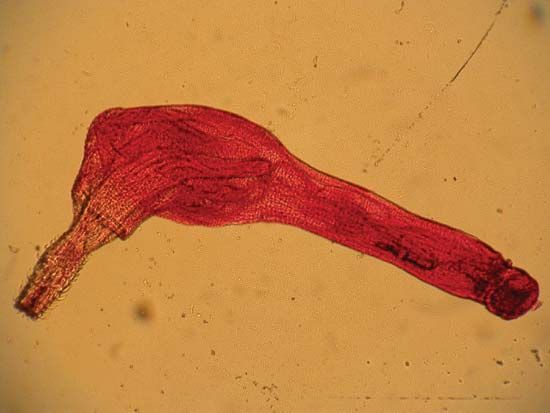
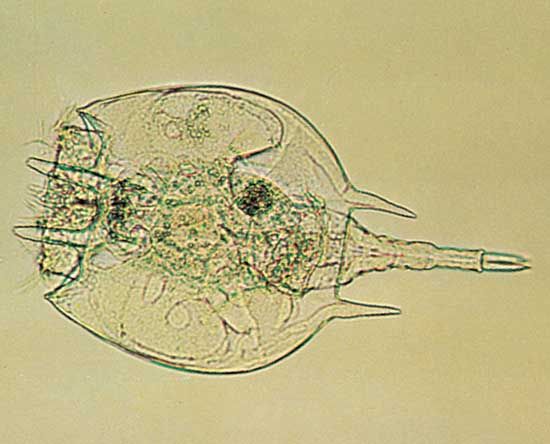
Rotifer
Rotifers move through their aquatic environments using several distinct methods, primarily facilitated by structures at their anterior end.
How do rotifers move through their aquatic environment?
Rotifers move through their aquatic environments using several distinct methods, primarily facilitated by structures at their anterior end.1
- Swimming: Most rotifers utilize a corona, a circular arrangement of tiny, hairlike cilia at their front end. The movement of these cilia resembles a rotating wheel, which allows the organism to swim through the water.1
- Looping: Members of the subclass Bdelloidea move along the bottom of ponds by looping. This involves an alternating attachment of their head and tail ends to the surface.1
- Anchoring: Some species remain stationary by anchoring themselves to the bottom using tubes or cases made of jelly. This process is supported by pedal glands, which are specialized glands located in the foot that secrete an adhesive substance to help the rotifer attach to surfaces.12
What is the ecological importance of rotifers in aquatic ecosystems?
Rotifers play a significant role in aquatic ecosystems as both consumers and a vital food source. By using their ciliated corona to create water currents, they efficiently extract small organisms from the water column, acting as primary consumers that help regulate populations of microorganisms.1
Beyond their role as grazers, rotifers consume a variety of food sources, including algae and other small organisms, while larger species may prey upon crustaceans. Because they are abundant in freshwater environments across all continents, they serve as a critical link in the aquatic food web, providing a substantial energy source for larger predators. Their ability to thrive in diverse conditions—ranging from open water to damp moss—allows them to maintain ecological balance across various microhabitats.1
How do rotifers reproduce and what is their life cycle?
Rotifers exhibit diverse reproductive strategies, often alternating between asexual and sexual phases depending on environmental conditions.15
Reproductive Modes
- Parthenogenesis: Many species reproduce through parthenogenesis, where females produce offspring from unfertilized eggs. In some genera, males are entirely unknown, and populations consist solely of females.15
- Sexual Reproduction: In species that reproduce sexually, males are typically smaller and appear only seasonally or under environmental stress. Copulation occurs via the injection of sperm into the female’s body wall.154
Life Cycle and Egg Types
Rotifers often produce different types of eggs to survive changing environments:
- Amictic Eggs: Produced during favorable conditions (often early spring), these diploid eggs develop into females without fertilization.54
- Mictic Eggs: When environmental stress occurs, females produce mictic eggs. If left unfertilized, these haploid eggs develop into males. If fertilized by a male, they become thick-shelled, dormant “winter eggs” capable of surviving harsh conditions like freezing or drying out.54
This cycle ensures the species can rapidly increase its population when conditions are optimal while maintaining a dormant stage to survive adverse periods.54
How do rotifers feed and what is unique about their feeding mechanism?
Rotifers utilize a specialized feeding mechanism centered on their corona, a structure at the anterior end featuring a circular arrangement of moving cilia. These hairlike structures beat in a coordinated fashion, creating water currents that resemble a rotating wheel—the feature from which the phylum derives its name.
The unique aspect of this mechanism is its dual functionality: the ciliated corona serves both as a means of locomotion and as a tool for feeding. By generating these currents, rotifers effectively extract small organisms from the surrounding water column to be ingested. Once captured, food particles pass into the mouth and down into a muscular pharynx known as the mastax. The mastax is a highly specialized organ containing hard, tiny jaws that grind or manipulate food before it enters the digestive tract. While many rotifers rely on this filter-feeding approach, some larger species are predatory, actively consuming other rotifers, crustaceans, and algae.
Sources
- rotifer — Encyclopædia Britannica
- pedal gland — Merriam-Webster
- Locomotion - Bottom locomotion — Encyclopædia Britannica
- Reproductive behaviour - Flatworms and rotifers — Encyclopædia Britannica
- Animal reproductive system - Parthenogenesis — Encyclopædia Britannica
- mollusk - The digestive system — Encyclopædia Britannica
Published on · 3 min read